
Research

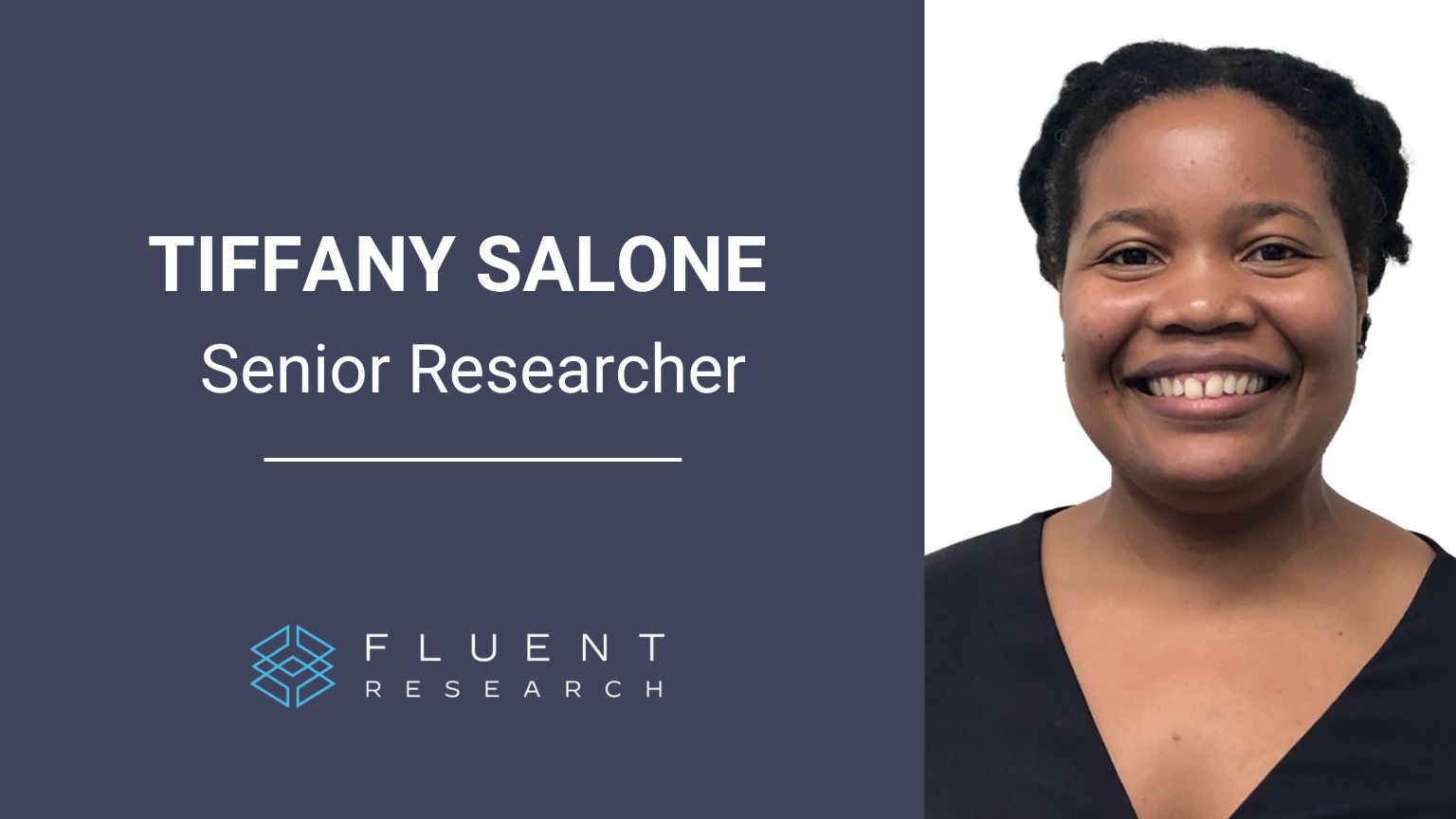
January 13, 2023 (New York, NY) – Fluent Research, a data and insights-driven strategic consulting firm, announced today that Tiffany Salone has been promoted to Senior Researcher. In this role, Tiffany will oversee a wide range of global research studies, informing the development of educational products and programs that benefit children, youth, and families.

“Tiffany excels at managing complex research projects, and she is an expert quantitative and qualitative analyst,” said Nellie Gregorian, Founder and President of Fluent Research. “Tiffany’s promotion acknowledges her contribution to our success and continuing growth.”

Tiffany has a deep background in technology and education. She is passionate about designing and conducting research that supports increased and equitable accessibility to education and technology, especially for young learners and their families. No matter what type of project she is working on, she is a consistent advocate for users, particularly those who are low-income or live in underserved communities around the world.

Prior to joining Fluent, Tiffany worked as a researcher in educational media and technology. Before working as a researcher, she spent eight years as a video producer, videographer, and editor of short documentaries and feature films.

About Fluent Research
Fluent Research is a data and insights-driven strategic consulting firm. Since 2006 Fluent has leveraged understanding of human behavior to help the world’s best-known brands and organizations advance worthy causes, innovate transformational products, and successfully navigate change. Fluent’s work centers around three practice areas: thought leadership research, formative research and evaluation, and social impact assessment. Fluent has applied rigorous and innovative research solutions in service of promoting children’s access to and quality of education, and gender equality in the U.S. and in over 70 countries around the world. Fluent’s creative arm, Fluent Productions, is an award-winning producer of original documentary content that harnesses the power of visual storytelling to bring attention to important issues facing our society, to build empathy and inspire action.

Contact: Stefanie Cousins
[email protected]
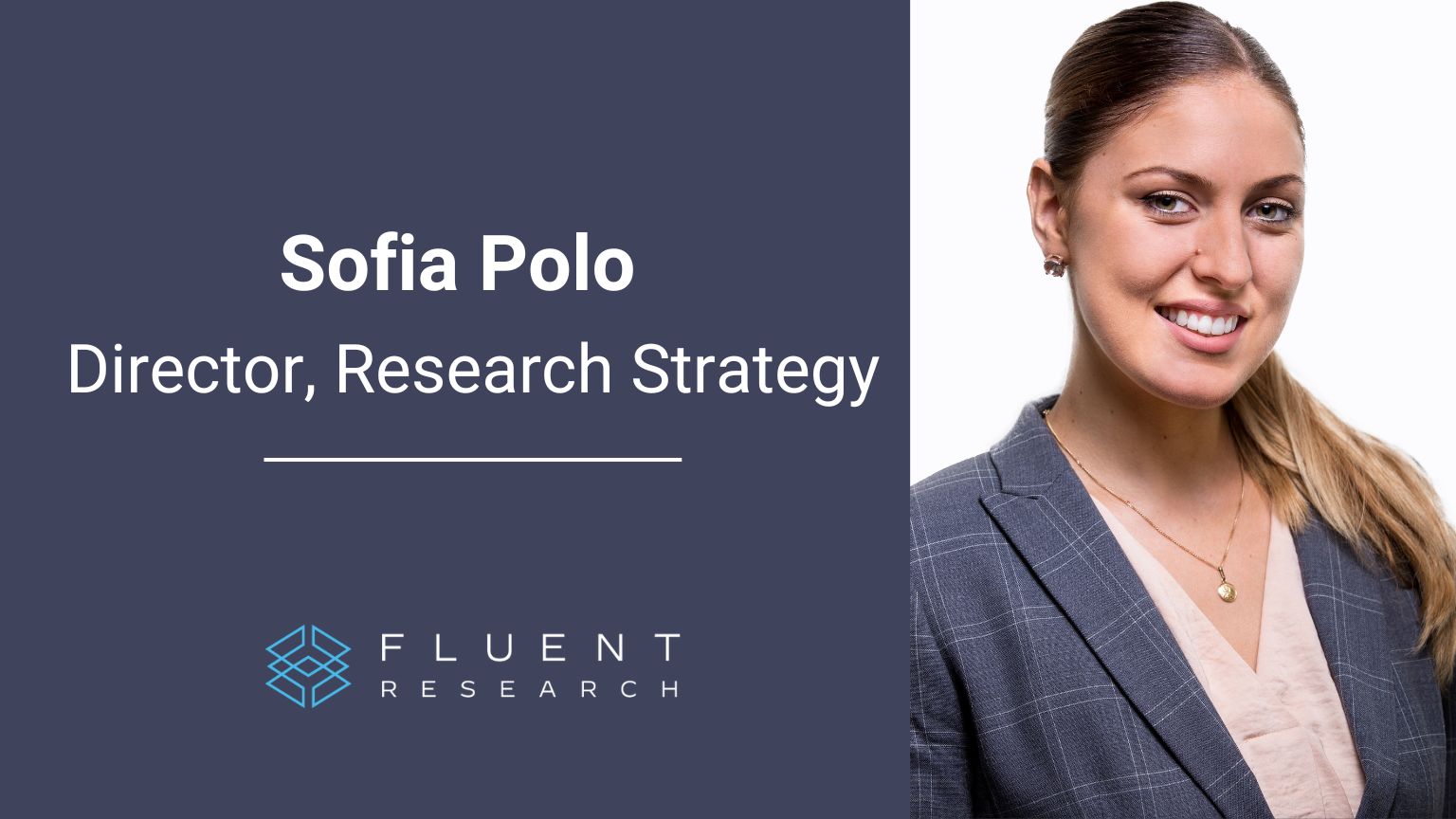
 

January 11, 2023 (New York, NY) – Fluent Research, a data and insights-driven strategic consulting firm, announced today that Sofia Polo has been promoted to Director, Research Strategy. In this role, Sofia will work with the senior executive team on advancing the company’s mission and strategic direction.

“Sofia has been a valuable member of our team and a mentor to many of our colleagues. I am thrilled that in her new role she will take on more management and leadership responsibilities,” said Nellie Gregorian, Founder and President of Fluent Research.

Sofia has a strong interest in leveraging research to promote education, health and mental health of children, youth, and families. A native Spanish speaker, Sofia is committed to amplifying the voices of the Latinx communities and advocating an equitable approach to research practices.

Prior to joining Fluent, Sofia worked as a health research training consultant at the New York City Department of Health and Mental Hygiene.

About Fluent Research
Fluent Research is a data and insights-driven strategic consulting firm. Since 2006 Fluent has leveraged understanding of human behavior to help the world’s best-known brands and organizations advance worthy causes, innovate transformational products, and successfully navigate change. Fluent’s work centers around three practice areas: thought leadership research, formative research and evaluation, and social impact assessment. Fluent has applied rigorous and innovative research solutions in service of promoting children’s access to and quality of education, and gender equality in the U.S. and in over 70 countries around the world. Fluent’s creative arm, Fluent Productions, is an award-winning producer of original documentary content that harnesses the power of visual storytelling to bring attention to important issues facing our society, to build empathy and inspire action.

Contact: Stefanie Cousins
[email protected]

When I joined Fluent as a User Experience Researcher I was most looking forward to acquiring interview moderation skills. It was crucial to me that I be well prepared to speak to participants in a way that elicited relevant insights and encouraged them to share their experiences openly. I felt nervous, of course, as I questioned my ability to conduct a successful interview that would produce informative insights.

That’s when it hit me. Moderating an interview has a lot of similarities with conducting a therapy session.

Back in my undergraduate days at Washington University in St. Louis, I was a part of a peer-counseling club. There, I took part in 100 hours of training on how to be a good listener and create an open environment for someone to share their emotions and personal experiences. As I prepared to moderate my very first interview at Fluent, I called upon the following skills that I learned as a peer counselor.

1) Keep It Simple: Whether it’s talking to a client in therapy or moderating a market research interview, it’s important that the interviewer keep their talking time to a minimum. Oftentimes, when we ask a question, we feel the need to add on or explain what we’re trying to ask to create less confusion for the interviewee. However, I have found through these conversations that adding on to a question in an attempt to create clarity, can actually lead to more confusion. Keep your questions concise. If the participant doesn’t answer your question fully, you can always follow up with a probe. This will give the participant more space to speak, with a clearer understanding of what is being asked.

2) Mirror Language and Summarize: In a therapy session, you wouldn’t want to refer to your client’s intrusive and spiraling thoughts as “anxiety” unless they used that term themselves. The same rule applies to research. When moderating an interview, it’s important that you take your participant’s lead. Using their words instead of your own allows them to tell their own story and, even more importantly, it lets them know that you’re listening.  Whenever you can, summarize the points that participants make. This type of active listening helps ensure that you are both on the same page and gives them a space to reflect on what they have just shared.

3) Leave Room for Silence: Oh, the dreaded awkward silence. We are so accustomed to filling the space when no one is talking. However, in both therapy and research, silence can be extremely valuable. In therapy, silence allows clients to sit with emotions that they may not have allowed themselves to ever feel before. In research, silence gives the participant a chance to sit with their thoughts and formulate an idea. If you as the moderator cut off the silence before the participant’s thought is fully formed, you might miss out on an informative insight. Instead of words, fill the silence with non-verbal communication such as head nodding or eye contact. This way, the participant knows you are listening and eager to hear their next thought whenever they are ready.

4) Create an Open and Judgment Free Zone: The most valuable tool for a therapist or moderator is the ability to make someone feel comfortable. In a research interview, creating an open and safe space will increase the likelihood that a participant shares their thoughts in depth, thereby producing fruitful insights. Build rapport with participants the way that a therapist would with their client. It will greatly impact both the quality of conversation and the quality of research.

The past three months at Fluent have given me the opportunity to conduct both remote and in-person interviews with parents, children, teens, and adults. Over time I have learned that no two moderators are the same. What sets Fluent apart is our willingness to leverage different moderation styles. My colleagues have encouraged me to find my own style of speaking with participants: one that feels true to myself. I have been so impressed with my colleagues’ skills at creating connections with participants in the first few minutes of an interview. At the end of the day, Fluent’s number one priority is creating open spaces for participants to feel safe and comfortable sharing their candid opinions. I know that I am in good hands here to continue improving my interviewing skills.

By Lia Abrams

As August ends and autumn approaches, companies, and schools across the country are preparing for a return to business as usual.

Now two years out from the initial disruption of the pandemic, many workplaces are seeing a return to “pre-pandemic” routines like mandated in-person work and school programs. With a slow return to life as we used to know it, combined with a significant drop in national unemployment and an employee-friendly hiring market, it seems like a promising time to be a young professional beginning a career in research.

Equally promising is the wave of recent interest and growth in UX research. Life in quarantine spurred innovation in tech and media design that opened new possibilities of inquiry and investigation for UX research. With the research market evolving rapidly, it is worth considering – what makes a good researcher? And how can young researchers pursue a career in UX research?

Each research team may be looking for something a little different, and there are countless different ways to pursue a career in research. But whether you are interested in statistical analytics or immersive ethnography, these four tips may help you hone your targets in the job hunt.

1. Identify your skills

Whether a researcher has a background in humanities, social sciences, or STEM, all researchers possess a unique set of skills and a wealth of knowledge that they will contribute to a research team. Consider what sets of knowledge you have acquired throughout your academic and professional career. Everything you have experienced, whether it was an intensive graduate program, unpaid internship, part-time job, or one-off volunteer opportunity, has given you a unique perspective that you can leverage and apply to your research process. Do not sell yourself short for having a resume that may not match those around you – all experience is good experience, even those that may seem like they aren’t directly relevant to your field.

The emotional intelligence and consumer familiarity acquired from working years in customer service can be just as useful in a research setting as academic expertise acquired in a Ph.D. program. The best researchers know how to recognize value and insight from the everyday life experiences of not just others, but themselves as well.

2. Identify your passions.

Pursuing a career in research means you are pursuing a career in endless exploration. Every economic sector, nonprofit, and government branch needs research to function and grow. When considering a career in research, remember that the opportunities for research are endless – so you should make sure you apply for jobs in an area that truly speaks to you and your passion. Identify what social issues, industry sectors, or creative interests are most important to you. Chances are, there’s a company within that sector that needs research.

3. Identify your potential for growth.

Career building is an ongoing, dynamic process with many small decisions along the way that contribute to what will become your overall lived experience. When looking for a career in research, ask yourself in what ways you would like to grow. Do you want to work alongside designers to create and perfect ideas at one particular company? Or do you want to be on the research vendor side, leading many different projects across a variety of industries? The research positions you seek out should not just reflect your interests, but also offer an opportunity for your growth as a researcher. The types of routines, co-workers, and topics that stimulate you the most may be indicative of what industries and work settings would be the best fit. Be curious, and reach out to industry professionals who could offer insight. Considering how you think you may contribute to a team and the ways in which you could grow within it is essential.

4. Market yourself!

You may have noticed the last three steps were all about reflection. While you may not need to know exactly what you want to do in research, you do need to have a deep understanding of yourself and who you are. Hiring is a two-way experience – employees and employers need to have a significant understanding of who they are and their potential contribution to the other. In pushing yourself to identify who you are and what you bring to the table, you are practicing articulating those qualities. Self-expression is half the battle in job hunting, so be vocal! Share what makes you unique as a researcher, what research philosophies speak to you the most, and why you see value in gathering and sharing knowledge.

As the research industry blossoms alongside a recovering economy, know that the possibilities for growth as a researcher have never been more expansive and exciting. In using these tips to reflect and grow, we hope that your journey in research remains expansive and exciting as well.

By Charlotte Beatty.

Charlotte Beatty is a User Experience Researcher at Fluent, where she specializes in qualitative research design, implementation, and analysis.

We’re so excited to have three talented interns working with our Fluent Research team this summer. Discovering and nurturing new talent is something we’re passionate about at Fluent, and we have no doubt that this cohort of interns will go on to do great things in their careers.

In the coming weeks, we’ll bring you brief interviews with each of our interns where they will share their background, what they’ve learned during their time with us, and what they hope to achieve in the future.

First up is Marko Stroumbakis, a rising sophomore at Hunter College in New York City.

Fluent: What made you want to intern at Fluent Research?

Marko: My initial internship search was for professional experience in the world of marketing, but being such a vast field, I quickly narrowed it to market research. As I explored my social network, I came across Fluent’s Founder and President Nellie Gregorian through a common contact. When doing research on the Fluent website, I was immediately intrigued by the variety of practice areas and services. Fluent is based in the heart of NYC, my home city, which was a huge plus for me. From there, I knew Fluent would be the best place to begin my professional career.

Fluent: What have you learned so far?

Marko: I have learned several skills during my time at Fluent. First, I have enhanced my professional communication, both verbal and non-verbal. I have also improved some technical skills in software such as Excel. Most importantly, I have gained a breadth of knowledge and experience in market research and business development. Checking both qualitative and quantitative data and working on survey testing as well as translating subject responses from Spanish to English has been valuable in understanding how data is used to inform insights.

Fluent: What has been the most interesting thing you have done? 

Marko: The assignment that has interested me the most so far was conducting secondary research in the preliminary steps of a new client project. As I uncovered more resources, I was captivated by the plethora of information and data on such a recent market trend.

Fluent: What do you hope to do after college? 

Marko: After I graduate from college, I hope to obtain my MBA in Marketing from Duke University, NYU, or USC. Throughout the rest of my academic career, I aim to gain several experiences and broad knowledge in the field of marketing, with a particular emphasis on brand management.

Digital contexts are becoming more prevalent in children’s lives than ever before, fueled in part by the COVID-19 pandemic and the need to move various aspects of children’s lives online*. Since human development is a holistic and dynamic process between the developing person and his or her context* and children develop in positive and healthy ways when their strengths are combined with the strengths of their contexts, we have an opportunity as researchers to bring this framework to the changing landscape of children’s lives.

What has become apparent in our company’s recent requests for proposals, is that there is a lack of fit between the knowledge and experience of many designers and the developmental needs and abilities of children. This lack of fit signals a fundamental problem, and an opportunity, given the growing presence of digital technology as a context for children’s development. The virtual world is a new frontier and there has been a land rush of companies looking to stake their claim flag.  This rapid growth has seemed to create holes in the capabilities of these frontier companies. More precisely, the talent needed to design for adults does not adequately translate to designing for kids. In the absence of comprehensive knowledge about child development, current designers may err in using themselves or those close to them as the markers of success and/or “normality”.

“We all have a blind spot and it’s shaped exactly like us.” – Junto Diaz, Author

Short of extensive training in child development, designers can utilize a few central rules of thumb when designing for kids. Keeping these in mind will go a long way to minimizing, or at least acknowledging, our biases:

1) All humans are whole. Sometimes by necessity, we need to zoom in and focus on a specific part of children’s development, such as their literacy level or their ability to swipe on a tablet. But it is important to understand those parts within the context of the whole developing person. We then need to further adjust our lens to view that person as situated within a dynamic relationship with his or her context.

2) There is no ‘typical’ child. Much of what we know and have studied about children is approximations that are gathered from information that has been averaged over large groups from mostly Westernized societies. Expectations about children should be considered approximations that can get you close to understanding.

3) All households are different. A common mistake is to view children’s development as unfolding in a vacuum. Rules and expectations differ greatly by household and are driven by cultural, situational, and practical factors. Just because a child is developmentally capable of something does not mean that they will do it.

4) Child development is less linear than it appears. Because development is an iterative process, there are often regressions that ebb and flow with progressions. Development of a skill or competency may occur steadily over time or rapidly in spurts. While many abilities get better over time, it is not always the case.  Some abilities, like attention span increase gradually over time during childhood while other capacities, like learning a new language, decrease over time. Other aspects of development, like identity development, are latent during younger years and then rapidly develop.

If there is one mantra that we could recommend to all designers and those thinking about how to best support kids, we would strongly offer this:

“Every [child] is like all other [children], some other [children], and no other [child].” – Kluckhohn & Murray, Anthropologist & Psychologist

By Dan and Amy Warren.

==========

1*Responsible Innovation in Technology for Children. UNICEF Office of Research – Innocenti, Florence, 2022.

*Lerner, R. M., Lerner, J. V., Almerigi, J., Theokas, C., Phelps, E., Gestsdóttir, S. Naudeau, S., Jelicic, H., Alberts, A. E., Ma, L., Smith, L. M., Bobek, D. L., Richman-Raphael, D., Simpson, I., Christiansen, E. D., & von Eye, A. (2005). Positive youth development, participation in community youth development programs, and community contributions of fifth-grade adolescents: Findings from the first wave of the 4-H Study of Positive Youth Development. Journal of Early Adolescence, 25(1), 17-71.


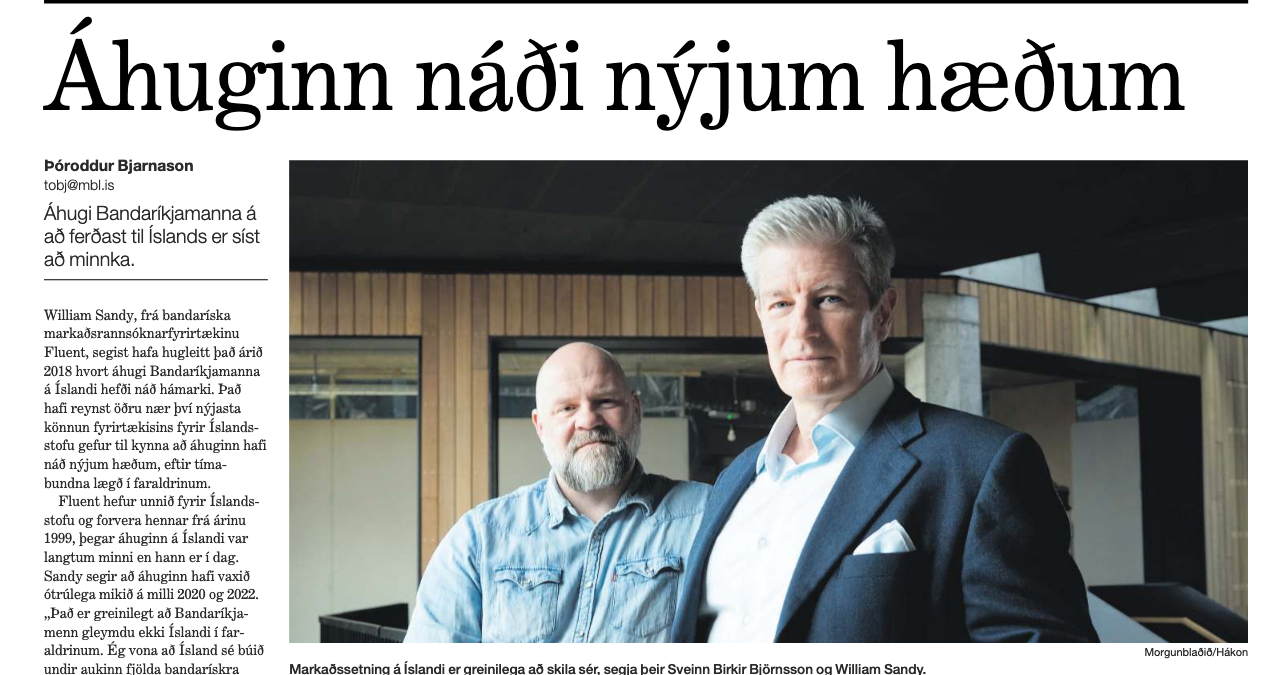
Have you been thinking about traveling to Iceland? If the answer is yes, you are not alone. Fluent Research’s 2022 survey among 1,000+ US consumers ages 18-70 shows a dramatic revival of interest in Iceland and Icelandic products since we last conducted the survey in 2020. In fact, 52% of respondents say they are highly likely to travel to Iceland for pleasure. The previous survey, conducted in 2020 amid the COVID-19 pandemic and associated lockdowns and layoffs, saw a softening of such interest, when only 39% expressed a desire for travel to Iceland. The relaxation of pandemic mandates and re-opening of cities and international borders has brought a vigorous rebound in interest.

All things associated with Iceland seem to be benefiting from the widening appeal of Iceland as a destination. According to Fluent’s Executive Director William Sandy, who was interviewed last month for an article about the survey results in The Morning News, an Icelandic newspaper, “American consumers expressed record levels of interest in travel to Iceland, and interest in stop-over travel to Iceland. The upward trend in awareness and interest in Iceland and Icelandic products that we have witnessed since 1999 has resumed and even accelerated. Marketing in Iceland is clearly paying off.”

Fluent Research has been tracking consumer attitudes towards travel to Iceland and Icelandic products in the U.S. on behalf of the Icelandic trade and tourism association, which promotes tourism, products, and culture of Iceland, since 1999. To see our last case study on our work with Iceland Naturally, click here.

Next month Fluent’s Director of Content & Evaluation, Dr. Allison Caplovitz, will be returning to Miami to attend the Kidscreen Summit after the conference’s two-year hiatus due to COVID. Allison’s favorite meeting of the year, the Kidscreen Summit is known as the most important annual event in the kids media industry.

Allison’s background includes deep experience informing the development of children’s television programs, evaluating curriculum development, and conducting summative research. She has advised 9 Story, Highlights for Children, Meta, Netflix, PBS Kids, Sesame Workshop, Warner Media, and YouTube Kids, and was instrumental to the success of the iconic children’s media property Blue’s Clues. Read all about Allison here and be sure to connect with her in Miami.

Today, the most cutting-edge thinking about human development is holistic, dynamic, and emphasizes the relationship between the developing person and his or her context.  This thinking is an important evolution; a stark contrast to outmoded ideas that see people as something to be molded by the context like a piece of clay or “filled” like an empty receptacle.

The Positive Youth Development (PYD) perspective is one such holistic and dynamic view, based on the ideas that:1

   1. All young people have strengths (because of the potential for developmental change across the lifespan), and

   2. All contexts have strengths as well. These strengths are resources that can be used to promote positive youth development.

   3. If the strengths of young people are combined with the strengths of the context, then positive, healthy development occurs.

PYD emerges out of this dynamic relationship and is evidenced by the presence in young people of “Five C’s”:  Competence, Confidence, Connection, Caring, and Character.

Digital contexts are becoming more prevalent in children’s lives than ever before, fueled in part by the COVID-19 pandemic and the need to move various aspects of children’s lives online.2  The growing presence of digital technology as a context for children’s development requires that we think deeply about its impact, identify its strengths, and consider how best to combine those strengths with the strengths of young people to promote their positive development.

Nutrient-rich digital contexts have many of the same features as those found in the physical world.  Both are guided by a deep understanding of children’s development, behavior, and natural play patterns.3  Both also recognize social interactions as the core of what it means to be human, seeking to enhance and extend (not obstruct) human connection.4  In turn, both types of contexts empower children to be agents in their own development, to make choices and course-corrections, to be generative and creative.5

We know digital contexts support positive development when children exhibit these six positive behaviors:3

    1. Communication (sharing ideas, caring about and interpreting the work of others)

    2. Collaboration (turning shared ideas into shared action)

    3. Community Building (contributing to the good of the community)

    4. Content Creation (using tools to create new artifacts)

    5. Creativity (being flexible and imaginative)

    6. Choices of Conduct (making decisions based on one’s personal sense of morality)

Taken together, these behaviors can be used to guide the design of developmentally-mindful digital contexts and, as well, to evaluate and revamp existing digital contexts.

When we take a positive developmental approach to digital contexts, we recognize that the quality and potential benefits of those contexts are contingent upon children’s developmental milestones.  Just as a child’s height determines the relevance of monkey bars, so too does their attention span, memory, symbolic representational skills and so on, determine the relevance and nutrient richness of digital contexts.  Certain developments, particularly in early childhood, happen best in the physical, multidimensional world.  Children must reach these key milestones to unlock and benefit from the strengths of digital contexts.  When unlocked, the strengths of young people can combine with the strengths of digital contexts to support positive development.

    1. Lerner, R. M., Lerner, J. V., Almerigi, J., Theokas, C., Phelps, E., Gestsdóttir, S. Naudeau, S., Jelicic, H., Alberts, A. E., Ma, L., Smith, L. M., Bobek, D. L., Richman-Raphael, D., Simpson, I., Christiansen, E. D., & von Eye, A. (2005). Positive youth development, participation in community youth development programs, and community contributions of fifth-grade adolescents: Findings from the first wave of the 4-H Study of Positive Youth Development. Journal of Early Adolescence, 25(1), 17-71.
    2. Responsible Innovation in Technology for Children. UNICEF Office of Research – Innocenti, Florence, 2022.
    3. Bers, M. U. (2012). Designing Digital Experiences for Positive Youth Development: From Playpen to Playground. Oxford, Cary, NC.
    4. Hirsh-Pasek, K., Zosh, J. M., Golinkoff, R. M., Gray, J. H., Robb, M. B., & Kaufman, J. (2015). Putting education in “educational” apps: Lessons from the science of learning. Psychological Science in the Public Interest, 16(1), 3-34.
    5. Lerner, R. M., Theokas, C., & Jelicic, H. (2005). Youth as active agents in their own positive development: A developmental systems perspective. In W. Greve, K. Rothermund, & D. Wentura (Eds.). The adaptive self: Personal continuity and intentional self-development (pp. 31-47). Göttingen, Germany: Hogrefe & Huber Publishers.

Amy Warren, Ph.D. is a Senior Child Development Researcher at Fluent Research. Amy holds a Bachelor of Arts in psychology from Clark University and M.A. and Ph.D. degrees in child development from Tufts University. Dan Warren, Ph.D. is Director, Youth Development and Education at Fluent Research. Dan holds a doctorate in Human Development and Child Study from Tufts University and taught elementary school in Massachusetts for nearly a decade. Together, they co-founded Home Base Learning Center, a nature-based elementary school guided by the core values of Positive Youth Development, Social Justice, and Earth Stewardship.

Here at Fluent Research, we find ourselves interacting with kids nearly all year around. We interview them about playtime and class time, film them at home and at school, play games with them, and even watch videos alongside them. We talk to kids a lot for the research we conduct on behalf of our clients!

Some researchers may be intimidated by talking to children. It’s understandable. We were young people too once, but we might not remember what it’s like to be 4, 6, or 8 years old. Well, fear no more! Our Director of Youth Development and Education Dan Warren put together the above video to help you get through your next interaction with a small human and have fun at the same time!

If you would like to download the slide show, click here.