

Research

In June, my colleague Amy Warren and I set out to recruit families from the Greater Boston and Providence areas for Fluent Research’s first ever Research Camp, a new and innovative take on community-based action research. For this inaugural camp, we focused on recruiting Latinx families for a GBH study funded by the National Science Foundation (NSF). But we were not just focused on hitting target recruitment numbers. Fluent’s Research Camp is about building genuine connections and embracing the diverse backgrounds of the communities that inform our research.

Anyone who has ever tried to recruit research participants knows it is no easy task, an uphill battle some may say. It requires a lot of time, energy, planning, and resources. The approach must be strategic, utilizing personal connections to tap into different networks. To make things easier, Fluent could have hired a professional recruiter and called it a day, but we wanted to connect personally with these families, hear their stories, and build bridges of trust.

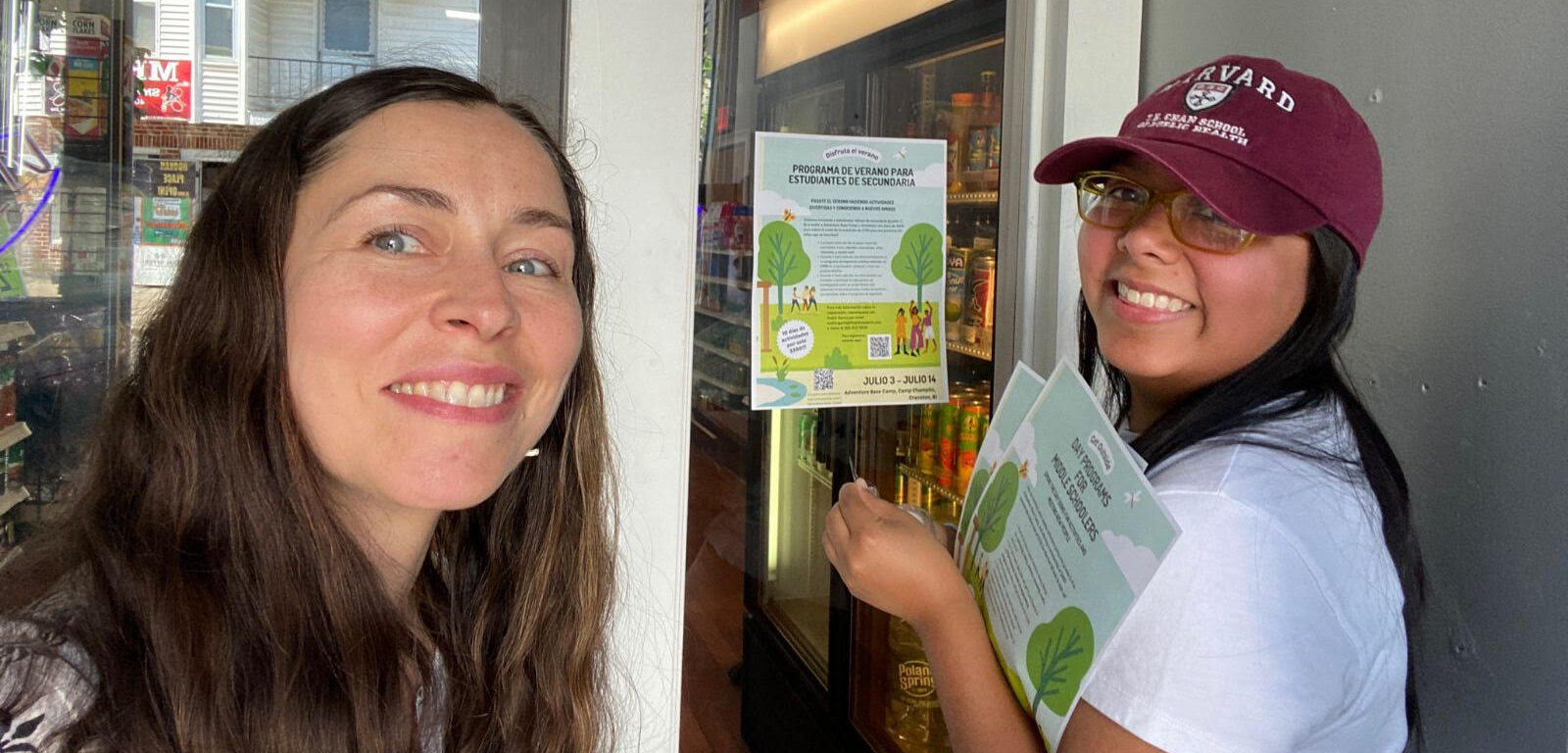
Armed with sunscreen, pushpins, tape, and stacks of flyers, Amy and I hit the streets of Boston and Providence in our most comfy sneakers to engage the community. Our recruitment journey was guided by a map we created of key locations where we could find our target population – bodegas, restaurants, laundromats, hair salons, schools, nonprofit organizations, etc. With a well-rehearsed spiel in English and Spanish, we set forth to talk to anyone who would listen.
Interestingly, our journey turned into an immersive cultural experience. At each stop, we heard fascinating stories from really interesting people that reminded us of the resilience and diligence of the Latinx immigrant community. For instance, we met a business owner from El Salvador, who had recently written a book about the first Central American migrants who arrived in the US in the 1800’s, a story not many people know about. Another notable encounter occurred with two young boys who were spending their summer helping out at the cash register of their family’s store. One of them expressed interest in going to summer camp because it was something he had always wanted to do. Towards the end of the day, we visited a tortilleria, a shop that makes and sells hand-made tortillas. There, I chatted with a worker about how tortillas connect our two cultures, hers Guatemalan and mine Mexican.

One major highlight was the opportunity to indulge in what felt like a culinary tour of Latin America. Amy and I tried dishes from a variety of cultures like Brazilian coxinhas, Colombian empanadas, Mexican agua fresca, and Dominican guisado de res, which made us feel more connected to the people we met.

As a Mexican-American woman, I felt a great deal of responsibility and pride employing my own cultural background and roots to build bridges of trust throughout this experience. I value knowing that my upbringing, principles, and Spanish-language skills allowed Amy and I to form authentic connections that otherwise could not be formed by simply using a recruiting service.

As I reflect on our journey, I am reminded of the true purpose of research, to gain a genuine and ethical understanding of the human experience. It is more than just hitting recruitment numbers and it begins long before the analysis phase. The process of uncovering insights begins when we build true human connection, when we appreciate and experience diverse cultures, and when we collaborate on the ground with communities.

By Evelin Garcia, User Experience Researcher, Fluent Research
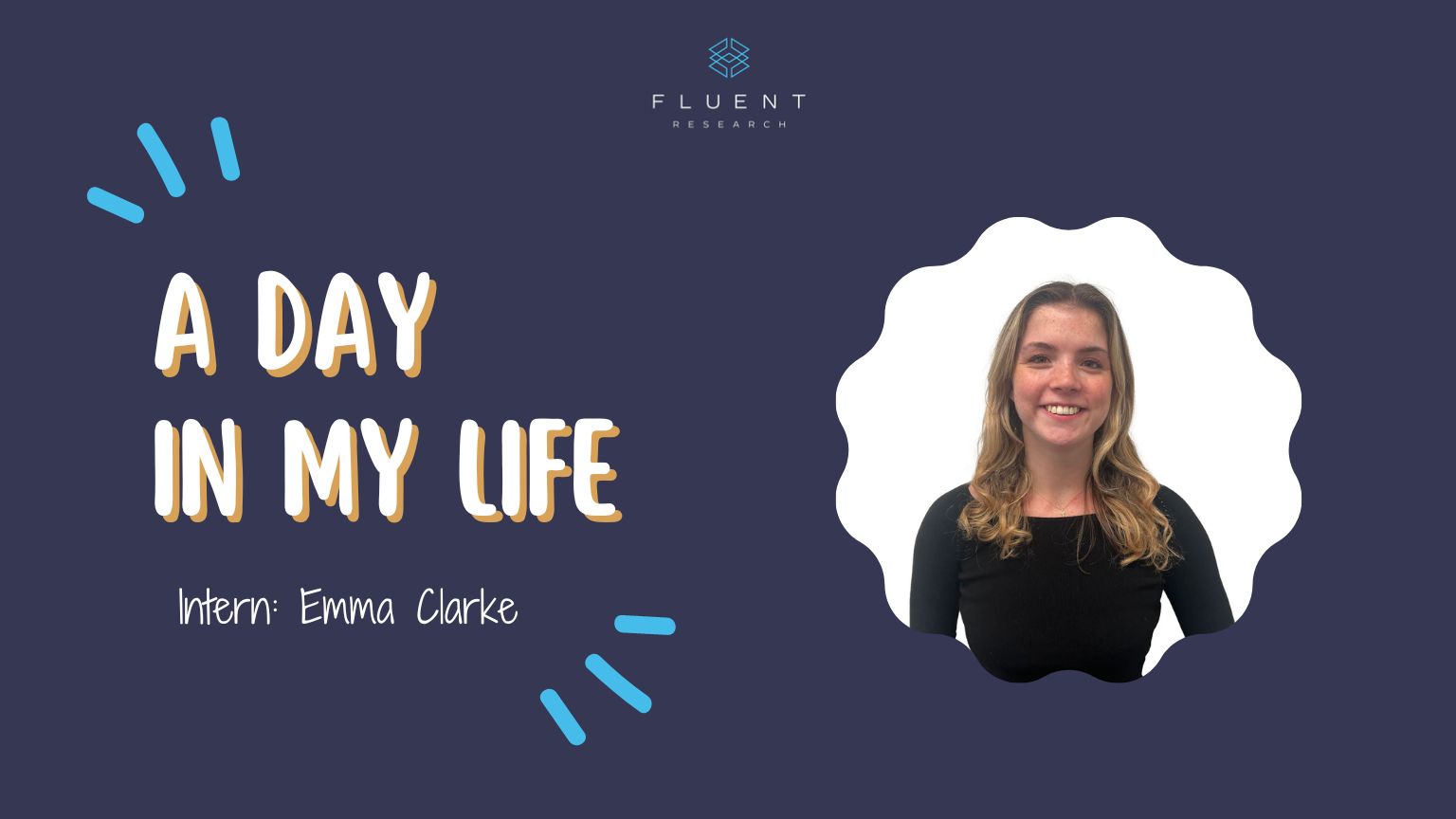
My name is Emma Clarke and I am an intern at Fluent Research. In the fall, I will be a senior at Tulane University in New Orleans, where I study psychology and cognitive studies. I first interned with Fluent during the summer of 2022 and I am very grateful to be back this summer. While my workdays are always a bit different, I’d like to give you an idea of what a typical day looks like.

8:00 A.M.

I typically wake up at around 8:00 in the morning because the work day starts at 9:00. I like to start my day by driving to get some coffee. My order this summer has been a brown sugar shaken espresso! When I get home from getting coffee, I make breakfast too. Usually I’ll make an omelet or a breakfast sandwich.

9:00 A.M.

The work day begins at about 9:00 in the morning. While Fluent Research has an office in New York City, I work remotely because I live outside of Philadelphia. First, I usually like to log on to my email to check for missed notifications from the previous day. Once I have done that, I will typically have some work left to complete from the day before.

11:00 A.M.

After I have completed the previous day’s work, I will either wait for someone to reach out to me with a new task they need support on, or I will message my supervisor, Mary Meyn, and ask her what I can help with for the day. I tend to work on whatever I have been assigned or attend meetings with colleagues.

This summer, I have really enjoyed attending presentations by Fluent staff to help interns learn more about the company and how it works. For example, I recently attended a presentation led by Sofia Polo about the essentials of report writing. The week prior, Farah Brensinger presented about what it means to be a user experience (UX) researcher. As I plan for my future post graduation, these presentations have provided me with insight about potential career paths. I really appreciate how everyone at Fluent is willing to help guide and teach the interns.

12:00 P.M.

Since I tend to make a big breakfast for myself, I’m not super hungry by lunchtime. I may have a small snack at this time, though.

On Fridays, we often have a “Lunch and Learn” presentation. Different staff members will present on a topic of their choice and everyone gets to learn something new. One of my favorite presentations was Charlotte’s discussion of how reproductive justice plays into research.

1:00 P.M.

At this time on Mondays, we have a weekly staff meeting, when we take time to thank and give kudos to colleagues for jobs well done over the past week, and go over the status of the current projects we are working on. I find this meeting really helpful because I can gauge where I may be of help to people that week and learn about interesting projects.

2:00 P.M.

The weekly meeting lasts for about an hour. I will then return to what I was working on prior to the meeting. This may be something like taking notes on user experience interviews, pulling quotes from interviews for reports, testing out surveys, or something else entirely. One thing I really appreciate about interning at Fluent Research is that I get to be involved in a variety of different projects and tasks.

No day is ever the same! While I can’t give details about any current projects I am working on, the most impactful one I have worked on in the past was a report on how to help military families who had a spouse that died of suicide after their service. This was a very sensitive subject andI learned a lot from it. I went through interviews of the military spouses discussing their experiences and how they would have liked to have been helped during such a tough time. It was great to know that this work was going to contribute to improving the experiences of others suffering from the same type of loss in the future.

4:00 P.M.

By about this time in the afternoon, I tend to be in need of a little break from the computer. I usually do this by taking my dog on a walk around the neighborhood. It’s nice to be outside and get a little exercise after working inside all day. I like to listen to a podcast while I walk, too. One of my favorites is “You’re Wrong About,” which discusses how events in the past have been misrepresented in society and how these events truly played out.

5:00 P.M.

When I return from my walk, I will typically continue working until around 5:00. Of course, sometimes the work day goes a little longer or ends a little earlier for me, but this is the general cutoff point.

I hope you enjoyed reading about a day in my life as an intern at Fluent Research! As I stated earlier, no day is ever the same in terms of what tasks or projects I will be working on. However, I think this portrait of a day in my life as a summer intern at Fluent Research will give a general overview of how my days are typically structured.

At Fluent, we have a deep commitment to uncovering and fostering emerging talent. This summer, we are thrilled to welcome three exceptional interns to our team. Learn more below about Emma Clarke, Halley Robbins, and Marko Stroumbakis – their backgrounds and plans for the future…


Emma Clarke

Emma Clarke is returning to Fluent Research as an intern for the second consecutive summer. Emma will continue assisting research teams with both qualitative and quantitative projects. In the past, Emma has found research concerning education and family relations to be the most rewarding. Her interest in this type of work stems from her previous experience as a volunteer and tutor for young children in high school.

Emma will be entering her final year of college as a psychology and cognitive studies major at Tulane University in the fall. Over the last three years she has helped conduct undergraduate academic research in social psychology and will continue to do so during her final year. After graduation, Emma hopes to pursue a graduate degree in social psychology.


Halley Robbins

Halley Robbins is a summer intern at Fluent Research. In her internship search, Halley was looking for a company where she could do quantitative data analysis for an organization whose mission strives to better the lives of others. Halley is excited to apply her experiences as a teacher’s assistant, president of a 60-person tutoring program, camp counselor, and more to add her unique voice to Fluent Research.

Halley grew up in New York City and is a rising senior at Washington University in St. Louis. She is majoring in economics and math with minors in psychology and computer science. After college, Halley is interested in going to graduate school for business or computer science. She is excited about working in her hometown and joining Fluent Research to put her data analytics skills into practice.


Marko Stroumbakis

Marko Stroumbakis, who has been an invaluable intern at Fluent Research since June 2022, will be continuing his work at Fluent this summer. As an intern who has worked with everyone on the Fluent staff over the past year, Marko has gained a breadth of knowledge and experience in market research. Verifying both qualitative and quantitative data, working on survey testing, and translating subject responses from Spanish to English have all been valuable for his understanding of how data is used to inform insights.

Marko would like to gain more experience and knowledge in the field of marketing, with a particular emphasis on brand management. He will be a junior at Baruch College in New York City this fall.


Have you noticed vibrant color schemes, unconventional patterns, curated clutter, and an eclectic mix of styles popping up in your social media feed lately? If so, then you may be familiar with Gen Z maximalism— a bold and expressive design aesthetic that exemplifies the motto, “more is more.” Let’s take a dive into this recent trend.

Gen Z maximalism is a far departure from minimalism, popular among millennials. Whereas the millennial generation prefers simplicity and functionality through clutter-free spaces, clean lines, and neutral colors, Gen Z prioritizes vibrancy, creative self-expression, and constant stimulation.

The rise of Gen Z maximalism is due, in large part, to the impact of the pandemic. With extended periods of quarantine and stay-at-home orders, young people spent more time indoors cultivating living spaces that emanated warmth and inspiration. Gen Z turned to maximalism as a way to infuse their homes with the energy, joy, and personality that reflect their unique tastes. The aesthetic goes beyond interior design. Gen Z’s maximalist effect on fashion and beauty subverts conventions and tradition with an eclectic style of bold patterns, textures, and colors.

In our work at Fluent Research, we often explore how digital products empower the creativity of young people around the globe. Gen Z maximalism reflects the unique ways in which this generation seeks to express their individuality, creating unique content that stands out in the crowded digital landscape. This aesthetic encourages personalization and unabashed exploration of various styles and modes of expression. We must ensure that Gen Z continues to have access to the latest digital platforms, innovations, and tools that empower them to customize and personalize their experiences and express their creativity.

By Natalia Belchikov


One of the most consistent findings I have noticed while studying families and digital media over the years is that parents want their children to be less dependent on them. At the same time, however, parents must also supervise their children and ensure their children’s online safety. In various studies about educational apps, children’s media, digital gaming, non-digital play, and reading, many parents have admitted that whatever the medium, they want their children to be both safe and independent. Therein lies the parenting conundrum.

Parents tend to opt for solo activities and resources for their children that can offer the safest options and the most autonomy. For example, while co-reading is important to parents to allow time to bond, they also want their child to grow to love reading and eventually choose to read independently on their own. Similarly, parents often prefer to send their children to the yard (if one is available to them) instead of a public park, since they can provide supervision while getting other things done at home.

While this idea may seem like a no-brainer (especially to parents), the solutions that research offers as the best and safest options for children—co-viewing and co-playing, for example, which we fully support—can admittedly leave parents feeling that they have to make a hard choice. They feel they have to choose between what they should do to be a “good parent” and what they end up doing in reality, which is often pushing their child toward the easiest solution that gets them out of their hair. We have heard from many parents that they struggle to balance their children’s need for activities that are educational, fun, and physically active —activities that often require supervision—with their own need for time to do what they need to do, which often requires their child to act independently.

According to our research, the capacity for independent play is one of the key drivers for parents to allow technology use among young children, beating out most other anxieties parents report having about screen time and active time. This is a particularly interesting finding to see come up time and again, especially given the vats of ink spilled over screen time since the debut of the iPad in 2010 (not to mention the invention of the television). Complicating the picture further, the levers for safety and autonomy are different for each family. A family most concerned about exposure, for example, might allow their 11-year-old to access any video game they want as long as their device is not connected to the internet. Another family concerned about contact and location might give their 11-year-old a phone so that they can be reached wherever they are, with less concern about how the child uses it.

Regardless of each family’s situation, however, there are certain takeaways tech companies might consider to help parents feel more confident in their child’s safety when using technology independently. Ideally, with this peace of mind, parents might be less anxious about not striking the balance between wanting to engage with their children and needing time to be more hands off.

1) Support the balance of learning and fun.

We have heard from many parents that, if their children are going to be on a screen anyway, they want the time spent to be as educational as possible. For some parents, an engaging educational app is a relief, since the alternatives are “mindless” apps that just waste time. But above all, we have heard that parents take cues from their children about what is engaging for them and worth spending time and money on. If it is educational but no fun, it is not going to be worth the time, let alone the money. App designers should strive for the happy medium. Note, however, that the desire for educational apps seems to change over time: as older children have increased responsibilities at school, parents want their children to relax and are more okay with “mindless” fun.

2) Support parents’ search for appropriate content.

We have likely all experienced the inundation of choices that have resulted from the proliferation of streamers, channels, and podcast networks. The children’s media landscape is no different. There is no shortage of options for devices, apps, or shows to choose from, and parents are operating on a combination of word of mouth, pre-vetting (using the apps themselves for a while), and trial and error. Issues with app store rating systems have been well documented, but in addition to overdue changes to those systems, parents need to be made aware of websites like Common Sense Media (CSM) that include parent and child reviews and media research. Outlets such as CSM can also help parents differentiate high-quality, research-based content from popular apps that claim to be educational. This information can help parents make their own decisions about what is right for their family.

3) Support parents’ efforts to keep their children safe.

Parents trust devices and apps that help them maintain control over what their children are exposed to. While they can control most of what comes into their home in other ways, technology can be a conduit to the wider world that parents have comparatively little control over. We have found that parents are not completely comfortable with company-imposed or set-it-and-forget-it filters, so we suggest clear controls that allow parents to customize and revisit the boundaries they’ve set over time.

4) Support regulations on children’s time.

Although parents like that technology can occupy their children’s time, they also fear and dislike the complete and utter takeover of their attention. Parents we have talked to complain about being excluded from engagement with their child while they are on devices. While some parents have outsourced being the screen time “bad guy” to timers and house rules, many parents wish apps and devices integrated periodic breaks after an appropriate amount of time. This feature would make transitions between activities smoother for everyone.

5) Support optional parent participation.

Although parents want and need their children to be independent, they still see the value of co-engagement and participation in their interests. Multiplayer modes and prompts for optional parent participation in activities invite parents to engage with their children in digital spaces rather than exclude them. Portals or logins that give parents a view of what their child is doing and the progress they have made also help parents feel connected without interrupting their child’s screen time.

Conducting research with parents and children provides me and my colleagues at Fluent with the opportunity to advise tech companies on how their products and services might have a positive impact on kids and their parents. These are some of the most common insights we have heard from families across our research studies. I look forward to seeing how Fluent Research continues to help make new innovations even better for them.

By Tiffany Salone*

Individuals who may be struggling with loneliness, depression, or anxiety and are in need of immediate relief or support are increasingly looking to apps as a middle-path tool when a mental health service provider may not be the most expedient solution. This BBC article explores the innovative possibilities of a chatbot therapist app called Replika, aimed at providing AI-generated counseling services to its users. Lia Abrams and Charlotte Beatty, two researchers at Fluent, consider the following to be important areas of research to investigate:

1) The consequences of around-the-clock access to chatbots. In face-to-face therapy, skill development often hinges on the time a patient spends away from a therapist; that is, the time patients spend in day-to-day life putting their coping skills into practice. While around-the-clock care could be useful for individuals who need immediate support, it’s important to consider how constant access to a chatbot could facilitate patterns of depending on the resource in times of stress instead of developing personal resilience.

2) The commitment to equitable mental healthcare. The technology described in this article primarily addresses the wider population of individuals with mild to moderate mental health issues. However, it is necessary to consider how the smaller population of people with severe mental illness could utilize the service. These individuals face significant stigma, present a more complex set of challenges, and potentially need more support and funding for their healthcare.

3) The ability of AI to replicate natural human skills and instincts. An important component of therapy is the ability to read a patient’s body language and facial expressions. Will an AI chatbot be able to pick up on the intricacies of a patient’s energy? How will this work if there is no prior knowledge of who the patient is, their personality, or their mannerisms?

4) The security of patient information and the quality of data mining. One important part of therapy is the confidentiality agreement that therapists sign, prohibiting them from disclosing patient information outside of sessions. How can chatbot therapy services ensure that patient data is not misused? In addition, if the data that chatbot algorithms draw on is skewed or doesn’t cover a wide enough demographic of people, then can algorithms truly care for all individuals as they see fit? There is substantial evidence that mental health experiences vary significantly across demographic lines like gender, race, ethnicity, and sexuality. How can AI and chatbots truly cater to the needs of each individual’s intersectional identity?

Here at Fluent, we prioritize research that amplifies voices of underrepresented communities. While the possibility of AI-generated mental healthcare offers significant benefits for increased accessibility to self-help practices, the above are factors that should be addressed and researched in order to ensure that platforms such as Replika can reach and serve a wide range of individuals.

By Lia AbramsCharlotte Beatty

A wise and dear professor once told me, “The medium is not the message. The message is the message.” And when television was the medium, that was certainly true. But is that still the case with the proliferation of interactive media for children taking hold? Does the interactivity of the medium outweigh the content being delivered on it?

In the podcast series, Chasing Life, Dr. Sanjay Gupta delves into the science behind the impact of technology on our brains. This particular episode, Inside a Lab Studying Toddlers and Touchscreens,” explores the impact of interactive touchscreen technologies on very young children. Dr. Dimitri Christakis, a pediatrician and director of Seattle Children’s Research Institute, explains how his research is finding that children between the ages of 18 and 24 months struggle to disengage from an app in comparison to a traditional toy. This knowledge triggers questions for both parents of young children as well as the technology companies that create these apps. What can parents and tech companies do to prevent adverse effects on children’s young brains from this relatively new technology?

As a parent myself, I see in my teenagers how the interactivity and stimulation of technology keeps them fully engaged and immersed. And in my role as Director of Content Research and Evaluation at Fluent Research, I help technology and media companies understand how children and parents experience apps, games, and other products so designers and producers who create digital content for kids do so with their wellbeing in mind. This is more important than ever as technology continues to evolve and draw in the attention of a generation. As Dr. Christakis says, “Every program is educational. The question is, ‘What is it teaching?’” We need to do better for our children.

By Allison Caplovitz, PhD

Last month, I attended the Critical UX: Challenging the Dogma of UX event hosted by HmntyCntrd. At this virtual symposium, academics, researchers and designers from around the world gathered to examine some of the prevailing credos that have emerged in the UX field. What ensued were rich discussions that went beyond buzzwords and unpacked inclusivity, universality, and individualism in UX research and design. At the end, I walked away with a deeper understanding of how to better honor my research participants’ lived experiences.

Three points especially resonated:

The value of wholesale inclusion

It is possible for those involved in research to take a narrow view of inclusion; making it primarily about whether someone from a historically underrepresented group is included in a sample. While representation in a sample is a good step forward, what if inclusion was more than just ensuring that those from underrepresented groups were included in a research?

Panelists at Critical UX asked the audience to scrutinize whether the entirety of their research processes considers the many facets of inclusion. Particularly, they asked those in attendance to think about recruitment processes, research methodologies, and whether built solutions are serving the needs of marginalized groups included in research. Panelist Alex Haargaard mentioned how recruiting people in wheelchairs, for example, could be one part of the inclusion process, but to be more comprehensively inclusive requires more thought into different elements of participation for people in wheelchairs. In practice, this could mean examining a research facility for accessibility or ensuring that tables in a testing room are at a wheelchair friendly height. Comprehensive inclusivity may also mean consistently engaging with wheelchair users through the many different stages of the product design process, so that early prototypes, built solutions, launched products, etc. can be tested with them.

The UX researcher is positioned to advance inclusion by creating research processes that are accessible. And though it may require more effort to sustain their involvement due to systemic barriers, a UX researcher can advocate for underrepresented participants to have a consistent presence in the design process, from product inception through continuous iteration cycles. I am freshly challenged to consider how my research process, from start to finish, can better include marginalized groups.

The importance of making space for different perspectives

In data collection, it’s possible to inadvertently shut out insights from people who have idiosyncratic ways of perceiving the world. This can affect the quality of data and the way it is ultimately used. It can therefore be helpful to proactively invite participants to volunteer their unfiltered perspectives about what matters to them in their daily lives. To illustrate this, panelist Dr. Madhuri Karak recounted a community mapping project with Asian villagers. The research participants insisted on faithful delineations of their places of interest. What resulted was a multi-sensory map that tracked orangutan breeding grounds, riverside resting places, trees with springtime songbirds, and other landmarks that may have been otherwise foregone.

Thinking on Dr. Karak’s example, I could see myself having expected the Asian villagers to map street names, schools, meeting halls, and other similar places when community mapping. Such expectations would reflect my own ideas of what is noteworthy in a community, but would have been an incomplete reflection of the research participants’ ideas of what is noteworthy.

At Fluent, our exploratory research spans the globe and we regularly visit participants’ homes, schools, workplaces, and communities to see their lives in action. Within UX research, it is essential to explore how participants actually perceive the world around them and understand how technological products integrate with their daily lives. For this reason, it’s important to make sufficient space for participants to offer their own perspectives. For me, this may require loosening my expectations for how participants “should” define aspects of their own lives in favor of how they actually define their lives. This may take on even greater importance in cross-cultural settings where research participants may have different worldviews.

The necessity of UX informing decisions about scale

As engineers and designers create technologies for education, healthcare, and other institutional spaces, many of them think about getting their products into as many hands as possible. Panelists had the audience consider the upsides and downsides to scaling up a product’s distribution, and the role that UX research can play in helping make decisions about scale. While some problems can be solved by blanket solutions that serve a broad array of people, other problems may require solutions that are more tailored. Moreover, as automation and AI become a larger part of technological design, questions of human-computer interaction enter the forefront in new ways. To illustrate this, panelist Andrea Ngan raised the question of “scaling health care” with automation, and how for patients, figuring out health care needs through machine interactions may be less appealing than working with other human beings. In cases where users have strong sentiments about a product, the success of a product, no matter how good it is, can hang in the balance.

Ngan’s example sheds light on instances where UX research can contribute to organizational decisions around scale and user adoption. User research can help identify whether a more universal solution can actually meet the differentiated needs of users, or whether a more customized, small-scale approach is more appropriate. UX research can also help understand user needs and sentiments, helping to determine the appeal of a product or service and whether there might be resistance to it. This line of conversation pushes me to think about the myriad of ways user-centric research can impact product design conversations, including some of the bigger questions along the product design roadmap.

Overall, the Critical UX: The Dogmas of UX strengthened who I am as a researcher by inviting me to take a closer look at my own research processes. I am grateful to have spent an afternoon listening to UX leaders who are entertaining the big questions in earnest. Furthermore, I’m eager to put what I’ve learned into practice to better elevate the voices and stories of participants I work with at Fluent.

By Senior User Experience Researcher Farrah Brensinger

If you have had any interactions with a teen or young adult recently, I am sure you have heard the word “cringy” uttered more than once. Consider Chicken Shop Date interviews with Amelia Dimoldenberg and Taylor Swift’s infamous 2022 NYU graduation speech when she says “… learn to live alongside cringe,” as examples of the current cultural relevance of cringe. But how about “meta-cringe”? Trend forecasters predict that 2023 is the year of meta-cringe for Gen Z. While cringe is generally defined as embarrassment, awkwardness or discomfort about something or someone being out of touch, meta-cringe is defined as having an awareness that something is cringey and enjoying it anyway. A hallmark of meta-cringe is that it’s unclear whether the act is sincere or ironic, and because of that, the question about intent loses importance all together.

It makes sense that meta-cringe is having its moment. In the current political and social climate, Gen Z are inundated with news and trends that move at a speed far too fast to keep up with. Young people are understandably anxious about the state of the world and disillusioned with emerging adulthood for many reasons, including the war in Ukraine, mass shootings, climate change, and economic uncertainty. These feelings of distress, combined with Gen Z’s value of authenticity, leads young people to deliberately engage in absurd, awkward, and idiosyncratic cringe humor. Gen Z are no longer interested in projecting a perfect online image. Instead, they are rejecting the societal pressures of a flawless feed and the shame associated with cringeworthy moments, and in lieu of this, opting for curated cringe. This kind of humor is often an expression of nostalgia for the media and cultural trends of Gen Z’s adolescence from the 2000s to 2010s (i.e., Shrek raves, viral memes about 2000s emo singing impressions).

In our work at Fluent, where we often conduct research with Gen Z teens and young adults, we consider the cultural shifts and values that embody meta-cringe when trying to connect with and design for young people. Here are some ideas to keep in mind when working with Gen Z:

– Be Nostalgic: Find unique and easy ways for Gen Z to connect with the beloved digital and media world they grew up with (2000s to 2010s).

– Embrace Absurdity: Don’t be afraid to be cringy. Intentional or not, this peaks interest.

– Play with “when the curtain drops” moments: Focus on content that feels unstaged and genuine. Consider the trope of “when the curtain drops” or “the camera stops rolling” humor where the viewer gets a glimpse into the inner world of a character, or behind the scenes.

– Be Authentic: Be cringey, be real, as long as you are being truthful to you. A curated and manicured public image is not in style anymore.

– Cultivate personal and meaningful connection: Ensure that connection feels vulnerable, intimate and simple, perhaps with smaller groups of peers.

– Share the unfiltered self: Encourage sharing in a way that feels like unedited, first takes. Consider BeReal and Poparazzi as examples of apps popular among Gen Z that are designed for unedited and in-the-moment photo sharing.

– Be Relatable: One aspect of meta-cringe is the relatability of those moments of embarrassment, awkwardness or discomfort. It may be painful to watch, but the humor connects with Gen Z who are disillusioned with the perfect, filtered digital image.

Meta-cringe will influence Gen Z’s expectations and behaviors in the digital world. Young people are embracing their guilty pleasures and giving themselves permission to be themselves, IRL and online. We can view this carefree attitude as a way for Gen Z to express more vulnerability when they connect with others online.

Sources:
https://i-d.vice.com/en/article/qjkywp/meta-cringe
https://www.russh.com/tiktok-meta-cringe/
https://zeefeed.com.au/meta-cringe/
https://www.tiktok.com/t/ZTRWYP36o/

By Natalia Belchikov, User Experience Researcher, Fluent Research

January 17, 2023 (New York, NY) – Fluent Research, a data and insights-driven strategic consulting firm, announced today that Farrah Brensinger has been promoted to Senior UX Researcher. In this role, Farrah will oversee a wide range of global research studies, informing the development of new technologies and content.


“Farrah has demonstrated her deep analytical skills while working on diverse projects, ranging from UX research to impact assessments of educational content,” said Nellie Gregorian, Founder and President of Fluent Research. “I am excited to see Farrah’s accomplishments in her new role.”


Farrah is passionate about designing products, services, and experiences that create a better quality of life and a brighter future for all. She leverages qualitative research methodologies to build empathy and provide data-driven, actionable recommendations.


Prior to joining Fluent, Farrah worked at Shimmy Technologies, contributing user research for the development of game-based training tools used in the manufacturing sector.


About Fluent Research
Fluent Research is a data and insights-driven strategic consulting firm. Since 2006 Fluent has leveraged understanding of human behavior to help the world’s best-known brands and organizations advance worthy causes, innovate transformational products, and successfully navigate change. Fluent’s work centers around three practice areas: thought leadership research, formative research and evaluation, and social impact assessment. Fluent has applied rigorous and innovative research solutions in service of promoting children’s access to and quality of education, and gender equality in the U.S. and in over 70 countries around the world. Fluent’s creative arm, Fluent Productions, is an award-winning producer of original documentary content that harnesses the power of visual storytelling to bring attention to important issues facing our society, to build empathy and inspire action.

Contact: Stefanie Cousins
[email protected]