
Get to Know Us

As part of Fluent Research’s 20th anniversary, we’re highlighting the people whose perspectives and experiences shape the work we do.

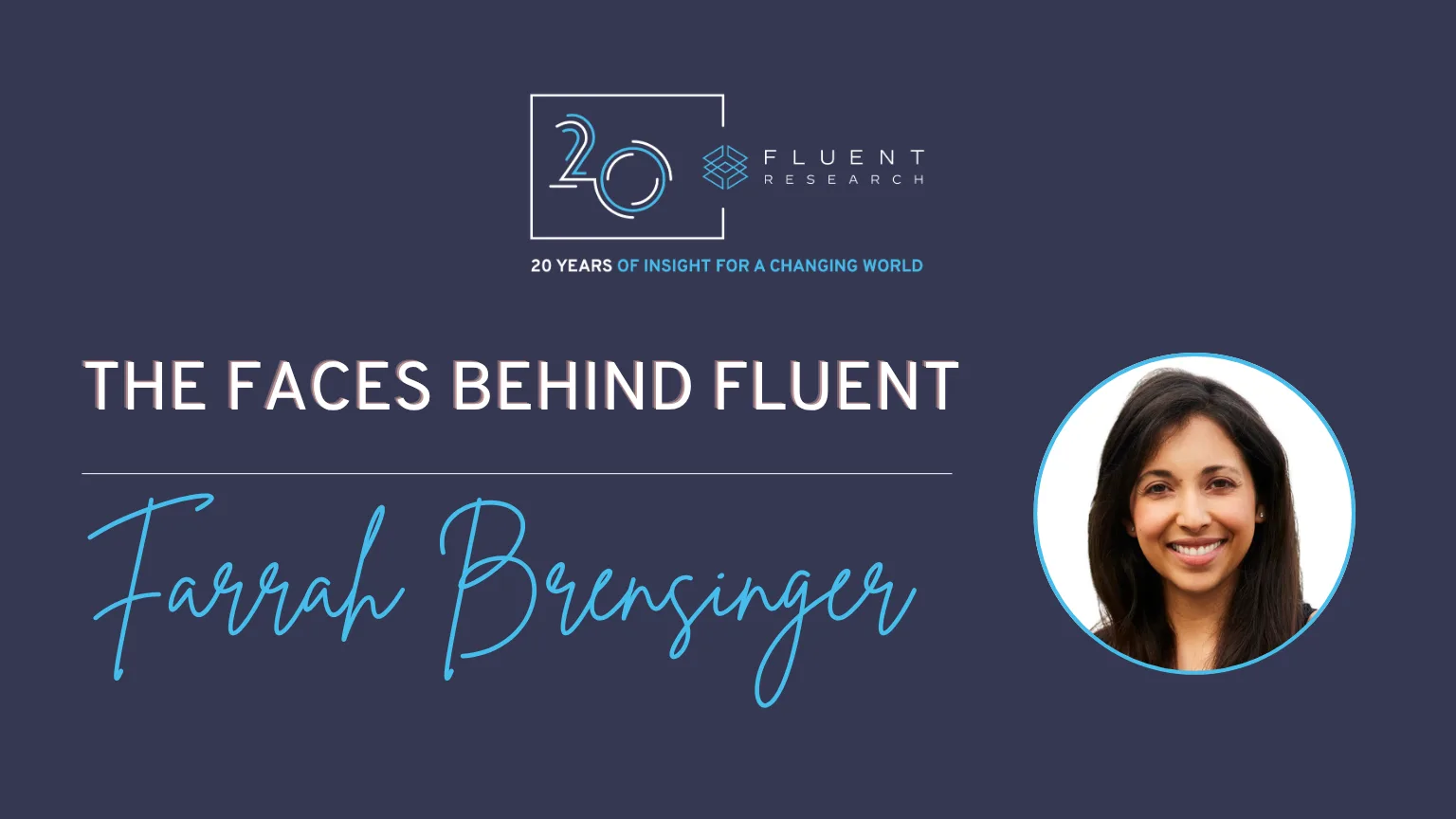
This week, we’re featuring Farrah Brensinger, a User Experience Researcher at Fluent. Drawn to the process of sense-making, Farrah brings together seemingly disconnected pieces of information to uncover the stories, patterns, and insights that help teams better understand the people they serve.

In the latest installment of “The Faces Behind Fluent,” Farrah shares what she enjoys most about research, why connecting with participants makes the work meaningful, and a few of the interests and routines that shape her life outside of Fluent.

1) Farrah, what’s your role at Fluent, and what does a typical day look like for you?

As a user experience researcher, I see my work as sense-making and forging new directions. Part of the joy of my role is taking what could look like disparate, disconnected pieces of information or data, and identifying the symbolism and story connecting them all. A typical day could look like moderating 1:1 interviews with user research participants, analyzing diary data, and capturing findings in writing.

2) What’s been your most memorable project or moment at Fluent?

I was moderating in-field research that consisted of 1:1 interviews with children. One of the participants was a particularly garrulous and incredibly intelligent boy of about 7 years old. I could tell he was having a good time during the research session, and I was enjoying the session as well. Completely unbidden, he came up to me after the session and invited me to his house to “hang out and play some more.” While I of course didn’t take him up on his offer, his comment was a happy reminder of how research can be fun for participant and researcher alike.

3) If you could have dinner with any public or historical figure, who would it be and why?

Robin Williams, hands down. I think the conversation would be both hilarious and sentimental.

4) What’s a book, movie, or podcast you’d recommend to everyone?

The movie Pan’s Labyrinth has the perfect blend of historical fiction, magic, and metaphor, with the power of a gut-wrenching twist at the end. The main character’s courage and love for her baby sibling is so moving. It is my favorite film.

As far as books, Circe by Madeline Miller has to be in my top 10 favorite books of all time. The writing is so rich, and I do love a strong female lead. 

5) Farrah, what’s your go-to productivity hack?

Noise-canceling headphones playing cafe jazz or soothing ambient (e.g., Henry Green) transports me into my own little, very productive, working world.

6) If you weren’t in research, what career would you have pursued?

Probably a therapist or teacher/instructor, but really anything where I’d get to connect with people in a meaningful way and be a part of their growth journey.

7) What’s one word you’d use to describe Fluent Research? Why?

Adaptive. I’ve witnessed Fluent navigate the seismic shift of AI.

8) What’s your favorite way to unwind after a busy day?

Cooking something delicious but uncomplicated, or going on a family walk with my husband and dog.

9) What’s your favorite snack or drink to have while working?

In our house, we are more than slightly obsessed with super-food smoothies (usually with blueberries or cacao as the star ingredient) and Aloha Bars.

10) What’s a hobby or activity you’re passionate about outside of work?

Mat Pilates/strength training. It’s a great energy booster! I’m also looking forward to getting back into rock climbing and dance.

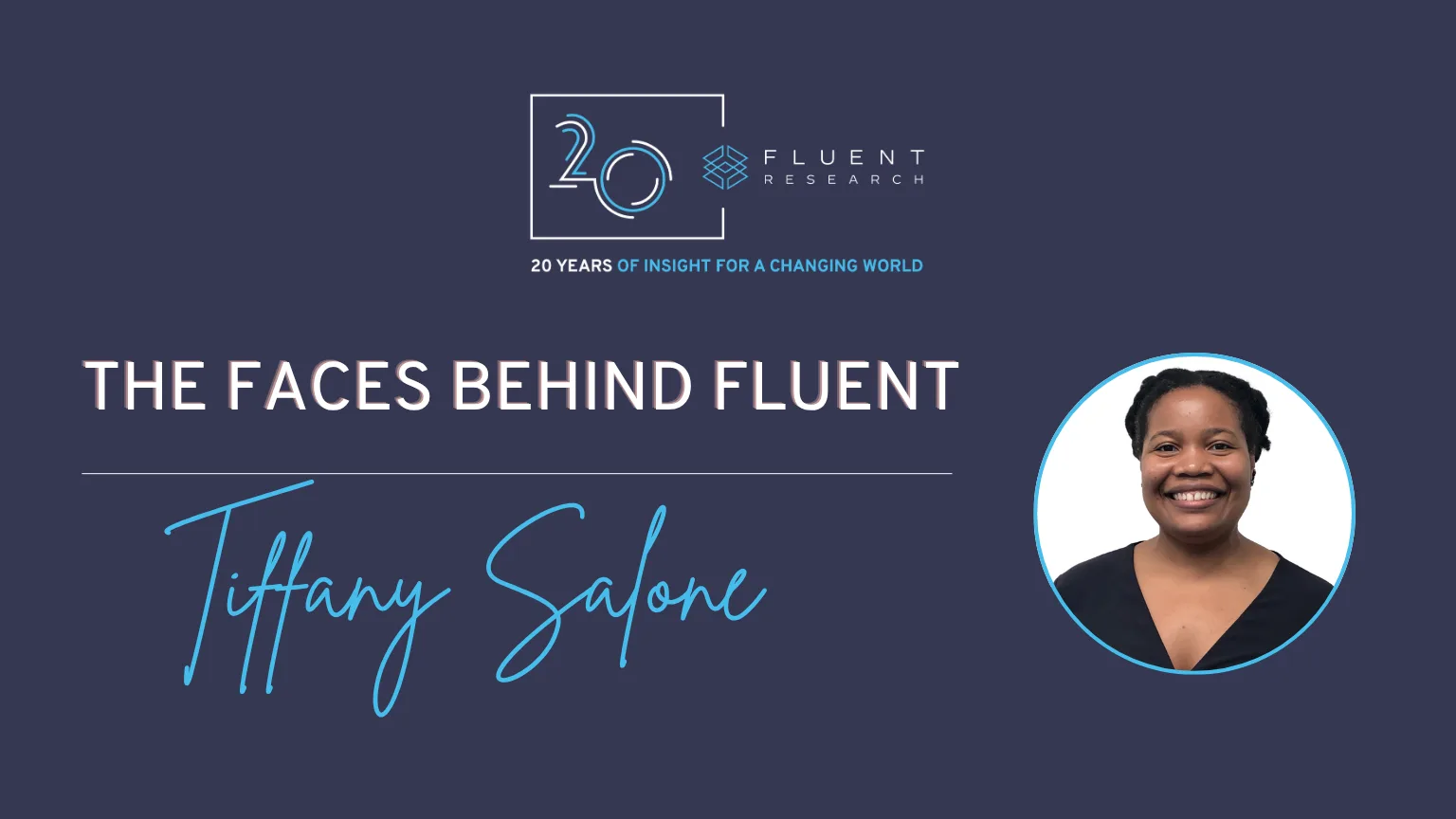
As part of Fluent Research’s 20th anniversary, we’re introducing the people behind the research and the experiences that shape how they approach their work. This week, we’re featuring Tiffany Salone, Senior Researcher at Fluent.

Tiffany is passionate about research that helps make education and technology more accessible and equitable, particularly for young learners, families, and communities that have historically been underserved. With a background spanning educational media research and video production, she brings both a human-centered and creative perspective to understanding how people engage with media, technology, and learning.

Read on to learn more about Tiffany’s path from video production to research and some of the interests and experiences that have shaped her along the way

1) What inspired you to join Fluent Research?

I was looking for an opportunity to continue researching how children and families use and learn from media and technology while gaining the chance to design and manage my own studies and teams. I’m good at managing people and projects, and I wanted more leadership opportunities than I had been afforded in more academically structured environments. The work that Fluent Productions was doing in 2021 also provided chances to use my skills as a producer and director from my previous career in service of the research we do at Fluent Research.

2) What’s a fun fact about you that most people don’t know?

All of my friends know this about me, so I guess it’s not most people, but I love languages. I started learning Mandarin at school starting at 5 years old, but I also expressed an early interest in other languages—one of the stories that I wrote and illustrated in elementary school was about how to say hello in other languages, including German, French, Swahili, and Spanish. Today, I have the basics down in Italian and Spanish; I have better-than-basic German; I’m alright with French; I’ve hung onto most of my Mandarin, and my latest project is learning Korean.

3) If you weren’t in research, what career would you have pursued?

I would probably still be exercising my research skills wherever I ended up, but I might apply them to sociology or organizational psychology.

4) What’s your favorite way to unwind after a busy day?

I love to knit. I usually have a couple of different projects going at once, so I’ll pick one up and listen to a podcast or watch TV.

5) If you could travel anywhere in the world, where would you go and why?

I’ve always wanted to go to New Zealand to experience all of the different climates and natural beauty there.


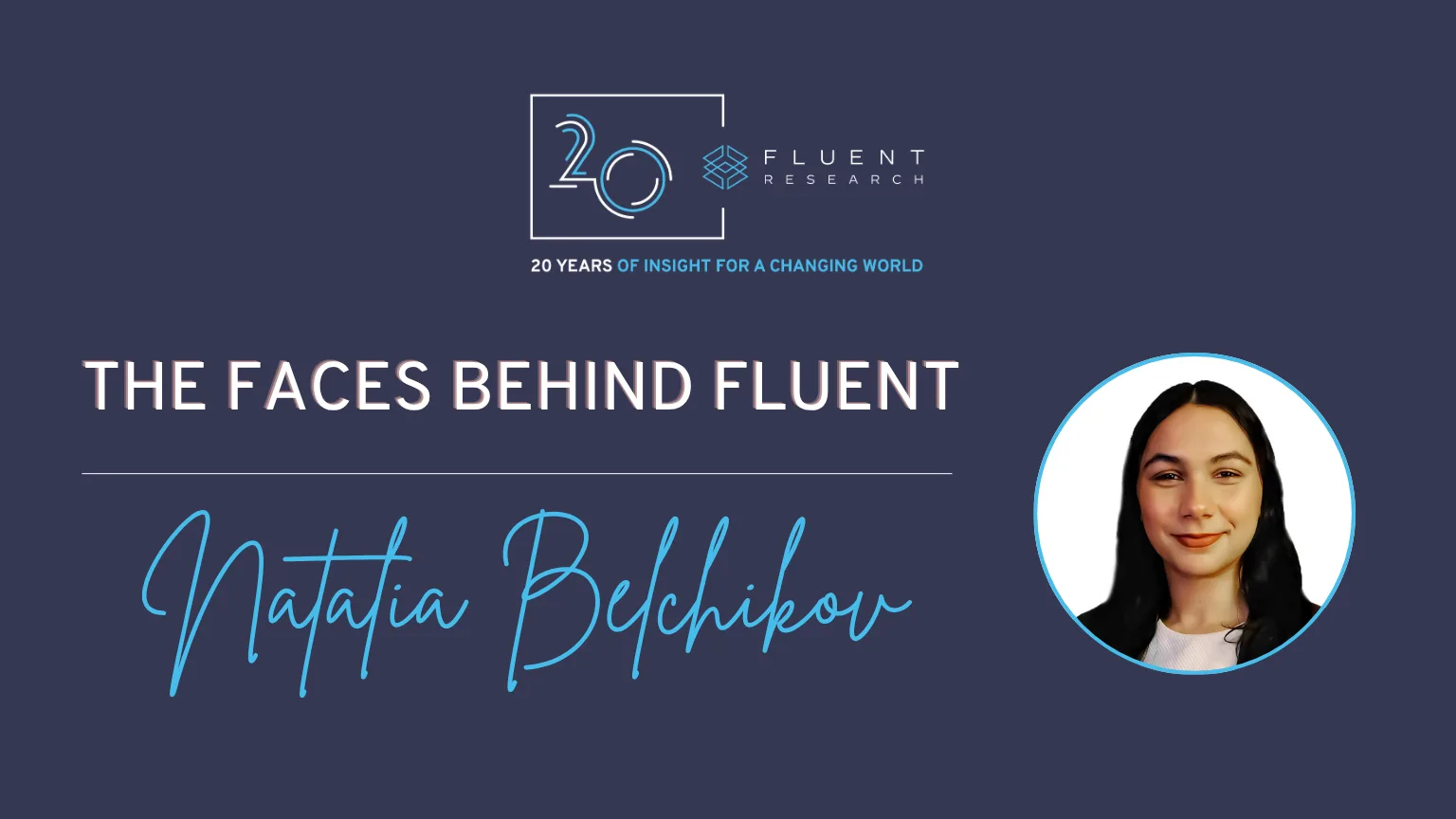
To celebrate Fluent Research’s 20th anniversary, we’re highlighting the people who have helped shape the organization along the way. This week, we’re featuring Natalia Belchikov, Senior User Experience Researcher.

With a background in anthropology and a focus on qualitative and ethnographic research, Natalia brings a deeply human-centered approach to understanding how people interact with media and technology. Her work is grounded in active listening, thoughtful analysis, and a desire to help create more caring, equitable, and empathetic experiences for users.

Read on to learn more about Natalia’s path into research, what drives her work, and how she approaches understanding the evolving relationship between people and technology.

1) Natalia, what inspired you to join Fluent Research?

What originally drew me to Fluent was its core commitment to children and education research; I was deeply inspired by the idea of building a body of work that directly supports youth and learning. Beyond that, I appreciated the philosophy at Fluent that everyone brings a valuable perspective to the table.

2) What’s your role at Fluent, and what does a typical day look like for you?

I’m a Senior UX Researcher at Fluent, and because I’m usually balancing multiple projects across different stages of development, no two days look quite the same! A typical day might involve anything from writing instruments and fielding studies to collaborating with vendors, hosting dynamic brainstorming sessions, or crafting insight-led reports.

3) What’s been your most memorable project or moment at Fluent?

Conducting in-person focus groups in schools across a few major cities in the US remains the most memorable project I’ve worked on in the past five years. Getting to travel across the country to directly engage with high schoolers and explore the nuances of teenage aesthetics was such a unique, fascinating experience. It highlighted the power of immersive, hands-on research.

4) How has Fluent evolved since you joined?

When I joined, I was only the fifth or sixth researcher on the team, so I have watched the company more than double in size! Beyond our physical growth, Fluent has continuously refined its internal practices, expanded its methodological tool kits, and broadened the scope of subject areas we tackle.

5) What’s one thing you’ve learned about research that surprised you?

I was surprised by how much creativity research really requires, but also how crucial it is to keep things simple enough that participants easily understand it. To do true thought-leadership research, you have to bring creativity and fresh, new ideas. At the same time, however, if those ideas create confusion or don’t land right with the participant, the data may be incomplete.

6) What’s your favorite part of working at Fluent?

My favorite things about working at Fluent are the workplace flexibility and the incredible people I get to work with. My colleagues welcome out-of-the-box thinking and challenge me to sharpen my approach. Seeing how deeply everyone around me cares about their craft inspires me to bring my best, think critically, and keep raising the bar

7) Natalia, what’s a fun fact about you that most people don’t know?

I’ve been a traveler at heart since my very first trip to Québec as a little girl, where I insisted on saying “Bonjour” to literally everyone I walked past. I would always try to convince my parents to go to more adventurous destinations. I still love connecting with people across new places today and try to take 1-2 trips a year!

8) If you could have dinner with any public or historical figure, who would it be and why?

I would love to have dinner with Audre Lorde. She is such a brilliant thinker, and it would be an honor to pick her brain. I come back to her book The Uses of the Erotic: The Erotic as Power regularly. Kirin Narayan would also be a top pick for me, I discovered her when I was studying anthropology in undergrad, and her work inspires me.

9) What’s a book, movie, or podcast you’d recommend to everyone?

Pachinko by Min Jin Lee is one of my favorite books; it’s a sweeping, multi-generational story that stays with you long after you finish it. In regard to podcasts, I’m a huge fan of Diabolical Lies. It’s a long-form podcast that always leaves me with a new perspective.

10) What’s your go-to productivity hack?

My go-to productivity hack would be the Pomodoro Technique. The hardest part of any task is just starting, so breaking work into manageable time chunks makes taking that first step so much easier. 

Second, I would recommend working with your body’s natural energy cycle rather than fighting it. It’s important to attune to your own natural rhythms, such as when you need to step away for a break, or even when you just need a snack and some water, because we all function in unique ways.

11) If you weren’t in research, what career would you have pursued?

If I weren’t in research, I’d likely be a therapist. When I first started college, I was actually on the pre-med track to become a doctor, but switching to anthropology made it clear that I was through-and-through meant for the social sciences. Listening to people, understanding their perspectives, and helping them navigate human experiences has always been at the core of what drives me.

12) What does Fluent’s 20th Anniversary mean to you?

To me, this milestone reflects a shared journey of growth. Having been here for several years, I’ve had the privilege of watching Fluent mature, and I’ve grown right alongside it. Reaching 20 years is a testament to the sheer commitment and diligence of our team. We come from so many different backgrounds, but we’re united by a common goal: delivering exceptional research and constantly raising the bar for our work.

13) How do you see Fluent evolving in the next 20 years?

I see Fluent cementing its place as a true thought leader at the forefront of modern research. My hope is that we continue to serve as an innovative, trail-blazing voice in our industry, especially as we navigate new frontiers like AI. I want to see us leading the charge in learning how to utilize AI sustainably, ethically, and responsibly, setting the standard for how technology and human-centered insight work together.

14) What’s one word you’d use to describe Fluent Research? Why?

One word I’d use to describe Fluent is dedicated. Every single day, I see my colleagues put their best foot forward. There is a deep, genuine care here, not just for the research itself, but for holding ourselves and our work to the highest standard. That level of collective commitment is rare, and it’s what truly defines Fluent.

15) What’s your favorite way to unwind after a busy day?

Either taking a dance class, cuddling with my two cats, or watching a movie or TV show.

16) If you could travel anywhere in the world, where would you go and why?

I love to travel! I think I would probably choose New Zealand or the Galapagos Islands. They are both dream destinations for me.

17) What’s your favorite snack or drink to have while working?

I love coffee, and I make myself a latte every morning.

18) What’s a hobby or activity you’re passionate about outside of work?

I am passionate about dance, personal style/fashion, and travel outside of work. I also try to make a dent in my TBR list, but at this rate, I think collecting books is also one of my hobbies. My goal is to have an extensive home library with something for anyone.

As part of Fluent Research’s 20th anniversary, we’re continuing to highlight the people whose experience, ideas, and perspectives have helped shape Fluent. This week, we’re featuring Allison Caplovitz, Director of Content Research and Evaluation.

Allison brings decades of experience in children’s media, education, and research to her work at Fluent. From helping shape “Blue’s Clues” during her time at Nickelodeon to advising leading organizations across media, technology, and education, she has built a career around understanding what engages children and families and using research to create more meaningful experiences.

Read on to learn what brought Allison to Fluent, why collaboration is such an important part of her work, the surprising connection she has to one of Malcolm Gladwell’s books and why she believes people skills will become even more important in the age of AI.

1) Allison, what inspired you to join Fluent Research?

I was working as a solo entrepreneur for many years and was really missing collaborative partners. And when I met Nellie, I knew that I could still do the amazing work I was used to, but have collaborative partners to do it.

2) What’s your role at Fluent, and what does a typical day look like for you?

What I love about my job is that there actually isn’t a typical day. Sometimes I’m reviewing screeners, sometimes I’m creating guides, sometimes I’m conducting interviews, sometimes I’m writing reports, sometimes I’m analyzing data. So every day is different, and that is what I really enjoy about working at Fluent.

3) How has Fluent evolved since you joined?

When I joined Fluent in 2021, there were only about seven full-time employees. Since then we have grown to over 20. That’s a large growth in a short amount of time!

4) Allison, what’s one thing you’ve learned about research that surprised you?

One thing that I have learned over the years is that it is just as important to collect quality data with integrity as it is to write it up in a way that is impactful and represents the participants’ views in a meaningful and impactful way.

5) What’s your favorite part of working at Fluent?

I would definitely have to say the people. All my colleagues are smart, interesting, helpful and fun to be around – truly! I can always count on them to be supportive as well as insightful!

6) What’s a fun fact about you that most people don’t know?

Malcolm Gladwell’s first book, The Tipping Point includes me in the chapter called “The Stickiness Factor.” The chapter is about what qualities make something engaging and one that people want to come back to – and he referenced our research process at Blue’s Clues.

7) Allison, if you could have dinner with any public or historical figure, who would it be and why?

I would love to have dinner with Joan Ganz Cooney, the creator of Sesame Street to hear exactly how she got buy-in for her novel idea and how she kept at it until it succeeded. While I could read books about it, I would want our conversation to focus more on the personality qualities it took to accomplish such an impactful feat.

8) What’s a book, movie, or podcast you’d recommend to everyone?

Theo of Golden was such a great book and I recommend it highly.

9) What’s your go-to productivity hack?

Write a list of to-dos before you end the day so the next day you can hit the ground running.

10) If you weren’t in research, what career would you have pursued?

When I was younger, I wanted to be a sign-language interpreter or an actress (yes very different career paths!) but I think I might be a real estate broker. I like the financial aspects, the client interfacing aspects and just seeing people genuinely happy with their purchase.

11) What does Fluent’s 20th Anniversary mean to you?

It’s a milestone to celebrate and reflect on – what were the past 20 years for me like and where will my next 20 years take us?!?!

12) How do you see Fluent evolving in the next 20 years?

I think with the advancement of AI we will have to lean into our people skills even more to show how we go above and beyond for both our participants and our clients.

13) What’s your favorite way to unwind after a busy day?

Sitting down to dinner with my family!

14) If you could travel anywhere in the world, where would you go and why?

I think I would go to Italy and explore the beautiful coast. It’s been so many years since I have been there and I would like to see it now as an adult.

15) What’s your favorite snack or drink to have while working?

Though I am not really a snacker, I have been forcing myself to drink more water during the day. I don’t love it, but I have a goal of drinking 32 ounces each day.

16) Allison, what’s a hobby or activity you’re passionate about outside of work?

Outside of work, I love taking long walks while listening to a good book or podcast. It is good for my soul. I also love to play mahjong.

As part of Fluent Research’s 20th anniversary celebration, we’re introducing the people whose perspectives, talents, and curiosity have shaped the organization. This week, we’re featuring Heath Cozens, Director of Productions.

Heath uses documentary filmmaking to bring research to life, creating films that reveal what people care about and how they experience the world. Drawing on a career that has taken him from New Zealand to Malaysia, Japan, and the United States, he approaches every project with curiosity, cultural fluency, and a commitment to representing participants’ stories honestly.

Read below to learn how Heath found his way to Fluent, why he sees the camera as an exploratory research tool, and how he hopes filmmaking can foster deeper human connection.

1) What inspired you to join Fluent Research?

I’d been a freelance filmmaker for most of my working life, focusing on documentaries. One of the first projects Nellie and I made together was a video capturing preschoolers responding to the pilot for a Fred Rogers children’s show. It was a modestly scaled project, but I took a story-based approach—capturing not just the viewing experience itself, but the moments that book ended the narrative. The resulting film captured the kids’ transformation from their perspective and was, in its own modest way, moving and beautiful. The client’s positive response led to more documentary work around the country, and soon, around the world.

Having worked in news, advertising, corporate and broadcaster-commissioned documentaries, I really appreciated the autonomy I was given at Fluent. I could use the camera as an exploratory tool and follow the evidence wherever it led. That’s what really inspired me to stay: being trusted to tell real stories that matter, without an agenda, collaborating with the participants, and creating work for attentive, intellectually curious clients.

2) What’s your role at Fluent, and what does a typical day look like for you?

I’m Fluent’s Director of Productions. There’s really no typical day.

In preproduction, I talk with the client to understand the research objectives and intended audience, ensure that an alarming number of batteries are charged, and check that every element of my camera rig—what our Executive Director, William Sandy, calls a “Rube Goldberg machine”—is in order, down to the last screw and washer. I prepare exhaustively so that I’m ready for any eventuality and can remain flexible on the day.

Before I film, I sit down with the participants first and get a feel for what matters to them, what they’re comfortable sharing, and how they think we should capture it. The basic approach is: “This seems important. How could we show it?” Having this chat in advance means that when the camera is rolling, I can be ready for anything and preserve as much spontaneity as possible. 

Then comes editing, the part where I return from a shoot slightly high on the whole experience and suddenly remember that I have to turn many hours of footage into a film. I often work with trusted freelancers and other members of the Fluent team to find the moments that illuminate the research.

Ultimately, we’re trying to make films that entertain and engage both heart and mind. We want to show our clients what their stakeholders care about and keep the work nuanced, clear, and, above all, real.

3) What’s been your most memorable project or moment at Fluent?

One of my favorite projects involved families and technology. Working with Dan Warren, Director of Youth Development & Education, I developed a form of scenario-based ethnography. We gave family members situations and asked them to show us how those moments might play out at home.

The approach was partly inspired by Sons, a 1996 film in which the members of a real Beijing family reenact events from their own lives without a hint of performance. They weren’t acting so much as reliving moments.

Just as participants in a home ethnography might show a researcher how they use a device, these families showed us how they interacted. They weren’t inventing characters or performing; they were showing us family dynamics that they knew intimately.

Often, while I was presenting a hypothetical scenario, somebody would interrupt and say, “Actually, this really did happen.” “Could you show me how that played out?” I’d ask. That was when things became fascinating.

I spent a full day with each family, capturing fresh, authentic conversations, negotiations, and unexpected revelations about technology, behavior, and wellbeing. At the end, we reviewed what we’d filmed and cross-checked it with each family: Was that true to form? Is that really how everyone reacts when there isn’t a camera around?

The client had understandable questions about the method at first, but the results were powerful enough to inspire a day-long workshop, with the film at its center. Workshop participants raved about the film, and we’ve since developed the approach into something we can offer again, which is very satisfying.

4) How has Fluent evolved since you joined?

When I first started working with Nellie, Fluent was something like four people, including a small group of trusted freelancers. It has since grown into a full team of roughly two dozen people.

Much of this growth happened around the COVID-19 pandemic. The scale, pace, and scope of research expanded very quickly. Nellie went from running a small operation to leading a much larger organization, which has been quite extraordinary to watch.

5) What’s one thing you’ve learned about research that surprised you?

What surprised me was how deeply anthropological research can be. At Fluent, we spend our time learning what people actually care about, how they live, what frustrates them, and what might genuinely improve their lives. That understanding allows our clients to serve people better.

6) What’s your favorite part of working at Fluent?

There’s an underlying theme at Fluent of speaking truth to power. Giving people a voice supports their agency, and finding fun, authentic ways to represent human needs and behavior to our massively influential clients is really gratifying. 

We’ve been fortunate to work with clients who genuinely want to understand people’s experiences, including findings that might be uncomfortable or unexpected. I value being trusted to tell those stories honestly.

7) What’s a fun fact about you that most people don’t know?

Here are a few:

• My first proper job was as a puppeteer, touring schools in Southland, New Zealand, teaching children disability awareness. 

• I recently learned to drive again after about 35 years, which has been both liberating and mildly terrifying. 

• I speak fluent Japanese. 

• I’m the former bassist of New Zealand’s premier Velvet Underground-inspired improvisational lo-fi psychedelic folk band.   

• I’m related to Charles Darwin… but only by marriage, which gives me very dubious evolutionary credentials, especially given the disconcertingly high concentration of Neanderthal DNA in my genome.

8) If you could have dinner with any public or historical figure, who would it be and why?

The Buddha. I’d invite him to a vegan degustation at CERN. We’d commandeer an imaginary mess hall overlooking the ATLAS detector and talk physics and philosophy.

9) What’s a book, movie, or podcast you’d recommend to everyone?

Animals have far richer cognitive and emotional lives than we’ve given them credit for. Ants recognize themselves in mirrors and perform first aid on wounded comrades. Bees experience joy and PTSD. Cats have hundreds of facial expressions. Birds combine phonemes into word-like forms, then combine those into phrases.

Animal sentience has always fascinated me, but Aza Raskin’s presentation about using AI to decode animal communication absolutely blew—nay, obliterated—my mind. I won’t spoil the talk, except to say that it includes one of the clearest explanations I’ve encountered of how large language models work. It then demonstrates how the same “shapes” used to map relationships among words in human languages can be mapped onto animal vocalizations—suggesting that perhaps the big barrier between us and other species is partly a translation problem that we’ll soon solve.

10) What’s your go-to productivity hack?

The one I’m using to answer these questions.

Basically, I hit record, mind-dump at length without organizing any of it, ask AI to extract and order the salient points as bare-bones bullet points, and then to reform those points back into my own words. That allows me to think aloud without worrying about whether my tangents make sense to other people.  

11) If you weren’t in research, what career would you have pursued?

Fiction filmmaking would be one possibility.

The documentary form allows you to fire on all cylinders at once. It involves people, technology, storytelling, observation, communication, physicality, artistry, and improvisation. It also carries a serious responsibility toward the people whose lives you’re filming. Sometimes I’m attracted to the freedom of being able to let my imagination run free.

My other answer is working in the field of animal cognition. I’d love to work on using AI to communicate with animals (watch that talk!)

Perhaps technology will enable these tools to merge: The dream project? To interview a farm animal. To ruminate with a ruminant. To produce the bovine version of My Dinner with Andre, if you will.

12) What does Fluent’s 20th Anniversary mean to you?

An anniversary naturally encourages you to look backward, but forgive me if I forgo the commemorative Tupperware. What matters to me is what 20 years of accumulated experience makes possible now.

I think of Fluent as a conduit: connecting clients with customers, organizations with the people affected by their decisions, and potential knowledge with insights people can act on. The questions have always been there; experience helps us ask better ones.

For me, our history is alive, informed by the past and in constant forward motion.

13) How do you see Fluent evolving in the next 20 years?

I’d like Fluent to become a hub for authentic, evidence-based human connection.

I think we’ll find increasingly creative ways to engage people and create immersive, potentially transformative experiences. These could allow our clients to connect with customers and stakeholders as actual human beings, and to build relationships that are transparent, meaningful, and mutually beneficial.

I can also imagine Fluent expanding what we’ve learned beyond conventional commercial research, perhaps in conflict resolution, international relations, or other areas where people have stopped understanding one another.

Technology and commerce should empower everybody. Society is facing some fairly serious divides, and I’d love Fluent to play a part in de-escalating them by revealing shared interests, making people feel heard, and highlighting the connections that bind us all.  

14) What’s one word you’d use to describe Fluent Research? Why?

Connection.

We’re connected in ways that aren’t always immediately visible. Good research and honest storytelling can spark that moment of recognition when a pattern suddenly becomes clear and people realize how much they share.

15) What’s your favorite way to unwind after a busy day?

I enjoy shared writing sessions with friends overseas. We turn on our computers, say hello, and then sit together writing without stopping. That unbroken stream-of-consciousness part is really gratifying.

16) If you could travel anywhere in the world, where would you go and why?

I fantasize about remote, high-altitude places: the Hindu Kush, the Patagonian Highlands, the South Pole. 

I’d love to spend time somewhere with an enormous landscape, no distractions, and a completely different relationship to time. Learning Tibetan dream yoga somewhere in the Himalayas, perhaps.

17) What’s your favorite snack or drink to have while working?

Black coffee.

18) What’s a hobby or activity you’re passionate about outside of work?

Prismatic photography.

With prism photography, I’ll begin with a conventionally beautiful image and then fracture or layer it in camera with arbitrary compositional elements: flares, reflections, and refractions. 

Recently I’ve started to build contraptions that allow me to program three-axis movements of multiple prisms and diopters. The prototype is starting to resemble a robotic insect, feeding itself light. I call it the MantisCam. It also looks vaguely ridiculous, which I kind of like. Rube Goldberg, eat your heart out!

To celebrate Fluent Research’s 20th Anniversary, we’re highlighting the people who have helped shape the organization along the way. This week, we’re featuring Amy Warren, PhD, Fluent’s Senior Child Development Researcher.

For Amy, meaningful research begins with human connection. Her work explores how children, families, and communities develop, and how research can help create the conditions people need to thrive. At Fluent, she brings a lifespan developmental perspective to projects spanning education, family life, technology, and wellbeing, helping clients translate insights into thoughtful action.

Read below to learn what drew Amy to applied research, why she believes people must feel fully seen and heard, and how she hopes Fluent can keep human development at the center of technological change.

1) What inspired you to join Fluent Research?

I was drawn to Fluent because it is a place where developmental science can be put to work in the real world. As an applied developmental scientist, having spent time in academe, I was eager for work that shortens the lag between research and application. My career has centered on understanding how people positively develop within families, communities, and larger systems, and Fluent gave me the opportunity to bring that perspective to organizations creating experiences for children and families.

I was also drawn to Fluent’s combination of intellectual rigor, creativity, and care. Our work is methodologically serious, but we never lose sight of the human beings behind the data. That balance is deeply aligned with how I believe research should be done.

2) What’s your role at Fluent, and what does a typical day look like for you?

I am a Senior Child Development Researcher, and I bring a lifespan developmental perspective to Fluent’s work. A major part of my role is helping organizations understand children, young people, parents, and educators, how they develop, and what they need in order to flourish.

My days vary widely. I may be designing an interview guide, moderating a conversation with a teacher or teen, analyzing qualitative data, developing a developmental framework for a client, or helping translate research findings into practical guidance for the people designing experiences and services. I especially value creating developmental guides that help clients make decisions in ways that honor children and families as whole, developing people. My translational role builds on a career spanning research with infants, families, adolescents, educators, and communities.

3) What’s been your most memorable project or moment at Fluent?

It is difficult to choose just one. Research Camp and in-home ethnographies have given me some of my most memorable experiences at Fluent because both allow research to become deeply relational and grounded in real life.

For Fluent’s first Research Camp, my colleague Evelin Garcia and I used a grassroots recruitment approach with Latinx families in Greater Boston and Providence. Armed with flyers, sunscreen, and a map of community gathering places, we visited bodegas, restaurants, laundromats, salons, schools, and local organizations. We listened to people’s stories, shared food, and began building trust long before formal data collection started.

That experience reflects something I believe deeply: The process of uncovering insight begins with genuine human connection. Recruitment is more than assembling a sample. It is the beginning of the research, the relationships that enable insights.

In-home ethnographies offer a similar richness. During a recent study, spending time in families’ homes alongside the client allowed us to notice details that would never have emerged, even in an in-depth interview. Our conversations between visits—comparing observations, testing interpretations, and workshopping ideas together—felt like action research in its truest sense.

4) How has Fluent evolved since you joined?

Since I joined Fluent, I have seen the company deepen its ability to build knowledge across studies. This is especially evident in our ongoing education work, where multiple projects begin to function as a genuine program of research.  We are able to carry insights forward, ask more sophisticated questions, and help clients build an increasingly nuanced understanding of students, teachers, learning, and emerging technologies.

I have also seen Fluent continue to engage directly with a changing social and technological landscape. Our Founder and President Nellie Gregorian always has her eye on the broader socio-political moment. I deeply respect how she, and we as a company, face the full context head on and then ground our work in care, rigor, and purpose, for our clients and for one another. 

5) What’s one thing you’ve learned about research that surprised you?

I am not sure it surprised me, but research has continually confirmed something I have long believed: Human understanding begins with human connection.

The most powerful research begins when people feel respected, when trust has been established, and when researchers enter a conversation with genuine humility and curiosity. Connection is the root of our capacity to influence, understand, and act together, so it makes sense that it is also the root of meaningful research.

Methods matter enormously, but methods become most powerful when they create the conditions for people to be fully seen and heard.

6) What’s your favorite part of working at Fluent?

My favorite part is the opportunity to translate knowledge into action alongside thoughtful colleagues and clients. I love the moment when a finding becomes more than an interesting observation and begins to shape what someone will design, communicate, or do differently.

I also value the continuity Fluent has allowed me to build across projects. In our education work, for example, one study has often informed the next, allowing us to build institutional knowledge and become stronger research and consulting partners over time. That ongoing learning feels much more developmental, and much more valuable, than approaching research as discrete projects.

Just as important is the flexibility and trust Fluent has extended to me. I am able to be deeply engaged in meaningful work, while also making space for my family, the nature-based elementary school Dan Warren and I co-founded, and the other interconnected parts of my work.

7) What’s a fun fact about you that most people don’t know?

One thing people may not know is that, alongside my work as a developmental scientist, I am also trained as a postpartum doula, lactation counselor, and Reiki Master practitioner. My interest in maternal-infant health has been present throughout my career, beginning with research on early family systems and infant development. 

More recently, I have trained as a Nesting Ambassador, someone who translates the transdisciplinary science of the Evolved Nest into practical ways of supporting human development. I am in the process of developing a perinatal education program designed to help parents and professionals build a whole ecology of care around mothers, babies, and families.

8) If you could have dinner with any public or historical figure, who would it be and why?

Jane Goodall and Fred Rogers.

Jane Goodall has profoundly shaped how I think about both science and change. Her research transformed our understanding of chimpanzees by first understanding them within the ecological and social systems they evolved in. But I also admire how she worked for change. Rather than standing outside existing systems, she partnered with governments, businesses, conservation organizations, and local communities to help those systems become part of the solution. That combination of scientific rigor, hope, and practical collaboration is something I aspire to in my own work. I recently wrote a piece about Jane for Resurgence and Ecologist, where I argue that her work laid the foundation not only for conserving chimpanzees, but for understanding any species, including ourselves, within the ecological conditions needed to thrive.

Fred Rogers has influenced me just as deeply. His observation that “love is at the root of everything…or the lack of it” captures a conviction that has guided my life’s work. From a very early age, I have been drawn to understanding and mending the “splits” that separate people from one another and from the natural world. I began by studying political science and genocide, trying to understand the consequences of disconnection, dehumanization, and moral exclusion. Eventually, I realized those problems often begin much earlier, in our earliest relationships, where love or the lack of it lays a foundation for everything that follows. That led me to developmental science and, especially, to a focus on the pivotal transitions in human development (e.g., infancy, matrescence, adolescence). Whether I am working as a researcher, educator, or doula, that thread continues to guide me.

9) If you weren’t in research, what career would you have pursued?

I suspect I would still have found my way to work involving human development, education, writing, or maternal-infant health. My professional life has taken many forms—developmental scientist, educator, postpartum doula, school co-founder, writer, and advisor—but they are all expressions of the same work: helping create the conditions in which people can develop well.

So I am not sure I would have chosen an entirely different career. But I might have taken a different entry point into “the work.”

10) What does Fluent’s 20th Anniversary mean to you?

Fluent’s 20th Anniversary is a chance to recognize the relationships, trust, and accumulated knowledge that have made the longevity of this company possible.

Although I have been part of Fluent for only a portion of those 20 years, I feel connected to the larger story. Fluent has created a culture in which researchers can bring their full intellectual and human capacities to the work. For me, the anniversary is both a celebration of what has been built and an opportunity to consider how our research can continue to meet this moment with care and purpose.

11) How do you see Fluent evolving in the next 20 years?

I see Fluent continuing to become an increasingly important bridge between human understanding and technological innovation.

As AI becomes more deeply embedded in education, family life, media, work, and culture, organizations will need more than information about how people use new technologies. They will need thoughtful guidance about how those technologies shape human development, relationships, identity, agency, and wellbeing. Fluent is well positioned to help clients ask those deeper questions.

I also hope we continue to develop long-term programs of research that build knowledge across projects and combine strong data collection, developmental and cultural expertise, participatory methods, and compelling storytelling. The future of research should not be less human because our analytical tools are becoming more powerful. It should allow us to become even more attentive to the complexity of human lives.

12) What’s one word you’d use to describe Fluent Research? Why?

Human.

Fluent’s work is rigorous and strategic, but its strength begins with a genuine interest in people, their experiences, relationships, cultures, contradictions, and possibilities. At our best, we do not reduce people to responses, segments, or data points. We seek to understand their lives in context and help that understanding lead to more thoughtful action.

13) If you could travel anywhere in the world, where would you go and why?

Tanzania! Our family is hoping to take a safari in Tanzania in 2027 or 2028. We would love to experience the vast plains and wildlife of the Serengeti, visit the Silale Swamp, an exquisite wetland rich with animal life, and learn from the Maasai, whose enduring relationship with the land is something I greatly admire.

14) What’s your favorite snack or drink to have while working?

I always begin my work after lunch with a cup of green tea. In fact, I started that ritual back in graduate school. My officemate was from China and taught me all about the health benefits of green tea.

15) What’s a hobby or activity you’re passionate about outside of work?

Time outdoors. Hiking and camping, talking around the fire, cooking and eating outdoors, sleeping with the sounds of the forest. Family camping trips have given us some of our most special memories. But even just daily walks, seeing the same fox because our schedules are in sync, or the wild turkey our kids affectionately named Linda. Reconnecting with Nature, our own True Nature, is a longtime passion.

To celebrate Fluent Research’s 20th Anniversary, we’re highlighting the people who have helped shape the organization along the way. This week, we’re featuring Dan Warren, Fluent’s director of youth development & education.

Drawing on his experience as a teacher, academic researcher, and youth development practitioner, Dan leads research that helps organizations better understand children and the environments in which they learn and grow. His work spans qualitative research, data analysis, and client strategy, with a focus on turning insights into more meaningful products, programs, and experiences for young people.

Read below to learn what first drew Dan to Fluent, how his background in education shapes his approach to research, and his experience as a member of the U.S. National Luge team.

1) What inspired you to join Fluent Research?

I first encountered Fluent while working for the Boy Scouts of America (BSA). We were exploring a research study on how scouting had affected the lives of its alumni. A friend who had worked with Fluent through the Girl Scouts recommended the company.

When I met Nellie and William, I was immediately impressed by how thoughtful, engaging, and creative they were in approaching research. Although the study ultimately did not move forward because we were unable to secure funding, I kept Fluent in mind as a company I hoped to work with someday. After the BSA bankruptcy, I reached out to Nellie while looking for my next opportunity, and I joined Fluent shortly afterward.

2) What’s your role at Fluent, and what does a typical day look like for you?

I am the director of youth development and education. There really isn’t a typical day, which is one of the things I enjoy about the role.

On any given day, I might moderate interviews, focus groups, or co-creation sessions; analyze data; write reports; or meet with clients. I’m generally working across several projects at once, so much of my day involves moving between different clients, research questions, and stages of the research process.

3) What’s been your most memorable project or moment at Fluent?

Because much of our work is proprietary, many of the projects that stand out most are difficult to discuss publicly. However, one major highlight has been collaborating with the Google EDU team. It has been incredibly rewarding to contribute to work designed to make the lives of students and teachers more productive, thoughtful, and personalized, especially after being a teacher for so many years.

Another memorable experience has been Research Camp, a concept I developed that combines day camp programming with research. Given my background in the camping world, it has been especially exciting to see children engaged outdoors while clients have the opportunity to observe and interact with them in a natural, energetic, and enjoyable environment.

4) How has Fluent evolved since you joined?

There were only five of us when I joined Fluent. At that time, most of the company was often working together on the same project or a small group of projects.

Since then, Fluent has grown exponentially into a much larger and more diverse team of researchers and support staff. We now work in more specialized teams and manage a much broader portfolio of clients and projects.

5) What’s one thing you’ve learned about research that surprised you?

Coming from an academic and program evaluation background, I was surprised by the enormous range of methodologies and approaches available in market research.

Academic research can sometimes be quite rigid and prescriptive. In market research, the approach needs to be much more responsive to the context, the audience, and what the client is ultimately trying to achieve. That flexibility can make the work more adaptive and, in many cases, more directly meaningful to the people who use it.

I have also experienced a major methodological shift personally. Historically, I worked almost exclusively in quantitative research, whereas today I work primarily in qualitative research.

6) What’s your favorite part of working at Fluent?

My favorite moments are when I see something in the world that I helped work on (which happens almost every day). It is especially rewarding to hear people talking about a feature, product, or experience that our research helped shape. Knowing that people are benefiting from the work we do makes me very happy.

7) What’s a fun fact about you that most people don’t know?

I was a member of the U.S. National Luge Team for several years. I competed on the World Cup circuit and was also an alternate for the Olympic team.

8) If you could have dinner with any public or historical figure, who would it be and why?

It is difficult for me to choose only one.

Jane Goodall would be fascinating because I would love to understand how she built relationships among very different stakeholders and made meaningful progress in such challenging circumstances. I also admire how she inspired people to reconnect with and care about the natural world.

I would also choose John Muir. I once heard that he would climb to the tops of enormous trees during severe storms so he could experience nature from that perspective. I love the curiosity and adventurousness behind that idea.

My third choice would be David Bowie. I love his music, and I have always found his creativity, curiosity, and perspective on life fascinating.

9) What’s a book, movie, or podcast you’d recommend to everyone?

The book I would recommend is A Walk in the Woods by Bill Bryson. I have read it several times, and I enjoy it more each time.

For a movie, I would recommend Wes Anderson’s The Royal Tenenbaums. I love its unusual cast of characters, its distinctive style, and the performances by some of my favorite actors.

I absolutely love the Desert Island Discs podcast. Biographical stories + music opinions…yes, please!! Any time I can listen to something for more than 30 minutes, and I am not working, this is my go-to.

10) What’s your go-to productivity hack?

My productivity hack is that I work with my wife, Amy. Fluent is not the only company where we have worked together. It’s a hack because we know each other so well that we can speak code and move very quickly through the work. Also, it helps that we work together, so she has some context for when I yell an idea about a project from the shower.

11) If you weren’t in research, what career would you have pursued?

I could imagine two very different paths. One would have been working as a physician in an emergency room setting. I think I would have enjoyed the fast pace, problem-solving, and immediate impact.

The other would have been a career in the building trades, perhaps as a general contractor, plumber, or HVAC professional. I enjoy understanding how things work and the satisfaction of solving tangible, practical problems.

12) What does Fluent’s 20th Anniversary mean to you?

It is an extremely impressive milestone. Reaching 20 years demonstrates that Fluent has consistently provided real value to its clients, maintained strong relationships, and continued to grow over time. Building and sustaining a company for that long is extraordinarily difficult, and it is something worth celebrating.

13) How do you see Fluent evolving in the next 20 years?

One opportunity I see is for Fluent to move beyond conducting research and become more involved in creating the products, programs, and resources that emerge from it. That could include tools and programming for parents or teenagers, proprietary research, educational curricula, professional development, or other practical resources that people can use directly.

I could see Fluent not only helping clients understand the world, but also building things that improve it.

14) What’s one word you’d use to describe Fluent Research? Why?

Stylish.

That has been my impression of Fluent from the very beginning. When I first met Nellie and William, they had such a distinctive voice and approach. The company felt thoughtful, creative, cool, and modern. That sense of style has always stayed with me, and it is something I have tried to emulate in my own work.

15) What’s your favorite way to unwind after a busy day?

I love watching television, especially familiar shows that I can return to again and again. How I Met Your Mother, The West Wing, and Frasier are three of my favorites. I have watched all three series from beginning to end several times.

16) If you could travel anywhere in the world, where would you go and why?

Nepal would be at the top of my list because I would love to experience the Himalayas. The days of climbing big mountains are over for me, but I would love to go to Everest and help clean up some of the trash.

17) What’s your favorite snack or drink to have while working?

I’m not much of a snacker. I usually have coffee in the morning, drink water throughout the day, and have a cup of green tea after lunch.

18) What’s a hobby or activity you’re passionate about outside of work?

Snowboarding is one of my favorite things to do. I especially love that it is something I can do with my children and that we live close enough to the mountains to make it part of our weekends throughout the winter.

To celebrate Fluent Research’s 20th anniversary, we’re highlighting the people who have helped shape the organization along the way. This week, we’re featuring Sofia Polo, Fluent’s Director of Research Strategy.

Sofia leads qualitative research that helps organizations better understand the needs of children, youth, and families. With a background in public health and extensive experience leading global research studies, she’s passionate about turning people’s experiences into insights that inform products, programs, and services with real-world impact.

Read below to learn what first drew Sofia to research, what she enjoys most about working at Fluent, and how she sees the future of research evolving.

1) What inspired you to join Fluent Research?

I’d just finished my Master’s in Public Health and loved doing research in all my roles—undergrad, grad school, and at the Health Department. Fluent really drew me in by offering a chance to do fast-paced and varied qualitative research. I knew I could grow and learn quickly.

2) What’s your role at Fluent, and what does a typical day look like for you?

I’m the Director of Research Strategy. Every day is a mix of conducting interviews, analyzing data, writing reports, meeting with clients and colleagues, developing research materials, and helping improve how we conduct research across the company. I also enjoy mentoring teammates and thinking about ways to strengthen our research practices.

3) What’s been your most memorable project or moment at Fluent?

It’s hard to choose just one because I genuinely get excited about almost every project I work on. I especially enjoy studies focused on health, wellness, and mental health, and when I can see how research can improve products, services, and people’s lives.

4) How has Fluent evolved since you joined?

One of the biggest changes has been how much we’ve grown as a team. As the company has expanded, we’ve built a great team with diverse backgrounds and talents.

5) What’s one thing you’ve learned about research that surprised you?

I’ve been surprised by how much participants genuinely enjoy being part of research. Many people tell us they find interviews fun, meaningful, and even the highlight of their day. It’s rewarding to see how much people appreciate having the opportunity to share their experiences and contribute to something bigger.

6) What’s your favorite part of working at Fluent?

I love the flexibility that comes with working at a smaller company. Research isn’t one-size-fits-all, so having the freedom to adapt our methods, try new ideas, and creatively solve problems allows us to better serve both our clients and participants. It’s exciting to continuously evolve our approach.

7) What’s a fun fact about you that most people don’t know?

My favorite thing to do during the summer is spend the day at the beach. I try to go as much as possible.

8) If you could have dinner with any public or historical figure, who would it be and why?

I’d choose Dr. John Snow. He traced the source of a cholera outbreak and laid the foundation for modern epidemiology.

9) What’s a book, movie, or podcast you’d recommend to everyone?

My favorite movie is Triangle of Sadness because it’s funny, thought-provoking, and tackles complex social themes in a really fun, artistic way.

10) What’s your go-to productivity hack?

Time blocking helps me plan my week and prioritize tasks. I also try to keep meetings to 30 min as much as possible and keep to the agenda.

11) If you weren’t in research, what career would you have pursued?

I would probably be in public health since that is my educational background and my passion. If not public health research, likely program planning and implementation, or public health policy.

12) What does Fluent’s 20th Anniversary mean to you?

It’s amazing to see that Fluent has been around for 20 years, and it’s also incredible how quickly the time has gone by. I’m proud to have been part of the company’s journey and growth.

13) How do you see Fluent evolving in the next 20 years?

I think we’ll continue growing, with team members across the country and even more collaboration than we have today. AI will become a much bigger part of research and transform our industry in ways we can’t even imagine today.

14) What’s one word you’d use to describe Fluent Research? Why?

Passionate. Employees care about doing great work and delivering meaningful insights to our clients.

15) What’s your favorite way to unwind after a busy day?

Taking my daughter to the playground and spending time together outside.

16) If you could travel anywhere in the world, where would you go and why?

There isn’t one specific place at the top of my list. I would just love to get out of town and experience a new place and culture. I am open-minded, so any opportunity to explore somewhere new would be exciting to me.

17) What’s your favorite snack or drink to have while working?

Fruit salad because it’s sweet and fresh.

18) What’s a hobby or activity you’re passionate about outside of work?

Going on walks and spending quality time with my family.

To celebrate Fluent Research’s 20th anniversary, we’re highlighting the people who have helped shape the organization along the way. This week, we’re featuring Dana Markow, PhD, Fluent’s Vice President, Research.

Dana wears many hats at Fluent, including leader of our quantitative, survey-based research and driver of business, innovation, and strategy development. Having conducted extensive research with children and teens, education products and services, and public affairs, Dana provides her clients with data-driven, human-centered strategic insights that help them address complex questions and support strategic decisions.

Read below to find out about what Dana’s typical day looks like, her favorite productivity hack, and the activities she enjoys outside the office.

1) What inspired you to join Fluent Research?

Nellie and I met around 10 years ago and I was really impressed with the work that she was doing. I was working as an independent consultant at the time and a project came my way that I thought would be a great opportunity for us to partner on. That project was a success, which led to a few more projects. So when the offer came to join Fluent on a full-time basis, I was thrilled to accept. 

2) What’s your role at Fluent, and what does a typical day look like for you?

I’m Vice President, Research and lead a team focused primarily on quantitative, survey-based research. I also have broader responsibilities for overall research strategy and innovation and business development. A typical day for me involves speaking with existing and potential clients, preparing a proposal for a new project, overseeing the various research projects managed by my team, and digging into the data to inform insights and recommendations for a client.

3) How has Fluent evolved since you joined?

It’s been a period of exciting growth. Since I’ve joined, the Fluent team has increased from fewer than five employees to more than 20 incredibly talented individuals. 

4) What’s your favorite part of working at Fluent?

I love the wide variety of topics and populations that we get to investigate. I have the opportunity to learn from my clients and colleagues, as well as deepen and expand my areas of expertise.  

5) What’s a book, movie, or podcast you’d recommend to everyone?

Bel Canto by Ann Patchett

6) What’s your go-to productivity hack?

Does taking a walk to clear my head count as a productivity hack?

7) What does Fluent’s 20th Anniversary mean to you?

It’s an opportunity to celebrate and reflect on our accomplishments and devote attention to what we want to achieve in the next 20 years. 

8) What’s your favorite way to unwind after a busy day?

Doing the puzzles on The New York Times Games app. Wordle, Sudoku, Pips, Spelling Bee, the crosswords–I’m obsessed with them all!

9) If you could travel anywhere in the world, where would you go and why?

The list is long, as I haven’t traveled nearly as much as I would have liked, but Italy is at the top. The “why” is probably obvious: history, art, the coastal landscapes, and of course, the food (pasta and gelato?!).

10) What’s your favorite snack or drink to have while working?

Almonds (raw, unsalted)

11) What’s a hobby or activity you’re passionate about outside of work?

I really enjoy cooking and baking. I love the entire process–from choosing the recipes, shopping for special ingredients, preparing the food and sharing it with others. The only part I’m less enthused about is washing the pots & pans, but that’s a small price to pay. 

To celebrate Fluent Research’s 20th anniversary, we’re highlighting the people who have helped shape the organization along the way. First up is William Sandy, Fluent’s Executive Director. With a background spanning market research, educational evaluation, and international development, William brings a global perspective to understanding human behavior and the motivations that drive it.

In this profile, he reflects on Fluent’s growth over the years, memorable projects from around the world, and the curiosity that continues to fuel his work today.

1) What inspired you to join Fluent Research?

I was working at a competing research firm, which didn’t seem to make sense once Nellie (Fluent’s founder and president) and I had gotten married.

2) What’s been your most memorable project or moment at Fluent?

The international projects: Working on impact assessment studies in the West Bank, in Nigeria, and in the DRC, or conducting focus groups in South Africa and Mexico.

3) How has Fluent evolved since you joined?

It’s grown from four people crammed into a tiny room in a shared office space, doing much research in-person and in the field, and doing a lot of work with not-for-profit organizations, to 25 people connected virtually around the country, doing research across digital platforms, and working for major companies

4) What’s your favorite part of working at Fluent?

The need to never stop learning; the opportunities to interview fascinating people; the ability to work alongside other extraordinary researchers.

5) If you could have dinner with any historical figure, who would it be and why?

Charles Darwin, David Hume, Denis Diderot, Gabriel García Márquez, Ernest Gellner, et al

6) What’s a book, movie, or podcast you’d recommend to everyone?

Don’t Lets Go to the Dogs Tonight, (a memoir by Alexandra Fuller), Not One Less (Chinese film), Hardcore History podcast.

7) What’s your go-to productivity hack?

Wish I had one.

8) If you weren’t in research, what career would you have pursued?

Something in evolutionary biology perhaps, or writing.

9) What’s your favorite way to unwind after a busy day?

Reading.

10) If you could travel anywhere in the world, where would you go and why?

The Pyrenees, The Caucasus, Botswana, Namibia, Albania, Slovenia, the Baltic countries, and many more.

11) What’s your favorite snack or drink to have while working?

Coffee and chocolate.

12) What’s a hobby or activity you’re passionate about outside of work?

I wouldn’t say passionate about them, but I do love snow skiing, water skiing, and sporting clays—though I rarely get to do them anymore.