


UX

The distinct cadence of a computerized voice echoing across the room was part of my early introduction to the world of accessibility. I was working in the disability services office at a university, and the robotic narration of JAWS (a screen reader) from a colleague’s desk had become part of the daily office foley. To me, the previously uninitiated, it was compelling to witness how much difference a piece of technology could make in enabling independence in the workplace and demonstrating inclusion.

Fast forward to today, where we all seem to be hurtling toward a future where, for many of us, our workplace and greater world will be heavily mediated by screens and all manner of artificial intelligence. Assistive technologies like JAWS, frankly, seem old hat by comparison. My news and professional feeds are regularly dotted with stories about how AI is poised to revolutionize technologies and bring more independence, more accessibility, and more equity. 

This Truly is the Stuff of Sci-Fi Movies

Multimodal AI: We are in an era where AI can “read” text on a screen. But what happens when AI operates multimodally? Authors Nithish Kumar and Aishwarya Srinivasan mention the myriad of possibilities for increasing accessibility in their article “The Sensory Revolution.” When AI can “smell” the sweetest strawberries at the grocery store, “see” the shortest checkout line, or “feel” the weight of the shopping bag, it can drastically support the experience of the built world for anyone who has a sensory limitation.

Wearable Technologies: Researchers are developing robotic exoskeletons to assist people with neuromuscular disorders (e.g., spinal cord injuries, stroke recovery). In-built AI systems could potentially provide “personalized control algorithms that could improve human–machine coordination” for these exoskeletons, according to a December 2025 article in Nature Communications. And jumping to a different type of wearable technology, Meta recently published an article about how its wearable glasses can be used, with AI assistance, to find lost keys, read restaurant menus, or get real-time captions.

New Robotics: Tatum Robotics is developing devices that can translate both words and images into tactile sign language and help deaf-blind users better communicate.

Trends in Product Development for Accessibility

At first glance, it all sounds pretty good. But as exciting as these developments may be, we still need to examine the means and ways these tools are developed. This need is made even more poignant by the fact that AI is not merely the final objective with these and similar new technologies; it is increasingly being deeply woven into the very fabric of product development and testing protocols. While I can’t speak to the development of the specific products described above, there are greater trends at play.  

According to Applause’s 2026 State of Digital Quality in Accessibility survey that surveyed more than 500 software development, QA, product, compliance and accessibility professionals, 79% reported that the organizations where they work use AI to improve digital accessibility in their websites and applications.. This, according to a large swathe of survey respondents, could look like “using AI coding tools to address/remediate accessibility issues” or “scan sites or apps for accessibility issues.”

One of the many issues with this is that many major LLM systems were not necessarily designed to be foremost disability-cognizant. Jackie Leah Scully reminds us in her article for Science, that “most AI developers have little formal knowledge of disability and are not taught about accessibility or inclusion during their training, while courses on AI ethics that discuss bias or diversity tend to focus on sex/gender and race, rather than disability” (Scully, 2018). If you are depending on AI to find the accessibility issues on your website, you must take into account that AI, historically, has been trained largely on websites that are not accessible and are then at risk of reproducing, as Eric Bailey described for GitHub, “accessibility antipatterns.” Moreover, AI models are trained on data that largely ignores the lived experiences of people with disabilities, which means their outputs frequently exhibit a lack of representation. This isn’t just a technical glitch; it’s a systemic deficit that can end up reinforcing existing biases. AI, simply put, cannot serve as be-all, end-all authority on accessibility.

Inclusion: “Nothing About Us Without Us”

These issues highlight a truth that the accessibility community has preached for decades: Product designers and technology developers must co-create with people with disabilities. This is not a new thought (“nothing about us without us”), but the increasing dependency on AI in product development makes the call to action all the more urgent. We cannot outsource the responsibility of designing accessible technologies to AI or synthetic participants, and people with disabilities cannot be brought in at the end-of-product design process for what amounts to token rubber-stamp approval. People with disabilities must be active stakeholders, present from the very first brainstorming session through the entire development pipeline. Yes, one could theoretically argue that the solution is just better AI. Yet, as our built environment rapidly transforms, the necessity of genuine human feedback becomes all the more important. AI systems, as aforementioned, are constrained by their training data, and therefore lack the agility to navigate cutting-edge built environment developments or offer the nuanced, lived responses that only a real person can provide. 

From a researcher’s perspective, these shifts underscore the necessity of intentional preparation to engage with the disability community during the research process. This Global Accessibility Awareness Day, I am reminded to reflect on my practice as a researcher in this age of AI, where the building of products is moving fast and there is more pressure to accelerate the research timeline. In my context of conducting research, this may mean advocating for the participation of individuals with disabilities, and holding the line when there is pushback. This may mean more time investment in finding people with disabilities to participate in research. It may mean dynamically adapting research instruments to meet the diverse needs of participants with disabilities. Or it may mean incorporating more flexibility within research sessions to meet differing needs. While these steps require time, resources, intentionality, and caution, the end result is worth it if it means a more thoughtfully designed, and genuinely accessible, technological future. As Debra Ruh famously said, “accessibility allows us to tap into everyone’s potential.” We must honor our responsibility—to those with disabilities, to those without disabilities who may or may not eventually develop disabilities, and to all technological progeny—to build things well.

By Farrah Brensinger, Senior User Experience Researcher
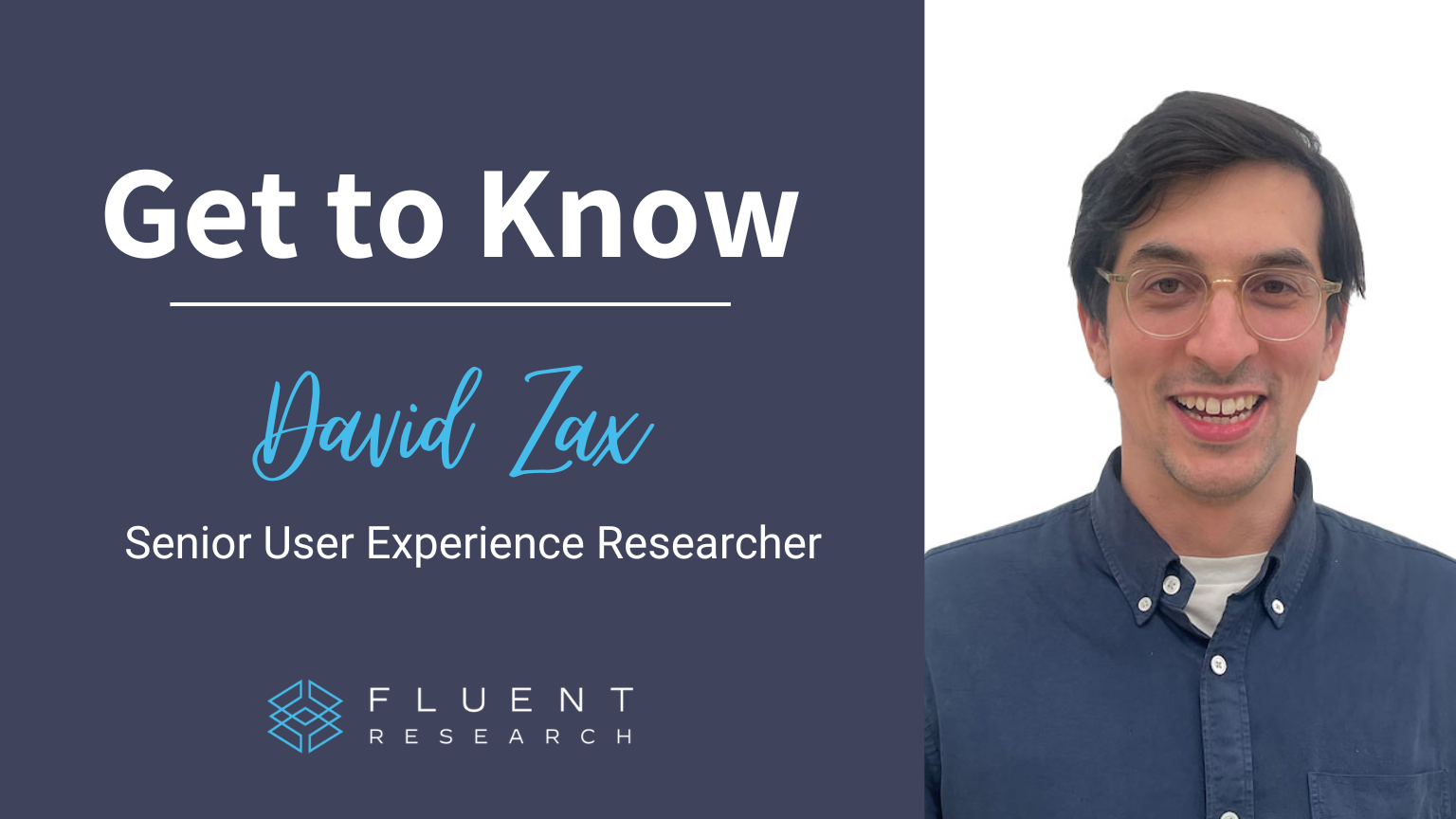
David Zax, our Senior User Experience Researcher, brings a unique mix of journalism, playwriting, and research expertise to Fluent. In this interview, he shares insights from his career, how he tackles challenges, and what excites him most about his role.

1) Tell us a bit about your career journey. What led you from a successful career in business journalism to becoming a user experience researcher?

A journalist is two things: a researcher and a writer. Actually, they are three things: a researcher, a writer, and lowly paid. About 10 years ago, I  completed a MFA in playwriting and began to identify as a different sort of writer in my creative practice. What was left over was that I had research skills and no money. That’s how I became a user experience researcher.

2) What’s a unique challenge you’ve faced in your career thus far, and how did you overcome it?

I have had some challenges. I had lectures on ethnography and statistics in my journalism school classes, for instance, and being a journalist inherently makes you practiced in interviews and lit reviews. However, I found that there can sometimes be a bit of a cultural disconnect between my approach and that of some of my colleagues and clients. I’ve overcome this by just being more aware of it, learning to “speak social science,” and taking the temperature of my client’s methodological bent before I get into research with them. I love scrappy, improvisational research (I began my UX career as an ethnographer), but if the client needs rigid uniformity to the data, I, of course, accommodate that.

3) With a diverse background in journalism and research, what skills have you brought from your career as a journalist into your work as a researcher?

I think more than anything, deep listening. My favorite thing to do in an interview, whether journalistic or research in nature, is to “probe” (in researcher parlance) or simply “ask follow-up questions” (in normal journalistic human speech). Wait, the person you spoke to just said something surprising — you felt it, your intuition says there’s something there, and now it’s time to go off-road from your discussion guide and see what you can dig up. That’s where the richest stuff — the most moving stories, the deepest insights — are mined.

4) What brings you joy outside of work?

I love to take my two dogs, Buddy and Junie, for walks in the park with my wife Shayna. I’m also a cinephile and go to see the latest auteurist film with my other movie-junkie friends.

5) What are you most excited about in your new role at Fluent Research?

I’m excited to focus on projects that increase wellness for children and families, just as I’m about to start a family of my own. I’m dying to work for Sesame Workshop and fulfill my lifelong dream of interviewing Big Bird.

6) What advice would you give to somebody just starting out their career in user research?

Try not to pigeonhole yourself in terms of methods. I thought of myself as a “qual guy,” but some of the most enjoyment I’ve gotten out of research studies in the last few years has been learning quantitative methods, and even doing a self-directed Codecademy course in Python. Don’t be scared of numbers! And ChatGPT can talk you through any methodological or spreadsheet issue you face.

Connect with David on LinkedIn!

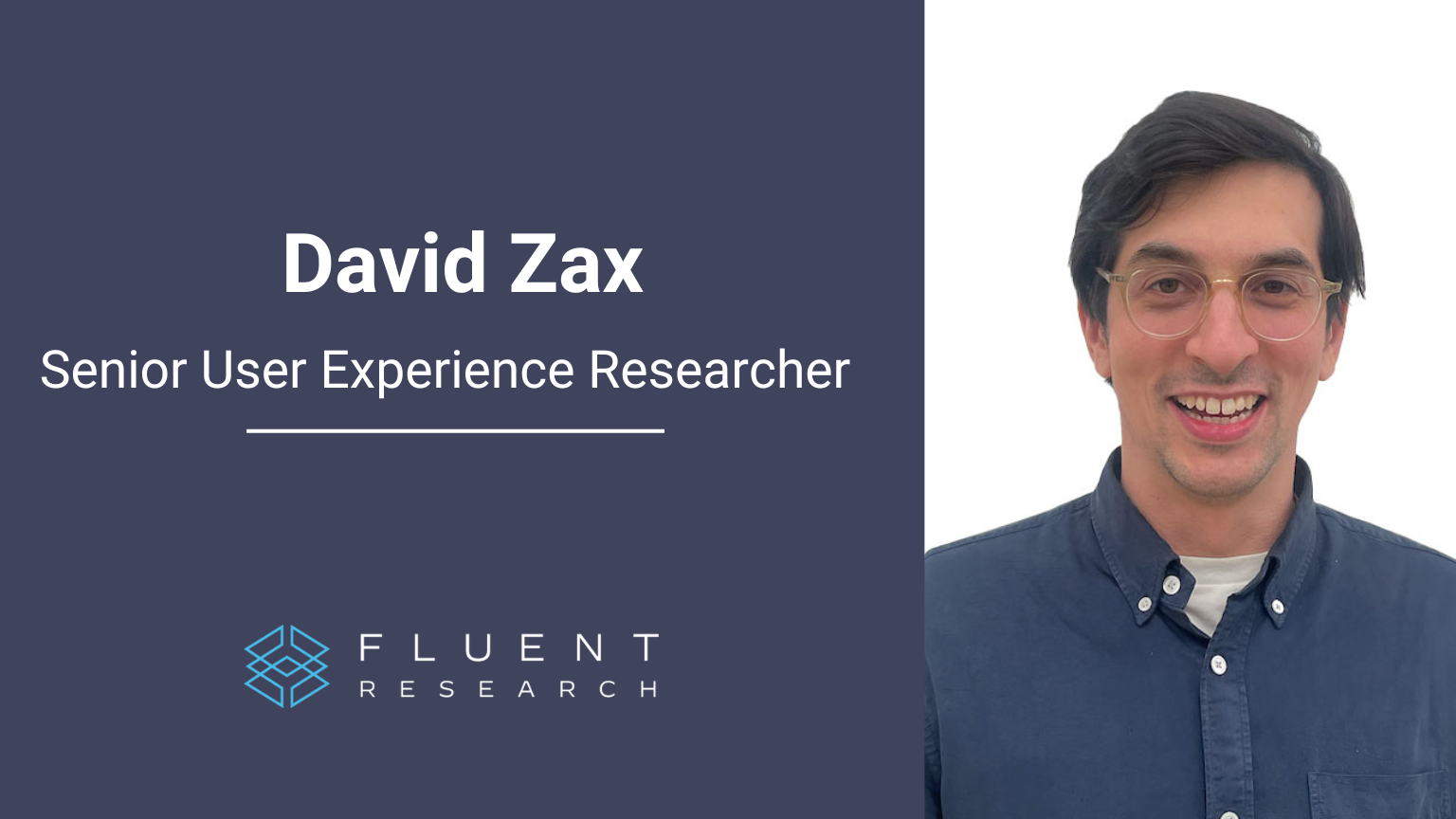
September 10, 2024 (New York, NY) –– Fluent Research, a data and insights-driven strategic consulting firm, announced today that David Zax has joined the company in the role of Senior User Experience Researcher. In his new position, David will conduct research for some of the world’s best-known brands and organizations; he will also help Fluent tell stories about the most successful of these research engagements.

“David joins Fluent after a distinguished career in both journalism and strategy consulting,” said Nellie Gregorian, Founder and President of Fluent Research. “His deep expertise in conducting empathic interviews and communicating his insights will delight both our existing clients and those we have yet to meet. We are excited to see all David can do to help Fluent Research in its mission of leveraging data and insights in order to make a positive impact on the lives of children, youth, and families.”

David has spent the last seven years working at other research agencies, conducting studies as varied as in-person ethnographic research with internet trolls (on behalf of Google) and large-scale user testing of AI chatbots (for Meta). Specializing in tech, and working on projects both strategic and tactical, his previous clients have included Airbnb, Dropbox, Intel, LinkedIn, Netflix, Twitch, and Twitter.

Before his years in research, David spent a decade as a journalist. His story on mattress marketing was named one of the best in Fast Company’s 25-year history. He has additionally contributed to The New York Times, This American Life, and other outlets. Holding a Master of Fine Arts degree from NYU in playwriting, David continues to write creatively. His plays have been produced and developed towards feature film production.

David is a graduate of Yale University and has a master’s degree in Science Journalism from Columbia University.

About Fluent Research
Fluent Research is a data and insights-driven strategic consulting firm. Since 2006 Fluent has leveraged understanding of human behavior to help the world’s best-known brands and organizations advance worthy causes, innovate transformational products, and successfully navigate change. Fluent’s work centers around three practice areas: thought leadership research, formative research and evaluation, and social impact assessment. Fluent has applied rigorous and innovative research solutions in service of promoting children’s access to and quality of education, and gender equality in the U.S. and in over 70 countries around the world.

Contact: Stefanie Cousins
[email protected]


Last month, I attended the Critical UX: Challenging the Dogma of UX event hosted by HmntyCntrd. At this virtual symposium, academics, researchers and designers from around the world gathered to examine some of the prevailing credos that have emerged in the UX field. What ensued were rich discussions that went beyond buzzwords and unpacked inclusivity, universality, and individualism in UX research and design. At the end, I walked away with a deeper understanding of how to better honor my research participants’ lived experiences.

Three points especially resonated:

The value of wholesale inclusion

It is possible for those involved in research to take a narrow view of inclusion; making it primarily about whether someone from a historically underrepresented group is included in a sample. While representation in a sample is a good step forward, what if inclusion was more than just ensuring that those from underrepresented groups were included in a research?

Panelists at Critical UX asked the audience to scrutinize whether the entirety of their research processes considers the many facets of inclusion. Particularly, they asked those in attendance to think about recruitment processes, research methodologies, and whether built solutions are serving the needs of marginalized groups included in research. Panelist Alex Haargaard mentioned how recruiting people in wheelchairs, for example, could be one part of the inclusion process, but to be more comprehensively inclusive requires more thought into different elements of participation for people in wheelchairs. In practice, this could mean examining a research facility for accessibility or ensuring that tables in a testing room are at a wheelchair friendly height. Comprehensive inclusivity may also mean consistently engaging with wheelchair users through the many different stages of the product design process, so that early prototypes, built solutions, launched products, etc. can be tested with them.

The UX researcher is positioned to advance inclusion by creating research processes that are accessible. And though it may require more effort to sustain their involvement due to systemic barriers, a UX researcher can advocate for underrepresented participants to have a consistent presence in the design process, from product inception through continuous iteration cycles. I am freshly challenged to consider how my research process, from start to finish, can better include marginalized groups.

The importance of making space for different perspectives

In data collection, it’s possible to inadvertently shut out insights from people who have idiosyncratic ways of perceiving the world. This can affect the quality of data and the way it is ultimately used. It can therefore be helpful to proactively invite participants to volunteer their unfiltered perspectives about what matters to them in their daily lives. To illustrate this, panelist Dr. Madhuri Karak recounted a community mapping project with Asian villagers. The research participants insisted on faithful delineations of their places of interest. What resulted was a multi-sensory map that tracked orangutan breeding grounds, riverside resting places, trees with springtime songbirds, and other landmarks that may have been otherwise foregone.

Thinking on Dr. Karak’s example, I could see myself having expected the Asian villagers to map street names, schools, meeting halls, and other similar places when community mapping. Such expectations would reflect my own ideas of what is noteworthy in a community, but would have been an incomplete reflection of the research participants’ ideas of what is noteworthy.

At Fluent, our exploratory research spans the globe and we regularly visit participants’ homes, schools, workplaces, and communities to see their lives in action. Within UX research, it is essential to explore how participants actually perceive the world around them and understand how technological products integrate with their daily lives. For this reason, it’s important to make sufficient space for participants to offer their own perspectives. For me, this may require loosening my expectations for how participants “should” define aspects of their own lives in favor of how they actually define their lives. This may take on even greater importance in cross-cultural settings where research participants may have different worldviews.

The necessity of UX informing decisions about scale

As engineers and designers create technologies for education, healthcare, and other institutional spaces, many of them think about getting their products into as many hands as possible. Panelists had the audience consider the upsides and downsides to scaling up a product’s distribution, and the role that UX research can play in helping make decisions about scale. While some problems can be solved by blanket solutions that serve a broad array of people, other problems may require solutions that are more tailored. Moreover, as automation and AI become a larger part of technological design, questions of human-computer interaction enter the forefront in new ways. To illustrate this, panelist Andrea Ngan raised the question of “scaling health care” with automation, and how for patients, figuring out health care needs through machine interactions may be less appealing than working with other human beings. In cases where users have strong sentiments about a product, the success of a product, no matter how good it is, can hang in the balance.

Ngan’s example sheds light on instances where UX research can contribute to organizational decisions around scale and user adoption. User research can help identify whether a more universal solution can actually meet the differentiated needs of users, or whether a more customized, small-scale approach is more appropriate. UX research can also help understand user needs and sentiments, helping to determine the appeal of a product or service and whether there might be resistance to it. This line of conversation pushes me to think about the myriad of ways user-centric research can impact product design conversations, including some of the bigger questions along the product design roadmap.

Overall, the Critical UX: The Dogmas of UX strengthened who I am as a researcher by inviting me to take a closer look at my own research processes. I am grateful to have spent an afternoon listening to UX leaders who are entertaining the big questions in earnest. Furthermore, I’m eager to put what I’ve learned into practice to better elevate the voices and stories of participants I work with at Fluent.

By Senior User Experience Researcher Farrah Brensinger