
Quantitative Research

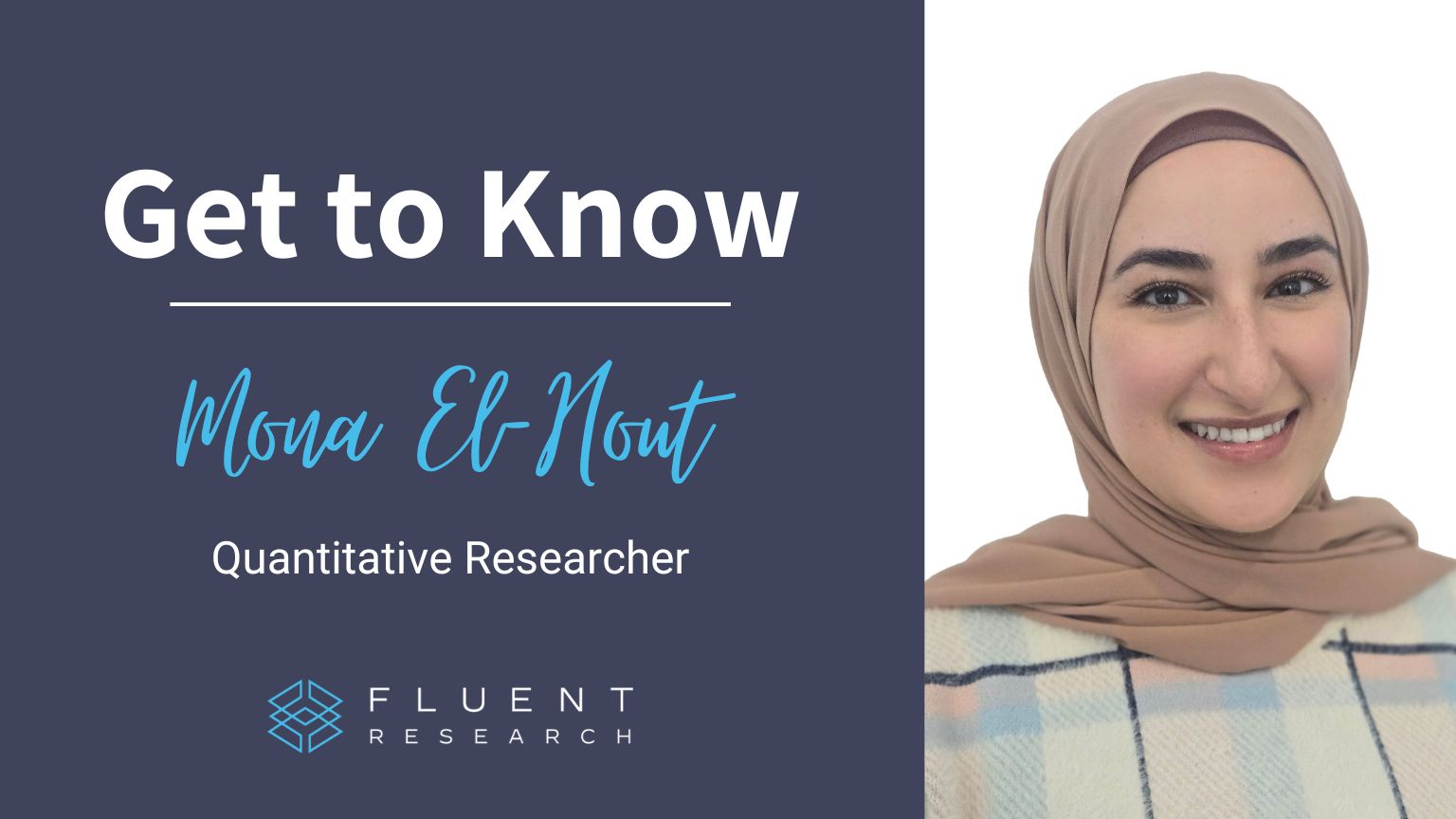
We’re so happy to have Quantitative Researcher Mona El-Hout on the Fluent team! With a diverse background in psychology, statistics, and research design, she brings a wealth of knowledge and experience. In this interview, we learn about Mona’s journey from academia to the world of quantitative research and the challenges she faced along the way.

1) Tell us a bit about your career journey. What inspired you to become a quantitative researcher? How did you navigate your path to Fluent Research?

My journey started the way most students begin their undergraduate degrees — with no clue what I wanted to do in the future. I took a wide variety of courses over the first couple of years and worked in different research labs through a work-study program. During this time I realized that the classes and research I found most engaging and interesting were all happening in the Psychology Department.

I went on to earn my M.S. in Health Psychology and my PhD in Social Psychology with the intention of one day becoming a professor. I spent two years as a Research Scientist at the University of Washington, where I conducted research on stereotypes, discrimination, and labor market outcomes. I also taught leadership and DEI courses to burgeoning engineers. As much as I enjoyed my time in that position, I realized that my skills, interests, and work-life balance desires were better suited to an industry position.

After a few months of reworking my resume, partaking in informational interviews, making connections with peers and recruiters, and putting my name out there, I landed my first industry position as a Quantitative Researcher with the Reliability User Research team at Apple. My time there was invaluable. It gave me my first taste of the world outside of academia. However, I knew that I wanted to be in a field that would allow me to experience and learn about diverse sectors and work on unique projects.

I began to seek out opportunities in market research. When I got the job alert for a Quantitative Researcher position at Fluent, I knew immediately that this was the job I had been looking for. I connected with our Founder and President Nellie Gregorian on LinkedIn after cold-applying for the position, and the rest is history. I genuinely could not be more thrilled to be one of the newest members of this incredibly intelligent, supportive, and hardworking team.

2) What’s a unique challenge you’ve faced in your career as a quantitative researcher and how did you overcome it?

There were two main challenges I had to overcome on my path to becoming a quantitative researcher. First, I had spent nearly a decade studying and working with the sole intention of one day becoming a professor. Choosing to switch gears away from academia took a lot of time, mental energy, and pros-and-cons lists. It felt like an identity crisis and a huge decision to make after what felt like a sunk-cost experience in the last decade of my life. Once I made the decision, though, I felt extremely relieved and I was able to focus on my new path forward.

What I didn’t anticipate was the next major challenge on my journey: the extremely tough job market I was entering that only got tougher as the years went by. Major layoffs were happening at massive and impressive tech companies, filling the job market with thousands of experienced individuals. Getting noticed in such a crowded market felt nearly impossible. Nevertheless, I knew that my time would come if I kept applying for jobs, making personal connections, and showcasing my skills, passion, and commitment to excellence.

3) With your extensive background in psychology, statistics, and research design, what advice do you have for those looking to pursue a career in quantitative research?

My first piece of advice is to acquire the necessary skills for a career in quantitative research. This could be through higher education courses focused on research design, methods, statistics, etc. It could also be through free or low-cost self-paced online courses, certificate programs, or even free websites and YouTube videos with tons of helpful tutorials and examples. There are a multitude of ways to learn quantitative research skills right at our fingertips. Take advantage of whatever opportunities are available to you to learn what you need to get your foot in the door.

My second piece of advice is not to give up when it starts feeling impossible and to think more broadly about companies and positions that would benefit from the skillset researchers offer. Coming out of academia, the only non-academic career path I ever heard about was UX Research, so that’s what I looked for when I began my job search. But there are so many ways to apply research skills across different industries, and a multitude of job titles other than UX Researcher that conduct impactful research and utilize the same skillset. Do your research (it’s what we’re good at, after all) and figure out what keywords to look for on your job search that will land you the career you want. Also, don’t be afraid to reach out to others for help along the way.

4) What’s your go-to hobby or activity outside of work that brings you joy?

I like to consider myself a dabbler in a lot of hobbies. I love to read or listen to audiobooks. I picked up painting during the pandemic. I used to do a lot of hiking when I lived in the Pacific Northwest. Lately, I’ve been really enjoying baking and experimenting in the kitchen. My favorite thing to do, though, is to travel with my husband, exploring new countries and cities. With the right person, even a coffee shop down the road that we have yet to try or a trip to the grocery store can be fun.

5) What are you most excited about in your new role at Fluent Research?

The work that Fluent has done and continues to do is so impactful, both to our clients and their users. A great portion of our work directly benefits families, children, and their collective wellbeing. The Fluent team is also extremely supportive of professional growth and learning opportunities, which is one of the things that attracted me to this position. It’s wonderful to be a part of a firm that cares about its clients, users, and team members. I am excited to dive into a wide variety of projects all the while learning from my talented colleagues!

Connect with Mona on LinkedIn!

Exciting news! We’re hiring for two new positions, a Senior UX Researcher and Quantitative Research Analyst!

Both positions are full-time roles located in the New York City Metropolitan Area, with some flexibility for remote work. They also offer valuable experience and exposure to the world’s best-known brands and organizations, and a competitive salary and benefits.

This is your opportunity to join our award-winning and innovative team, so if these positions sound like something you’re interested in, please explore the detailed descriptions below. Applications may be submitted via LinkedIn. We’re looking forward to receiving yours!


Senior UX Researcher:

Role Description

This is a full-time role for a Senior UX Researcher located in the New York City Metropolitan Area, with some flexibility for remote work. The Senior UX Researcher will be responsible for conducting user research, applying design thinking methodologies, and utilizing human computer interaction principles to help create innovative user experiences. We’re looking for excellent communicators who are knowledgeable about research devoted to understanding people, and curious about the relationship between technology and society. They will also need to be comfortable in a fast-moving organization, open-minded about learning new research methods, committed to high-quality and rigorous research, and focused on contributing to the growth and success of Fluent Research.

Key Responsibilities

The Senior User Experience Researcher will work with internal and external stakeholders across functions and levels to help them understand user needs at all stages of product development. The Senior User Experience Researcher will be responsible for conducting primary research such as field studies, interviews, diary studies, participatory workshops, ethnography, surveys, usability testing, and data analysis.

∙ Work with clients to define and set project specifications/objectives

∙ Design and execute end-to-end custom primary research using a wide variety of methods

∙ Prepare project proposals, including securing estimates from all parties and managing costs with suppliers

∙ Develop research instruments, including screeners and interview protocols

∙ Perform or monitor online programming and testing of research instruments

∙ Moderate focus groups, interviews, diaries, and ethnographies

∙ Conduct qualitative data analysis, generating insights that both fuel ideation and evaluate designs

∙ Write written reports and presentations of research findings, including data visualizations

∙ Communicate results and illustrate suggestions in compelling and creative ways

∙ Present research findings to clients

∙ Contribute to Fluent’s proprietary studies and thought leadership research

Qualifications

∙ Experience conducting user research and using UX research methods

∙ Strong analytical skills

∙ Experience with design thinking methodologies

∙ Knowledge of human computer interaction principles

∙ Excellent communication, collaboration, and interpersonal skills

∙ Master’s or PhD degree in Human-Computer Interaction, Cognitive Science, Statistics, Psychology, Anthropology, related field, or equivalent practical experience

∙ 4 years of experience in an applied research setting, or similar

∙ 2 years of experience conducting UX research on products, managing projects, and working either in a technology or media company or an agency specializing in UX research


Quantitative Research Analyst:

Role Description

This is a full-time role for a Quantitative Research Analyst located in the New York City Metropolitan Area, with some flexibility for remote work. The Quantitative Research Analyst will be responsible for conducting research, analyzing data, and generating quantitative insights for our clients. The role involves working closely with the research team, project managers, and clients to design and execute research studies and provide actionable recommendations based on data and insights.

Key Responsibilities

The Quantitative Research Analyst is responsible for designing and conducting public opinion and market research studies, including designing methodology and sampling plans, developing survey questionnaires, monitoring data collection and conducting quality controls, conducting statistical analysis of data, and writing reports of research findings.

∙ Work with clients to define and set project specifications/objectives

∙ Design quantitative research studies, including methodology and sampling plans

∙ Prepare project proposals, including securing estimates from all parties and managing costs with suppliers

∙ Develop survey questionnaires

∙ Perform or monitor survey programming and testing

∙ Monitor data collection, including quality controls

∙ Create cross-tabulation and data analysis plans

∙ Conduct data analysis, utilizing sophisticated statistical techniques, including factor analysis, multivariate analysis, conjoint, max/diff analysis, segmentation analysis and other methods

∙ Write written reports and presentations of research findings, including data visualizations

∙ Present research findings to clients.

Qualifications

∙ Graduate degree in statistics or social sciences (psychology, sociology, or other related field)

∙ 3-5 years of work experience at a market research firm

∙ Proven experience managing multiple responsibilities

∙ Customer service orientation

∙ Strong written and oral communication skills

∙ Ability to derive meaning from data and translate data findings into actionable recommendations for clients

∙ Proficient in statistical software (e.g., SPSS, STATA, S+) and MS Office

∙ Exhibits creativity and critical thinking

∙ Is a team player and has the ability to work in a fast-paced environment

∙ Experience in Media, Technology, or Education is a plus


When I joined Fluent as a User Experience Researcher I was most looking forward to acquiring interview moderation skills. It was crucial to me that I be well prepared to speak to participants in a way that elicited relevant insights and encouraged them to share their experiences openly. I felt nervous, of course, as I questioned my ability to conduct a successful interview that would produce informative insights.

That’s when it hit me. Moderating an interview has a lot of similarities with conducting a therapy session.

Back in my undergraduate days at Washington University in St. Louis, I was a part of a peer-counseling club. There, I took part in 100 hours of training on how to be a good listener and create an open environment for someone to share their emotions and personal experiences. As I prepared to moderate my very first interview at Fluent, I called upon the following skills that I learned as a peer counselor.

1) Keep It Simple: Whether it’s talking to a client in therapy or moderating a market research interview, it’s important that the interviewer keep their talking time to a minimum. Oftentimes, when we ask a question, we feel the need to add on or explain what we’re trying to ask to create less confusion for the interviewee. However, I have found through these conversations that adding on to a question in an attempt to create clarity, can actually lead to more confusion. Keep your questions concise. If the participant doesn’t answer your question fully, you can always follow up with a probe. This will give the participant more space to speak, with a clearer understanding of what is being asked.

2) Mirror Language and Summarize: In a therapy session, you wouldn’t want to refer to your client’s intrusive and spiraling thoughts as “anxiety” unless they used that term themselves. The same rule applies to research. When moderating an interview, it’s important that you take your participant’s lead. Using their words instead of your own allows them to tell their own story and, even more importantly, it lets them know that you’re listening.  Whenever you can, summarize the points that participants make. This type of active listening helps ensure that you are both on the same page and gives them a space to reflect on what they have just shared.

3) Leave Room for Silence: Oh, the dreaded awkward silence. We are so accustomed to filling the space when no one is talking. However, in both therapy and research, silence can be extremely valuable. In therapy, silence allows clients to sit with emotions that they may not have allowed themselves to ever feel before. In research, silence gives the participant a chance to sit with their thoughts and formulate an idea. If you as the moderator cut off the silence before the participant’s thought is fully formed, you might miss out on an informative insight. Instead of words, fill the silence with non-verbal communication such as head nodding or eye contact. This way, the participant knows you are listening and eager to hear their next thought whenever they are ready.

4) Create an Open and Judgment Free Zone: The most valuable tool for a therapist or moderator is the ability to make someone feel comfortable. In a research interview, creating an open and safe space will increase the likelihood that a participant shares their thoughts in depth, thereby producing fruitful insights. Build rapport with participants the way that a therapist would with their client. It will greatly impact both the quality of conversation and the quality of research.

The past three months at Fluent have given me the opportunity to conduct both remote and in-person interviews with parents, children, teens, and adults. Over time I have learned that no two moderators are the same. What sets Fluent apart is our willingness to leverage different moderation styles. My colleagues have encouraged me to find my own style of speaking with participants: one that feels true to myself. I have been so impressed with my colleagues’ skills at creating connections with participants in the first few minutes of an interview. At the end of the day, Fluent’s number one priority is creating open spaces for participants to feel safe and comfortable sharing their candid opinions. I know that I am in good hands here to continue improving my interviewing skills.

By Lia Abrams

As August ends and autumn approaches, companies, and schools across the country are preparing for a return to business as usual.

Now two years out from the initial disruption of the pandemic, many workplaces are seeing a return to “pre-pandemic” routines like mandated in-person work and school programs. With a slow return to life as we used to know it, combined with a significant drop in national unemployment and an employee-friendly hiring market, it seems like a promising time to be a young professional beginning a career in research.

Equally promising is the wave of recent interest and growth in UX research. Life in quarantine spurred innovation in tech and media design that opened new possibilities of inquiry and investigation for UX research. With the research market evolving rapidly, it is worth considering – what makes a good researcher? And how can young researchers pursue a career in UX research?

Each research team may be looking for something a little different, and there are countless different ways to pursue a career in research. But whether you are interested in statistical analytics or immersive ethnography, these four tips may help you hone your targets in the job hunt.

1. Identify your skills

Whether a researcher has a background in humanities, social sciences, or STEM, all researchers possess a unique set of skills and a wealth of knowledge that they will contribute to a research team. Consider what sets of knowledge you have acquired throughout your academic and professional career. Everything you have experienced, whether it was an intensive graduate program, unpaid internship, part-time job, or one-off volunteer opportunity, has given you a unique perspective that you can leverage and apply to your research process. Do not sell yourself short for having a resume that may not match those around you – all experience is good experience, even those that may seem like they aren’t directly relevant to your field.

The emotional intelligence and consumer familiarity acquired from working years in customer service can be just as useful in a research setting as academic expertise acquired in a Ph.D. program. The best researchers know how to recognize value and insight from the everyday life experiences of not just others, but themselves as well.

2. Identify your passions.

Pursuing a career in research means you are pursuing a career in endless exploration. Every economic sector, nonprofit, and government branch needs research to function and grow. When considering a career in research, remember that the opportunities for research are endless – so you should make sure you apply for jobs in an area that truly speaks to you and your passion. Identify what social issues, industry sectors, or creative interests are most important to you. Chances are, there’s a company within that sector that needs research.

3. Identify your potential for growth.

Career building is an ongoing, dynamic process with many small decisions along the way that contribute to what will become your overall lived experience. When looking for a career in research, ask yourself in what ways you would like to grow. Do you want to work alongside designers to create and perfect ideas at one particular company? Or do you want to be on the research vendor side, leading many different projects across a variety of industries? The research positions you seek out should not just reflect your interests, but also offer an opportunity for your growth as a researcher. The types of routines, co-workers, and topics that stimulate you the most may be indicative of what industries and work settings would be the best fit. Be curious, and reach out to industry professionals who could offer insight. Considering how you think you may contribute to a team and the ways in which you could grow within it is essential.

4. Market yourself!

You may have noticed the last three steps were all about reflection. While you may not need to know exactly what you want to do in research, you do need to have a deep understanding of yourself and who you are. Hiring is a two-way experience – employees and employers need to have a significant understanding of who they are and their potential contribution to the other. In pushing yourself to identify who you are and what you bring to the table, you are practicing articulating those qualities. Self-expression is half the battle in job hunting, so be vocal! Share what makes you unique as a researcher, what research philosophies speak to you the most, and why you see value in gathering and sharing knowledge.

As the research industry blossoms alongside a recovering economy, know that the possibilities for growth as a researcher have never been more expansive and exciting. In using these tips to reflect and grow, we hope that your journey in research remains expansive and exciting as well.

By Charlotte Beatty.

Charlotte Beatty is a User Experience Researcher at Fluent, where she specializes in qualitative research design, implementation, and analysis.

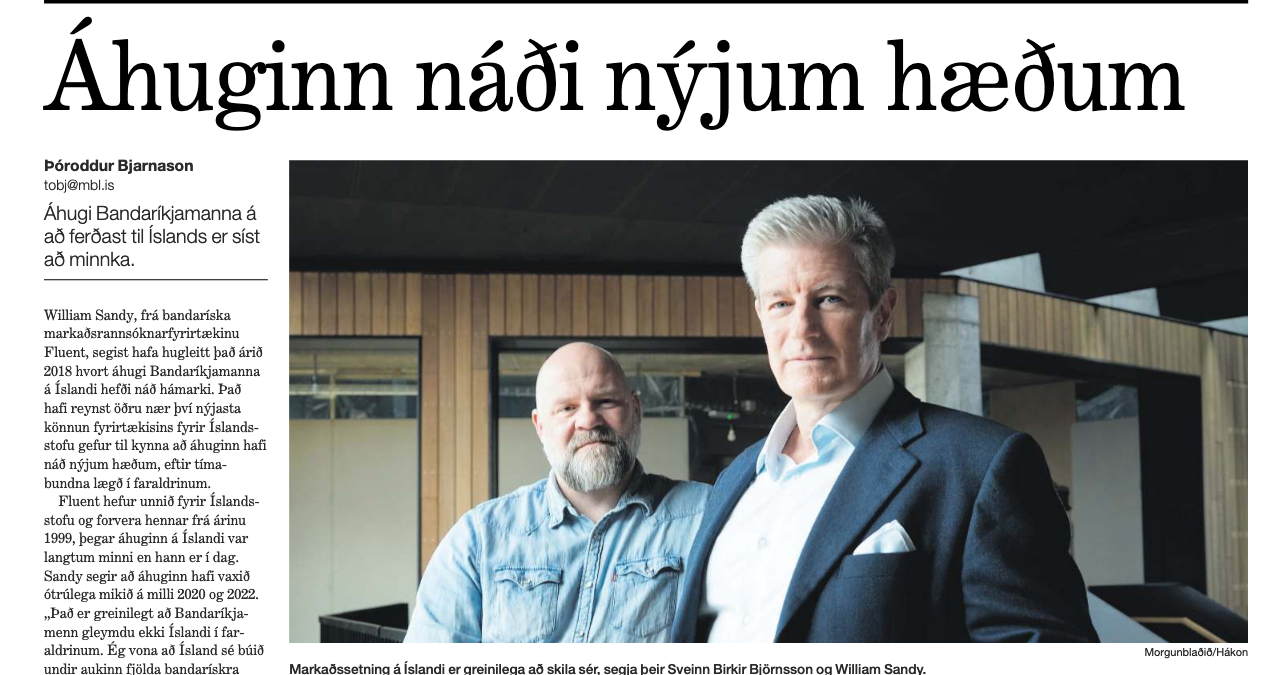
Have you been thinking about traveling to Iceland? If the answer is yes, you are not alone. Fluent Research’s 2022 survey among 1,000+ US consumers ages 18-70 shows a dramatic revival of interest in Iceland and Icelandic products since we last conducted the survey in 2020. In fact, 52% of respondents say they are highly likely to travel to Iceland for pleasure. The previous survey, conducted in 2020 amid the COVID-19 pandemic and associated lockdowns and layoffs, saw a softening of such interest, when only 39% expressed a desire for travel to Iceland. The relaxation of pandemic mandates and re-opening of cities and international borders has brought a vigorous rebound in interest.

All things associated with Iceland seem to be benefiting from the widening appeal of Iceland as a destination. According to Fluent’s Executive Director William Sandy, who was interviewed last month for an article about the survey results in The Morning News, an Icelandic newspaper, “American consumers expressed record levels of interest in travel to Iceland, and interest in stop-over travel to Iceland. The upward trend in awareness and interest in Iceland and Icelandic products that we have witnessed since 1999 has resumed and even accelerated. Marketing in Iceland is clearly paying off.”

Fluent Research has been tracking consumer attitudes towards travel to Iceland and Icelandic products in the U.S. on behalf of the Icelandic trade and tourism association, which promotes tourism, products, and culture of Iceland, since 1999. To see our last case study on our work with Iceland Naturally, click here.

We’re excited to welcome two new team members to Fluent Research. Amber Gonzalez is a Quantitative Researcher and Charlotte Beatty is a User Experience Researcher.

Prior to joining Fluent, Amber worked at EDC’s Center for Children and Technology as a field researcher and at NYU School of Medicine’s Student Health Service, where she leveraged data-driven insights to expand mental health services for medical students.

Charlotte recently graduated from Boston University, where she studied the anthropology of health and medicine. For her undergraduate academic research, Charlotte designed and conducted an investigation into aspirations for marriage and family among Gen Z young adults. Check out Amber and Charlotte’s full bios on our website.

May 18, 2022 (New York, NY) – Fluent Research, a data and insights-driven strategic consulting firm, announced today that Mary Meyn has joined the company in the role of Director, Research. In her new position, Mary will manage public opinion and market research studies for some of the world’s best-known brands and organizations.

“Mary joins Fluent after a distinguished career in political polling, public opinion and market research,” said Nellie Gregorian, Founder and President of Fluent Research. “Mary’s outstanding analytical skills and her deep commitment to the professional standards of public opinion research will further improve the caliber of our work. We could not be more thrilled for Mary to join Fluent Research and help us advance our mission of leveraging data and insights in service of making a positive impact on the lives of children, youth, and families.”

Prior to Fluent, Mary was Vice President at Edison Research, where she spent 16 years supporting the national Election Day exit polls, providing critical and time-sensitive data about who Americans voted for and what issues were important to voters. Mary has also worked with major companies in media and policy, including AMC Theatres, The Brookings Institution, ESPN, NPR, Marketplace, and Univision, among many others.

Mary has been an active member of the American Association of Public Opinion Researchers (AAPOR) community, serving for many years on the Executive Council of the Pennsylvania/New Jersey chapter, including serving as President in 2019.

Mary is a graduate of Binghamton University and has a master’s degree in Politics and Public Affairs from the Edward J. Bloustein School of Planning and Public Policy at Rutgers University.

About Fluent Research
Fluent Research is a data and insights-driven strategic consulting firm. Since 2006 Fluent has leveraged understanding of human behavior to help the world’s best-known brands and organizations advance worthy causes, innovate transformational products, and successfully navigate change. Fluent’s work centers around three practice areas: thought leadership research, formative research and evaluation, and social impact assessment. Fluent has applied rigorous and innovative research solutions in service of promoting children’s access to and quality of education, and gender equality in the U.S. and in over 70 countries around the world. Fluent’s creative arm, Fluent Productions, is an award-winning producer of original documentary content that harnesses the power of visual storytelling to bring attention to important issues facing our society, to build empathy and inspire action.

Contact: Stefanie Cousins
[email protected]