

Youth Development Tag

“Don’t believe the hype.”
—Public Enemy

“Reading the world always precedes reading the word.”
—Paulo Freire

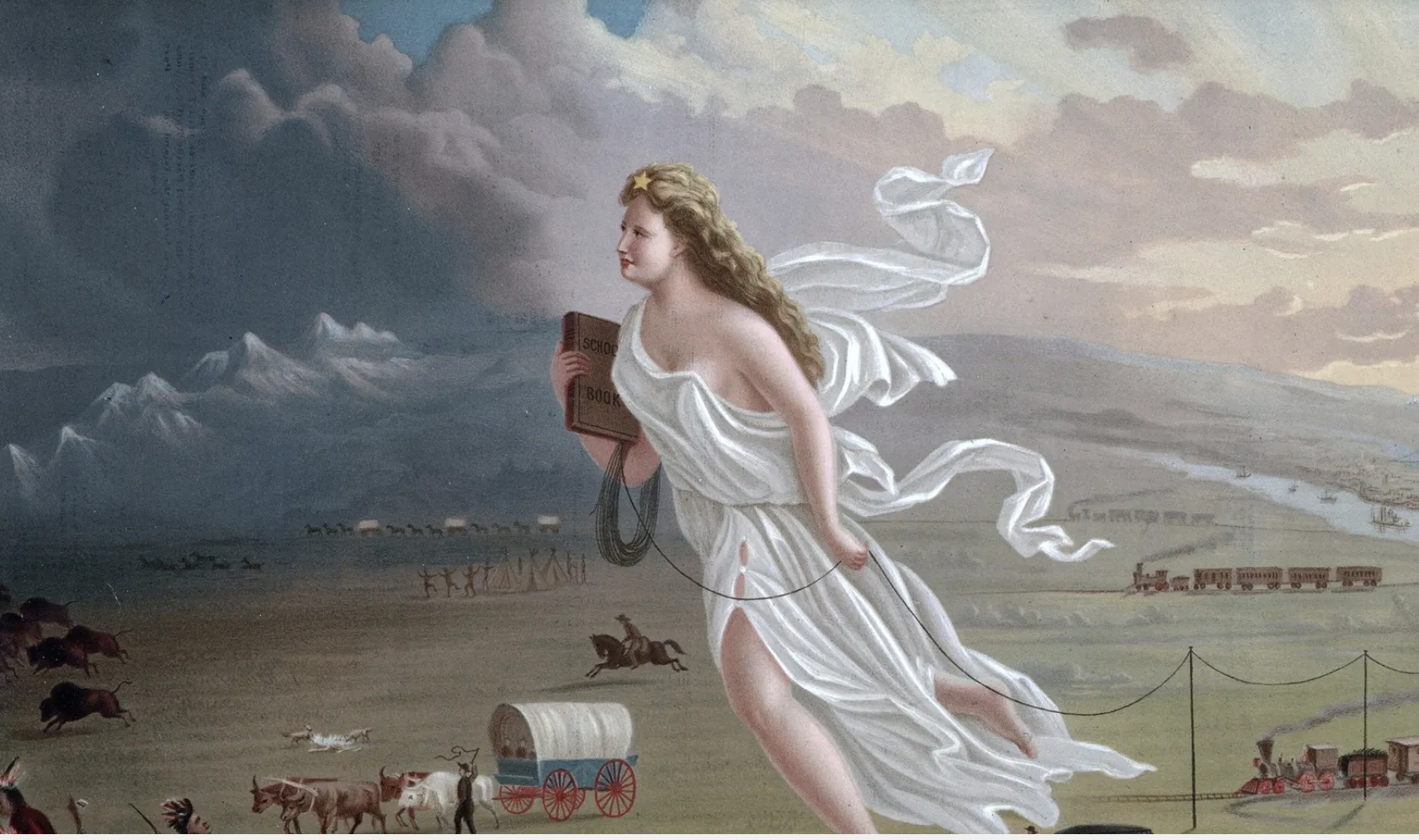
I remember seeing a painting in social studies class of a woman floating westward across the continent, glowing in white, carrying a book. Behind her were farms, ships, railroads, towns and light. Before her were Native people, buffalo, wild animals and darkness, all being pushed toward the edge of the frame. This was John Gast’s “American Progress.” What I didn’t know until recently was that the woman was Columbia, the female personification of the United States, and that she was carrying a telegraph wire in one hand and a book in the other. I assumed the book was the Bible. Upon closer inspection, it says “Schoolbook.” I was intrigued.

The message was now clear to me: Civilization is arriving. Communication is arriving. Schooling is arriving.

Educational historians like Joel Spring have noted that nineteenth-century schooling was not only a benign push for literacy. It was also a policy of denationalization, using schools to dismantle a people’s language, history and sovereignty and replace them with Anglo-American norms. For me, the schoolbook may be the most revealing object in the painting because it exposes the arrogance at the center of the image. Columbia is not simply bringing education. She is bringing a premade idea of Schooling: formal, institutional, book-based and settler-defined. The painting asks us to see that book as progress. It also asks us to ignore the forms of knowledge already present in the darkness.

The people living there were not uneducated. They were educated differently. Developmental psychologist Darcia Narvaez has argued that Indigenous worldviews begin from a radically different premise than the dominant Western one: human beings are not separate from nature, but nested within a living web of relationships, responsibilities and reciprocal obligations. That kind of education was carried through language, story, ceremony, observation, memory, practice and relationship. Children learned how to read weather, follow animals, understand plants, prepare food, honor kinship, recognize danger, share responsibility and live within the limits of a place. Education was not separate from life. It was how life continued.

Columbia’s schoolbook, then, does not simply symbolize learning. It symbolizes the dismissal of culture.

That dismissal matters because settlers moving west were entering environments many of them did not understand. A book from the East (U.S.) could teach reading, arithmetic, scripture, citizenship and national identity. But it could not, by itself, teach the daily work of making life possible in a new landscape. The knowledge most urgently needed in those places was often place-based, practical, ecological and communal. Much of it was already held by the people being displaced.

People have always migrated, traded, borrowed, taught, married, adapted and learned from one another. There were surely things settlers knew that could have been useful to Native communities, just as there were countless things Native communities knew that settlers urgently needed to understand.

That is the ordinary and humane version of cultural exchange: people meeting one another with curiosity, humility and practical need. That is dialogue.

But that is not what “American Progress” shows. The painting does not imply mutual learning. It moves in only one direction. Columbia does not arrive as a neighbor. She arrives as a teacher. She does not ask what is already known. She assumes need and want.

That is the real failure of Columbia’s schoolbook: she brought education without listening. Settlement without humility becomes possession. Education without listening becomes conquest.

That pattern has not disappeared. It has only changed direction. Today, the imposition is from well-resourced (and well-intentioned) “American-dream groups” to under-resourced communities. Adults, institutions, philanthropies and policymakers arrive with their own schoolbooks: everyone should go to college, every child needs a laptop, every school needs the same pathway to success, every community needs the same innovation.

Some of these ideas are useful. College can open doors. Technology can expand access. Credentials can matter. But when these solutions arrive already written, they can repeat Columbia’s mistake. They assume the problem is absence: absence of aspiration, absence of knowledge, absence of tools, absence of culture. They do not always begin by asking what is known and what is meaningful.

The geography has changed, but the posture can remain the same. What I see resulting from this are “successful” young people who have learned how to succeed inside school rather than how to live well outside it. They may know how to perform the rituals and routines of a stranger’s vision, yet feel disconnected from their bodies, communities, environments and practical responsibilities.

Environmental educator David Orr famously argued that the planet does not need more “successful” people in the narrow institutional sense; it needs people who know how to inhabit a place well. Modern education often separates knowledge from place and people. It teaches students to master symbols while losing fluency in the living systems that sustain them.

A different book may have been better. Or perhaps it would not have been a book at all. It might have been a seasonal calendar, a bundle of stories, a set of tools, a map drawn by those already there, a packet of seeds, an empty notebook. It might have taught reading and writing, but also tending, repairing, growing, observing, sharing and belonging.

Columbia’s mistake was that she brought a book already written. She should have brought an empty one — and learned how much was already known.

Oh, I should probably acknowledge that there are no hip-hop references here. Sorry.

***

By Dan Warren, Director, Youth Development & Education, Fluent Research

This article was originally published in Youth Today on July 16, 2026 as part of the series Dan writes called Pass the mic: Where hip-hop meets human development. Each month, he brings scholars and rappers into dialogue to spark new ways of seeing youth, culture and change.

Previous pieces in the Pass the MIc series:

“Styles upon styles upon styles is what I have.”
—Beastie Boys

“People believe they have learning styles, and they try to think in their preferred style, but doing so doesn’t help them think.”
—Daniel Willingham

My music app thinks it knows me. Most days it does.

I went on a streak of listening to 1970s and early 1980s New York rap a month ago. Must have listened to Funky 4+1’s “That’s the Joint” fifty times over the course of a week, and my algorithm noticed.

At first, that feels good. The algorithm gets me. It recognized my taste and responded to feed me some more tasty stuff with similar flavors. But after a while, the recommendations can feel less like discovery and more like confinement. It keeps giving me the same music, when what I liked was bigger than the songs themselves.

Maybe I wasn’t only drawn to “old-school NY rap.” Maybe I was drawn to the party atmosphere, the call-and-response, the group vocals, the dance-floor pulse, the funk and disco underneath it. A smarter algorithm might hear those deeper qualities and move outward: go-go, house, electro, club rap or later records that sampled and reimagined that early energy (e.g., the Beastie Boys’ Paul’s Boutique).

The problem is not that the algorithm knows I like Funky 4+1. The problem is that it may not know why.

That, in my opinion, is also the problem with learning styles.

For years, there has been a strongly held popular belief that people (especially young people) have a specific way they learn best: visual, auditory, kinesthetic or some other style. Throughout my frequent conversations with teachers, I hear this distinction frequently about the students they teach and an inevitable declaration about their own learning style. The idea comes from a good place. It sounds respectful. It tells young people, especially those who have struggled in school, “You are not bad at learning. You just learn differently.”

While it stems from a generous and well-meaning instinct, the popular focus on fixed learning styles can be more restrictive than helpful.

Educators and youth workers should notice a difference. But Daniel Willingham, a cognitive psychologist at the University of Virginia, is one of the leading researchers challenging the claim behind learning styles that students learn better when instruction is matched to a fixed personal style.

Willingham reinforces the point that students are not all the same. He echoes the feeling that preferences are real and powerful. But he is also saying that preference is not destiny. The best way to teach something depends less on a learner’s label and more on the content, the task, prior knowledge, attention, practice and what the student is asked to think about.

A map may help with geography because geography is spatial. Hearing pronunciation matters when learning a language. Physical practice matters in dance or sports. But none of that should compel us to believe that a person is permanently one kind of learner. It only proves that good teaching matches the strategy to the material.

Learning styles become dangerous when they start to operate like a shallow algorithm.

A student says: “I like seeing things that I am learning about.”

The system responds: “You are a visual learner! We will give you visuals.”

The student concludes: “I am a visual learner.”

The system narrows further: “Then we will avoid methods that do not match your style.”

Then the student begins to wield the label too: “Yes, I will also avoid methods that do not match my style.”

This is where the label becomes more than a description. It becomes a form of agency. The young person now has language to explain discomfort, defend preference and opt out of unfamiliar learning situations. That may feel empowering at first, but over time it can shrink the learner’s range. Reading feels foreign. Lecture feels impossible. Discussion feels inefficient. Writing feels like punishment. Practice feels boring.

What began as recognition becomes restriction.

The better response is not to ignore preference. Preference matters. If a young person says they like visuals, we should listen. But then we should ask what is underneath that preference. Do they need structure? Examples? Pattern? A model before they try?

Those are different needs. They call for different supports. Calling all of them “visual learning” may be as crude as calling Funky 4+1 only “old-school rap.” It is accurate enough to feel useful and crude enough to become harmful.

Although such simple labels are lovely in their own way, youth work should be more expansive than that. When a young person tells us what feels comfortable, we can treat that as a doorway, not a diagnosis. We can begin where they are, but we should not leave them there.

The goal is not learning style. The goal is learning range. It is dynamic.

A good youth-serving professional, like a good DJ, widens the mix. They invite young people to talk, read, move, build, listen, perform, revise, reflect and try again. They honor and celebrate what youth prefer while helping them discover what else they can do.

People are not visual learners, auditory learners or kinesthetic learners. They are learners.

Our job is not to build a smaller playlist around their preferences. It is to hear the deeper pattern, widen the mix and help them discover capacities they did not know they had.

And if we didn’t know that before — well, now we do.

***

By Dan Warren, Director, Youth Development & Education, Fluent Research

This article was originally published in Youth Today on July 16, 2026 as part of the series Dan writes called Pass the mic:Where hip-hop meets human development. Each month, he brings scholars and rappers into dialogue to spark new ways of seeing youth, culture and change.

Previous pieces in the Pass the MIc series:

“When it’s real, you’re doing this even without a record contract.”
— Nas

“Sparks — when illuminated and nurtured — give young people joy, energy and direction.”
— Peter Benson

When I was in graduate school, I taped to the wall in my office an image of Nas (from a Rolling Stone illustration) along with the lyric above. To some degree, it mocked me. I often felt that the only reason I chained myself to that desk was for the letters that would follow my name when I was done. Anyone who has gone through doctoral training can probably attest to that kind of crisis, and Nas got a front row seat to mine. I still cannot fully explain why I went through that process, but I am pretty sure it was not because of a deep love of learning. I snowboarded, played hockey, worked in my garden and played music because of the joy I felt while doing them, not because I expected recognition or reward. Graduate school felt different, and Nas and I knew it.

What makes that line resonate with me is partly what it meant and partly that Nas said it to open Illmatic, his critically acclaimed debut studio album, released in 1994, which is widely regarded as one of the greatest hip-hop albums of all time. It stays with me because it offers a definition of realness that has very little to do with recognition. It points instead to a kind of commitment that exists before validation arrives. The contract comes later. The applause comes later. The proof comes later. What comes first is the relationship between a person and the thing they feel called to do. It involves passion and faith.

That raises an important question for those of us who care about young people:

Are we helping them develop a genuine relationship with the process of doing something, or are we surrounding them with environments that teach them to care mostly about the outcome?

Nas is a useful example because his story makes that distinction visible. Before the acclaim, before Illmatic, before the industry confirmed his value, there was a young person in Queens who had already found something that mattered to him. Hip-hop was not initially a product or a career path. It was a place to put his mind, his observations, his hunger and his craft. The record contract formalized something that already had life. It did not create the life itself.

Peter Benson had a beautiful word for this kind of energy: sparks. He used it to describe the talents, interests and passions that give young people a sense of direction and aliveness. A spark is more than competence. A person may be skilled at many things and feel deeply connected to only one or two of them. I was a much better student than a gardener. A spark has heat. It draws a person back. It makes effort feel worthwhile.

That question applies as much to school as it does to youth programs. Schools often speak the language of curiosity and growth, yet students quickly learn that much of the system revolves around grades, ranking, compliance, deadlines and visible achievement. Youth programs can fall into a similar pattern through leadership outcomes, portfolios, showcases and other measurable indicators of growth. None of those things are unimportant.

The problem begins when the structure surrounding the activity becomes so dominant that the activity itself loses its inner pull.

Edward Deci and Richard Ryan’s Self-Determination Theory helps explain why some environments nourish motivation while others thin it out. They argue that people are more likely to stay deeply engaged when three conditions are present: autonomy, competence and relatedness. Young people need room to exercise ownership. They need the experience of becoming more capable. They also need to feel connected to other people and to some larger sense of meaning.

William Damon’s work on purpose shows what can happen when a spark survives long enough to mature. Purpose is not a passing interest. It is a stable and meaningful commitment that matters to the self and also reaches beyond the self. A spark begins as energy. Intrinsic motivation sustains that energy over time. Purpose gives it direction and weight.

Seen through that lens, Nas’s line captures the beginning of a developmental arc. If it is real, you are doing it before anyone confirms that it is worthwhile. You are still there when the work is repetitive, when no one is watching and when the result is uncertain. That is what makes the contract meaningful in the first place.

For schools and youth programs, the practical implication is clear. We should care about outcomes, but we should also pay attention to the quality of a young person’s engagement along the way. We should ask whether they are becoming more curious, more self-directed, more absorbed and more connected to what they are doing.

This feels especially urgent in a culture that constantly invites people to bypass process. The deeper concern, though, is older than any current tool. When process loses its meaning, passion begins to thin out. When passion thins out, purpose becomes harder to form.

The task, then, is helping young people stay lit from within. It is to notice the early spark, to build schools and programs that support intrinsic motivation and to respect the long, uneven process through which a real interest becomes a real calling.

Nas was right. If it is real, you are doing it anyway.

And if we didn’t know that before — well, now we do.

***

By Dan Warren, Director, Youth Development & Education, Fluent Research

This article was originally published in Youth Today on May 21, 2026 as part of the series Dan writes called Pass the mic:Where hip-hop meets human development. Each month, he brings scholars and rappers into dialogue to spark new ways of seeing youth, culture and change.

Previous pieces in the Pass the MIc series:

By Dan Warren, PhD


“If you don’t know, now you know.”
-The Notorious B.I.G.


“Witness the American ideal: The Self‑Made Man. But there is no such person … If, as adults, we can lay claim to competence and compassion, it only means that other human beings have been willing and enabled to commit their competence and compassion to us …”
-The Urie Bronfenbrenner P.H.D.


I doubt Urie Bronfenbrenner ever listened to Biggie Smalls. But if he had, I imagine he would have nodded along — not just to the rhythm, but to the deeper truths hidden in Biggie’s stories. Biggie’s lyrics painted a vivid picture of complexity — family struggles, neighborhood pressures, and the larger systemic forces shaping his life and community. Similarly, Bronfenbrenner, a renowned developmental psychologist, created a framework to help us understand how young people grow and thrive within layered, interconnected environments.


Unfortunately, when many of us design experiences or create policies for young people, we tend to overlook this complexity. Instead, we often rely on broad generational labels, such as “Gen Z,” to describe large groups of youth. While this practice may seem harmless and convenient, it actually limits our understanding of young people’s true needs and can inadvertently create barriers rather than meaningful engagement.


Both Bronfenbrenner’s research and Biggie’s storytelling remind us of an essential truth: real understanding requires looking deeper.

The Limits of Generational Labels

Today, much of our talk about young people is framed in generational terms. Marketers, educators and even policymakers rely on shorthand like “Gen Z” or “Gen Alpha.” These categories offer an easy way to describe broad groups of youth who came of age in a shared historical moment.


To be fair, this framing does capture something important: it acknowledges the power of the influence of time and history on development or, as Bronfenbrenner put it, the chronosystem. It reminds us that kids who grew up with smartphones or social media inhabit a different world than kids who didn’t.


But the concern is that generational labels stop there. They collapse all the developmental phases within that generation into one big block. A 12-year-old navigating the first steps of adolescence and a 22-year-old entering the workforce may both be “Gen Z,” but their developmental needs, capabilities, and vulnerabilities couldn’t be more different. Relying only on generational categories risks oversimplifying, stereotyping and overlooking the specific supports young people need at each stage.

Bronfenbrenner’s Lens: Seeing the Layers

Bronfenbrenner’s ecological systems theory provides a clearer and more nuanced view. He explains that multiple, interconnected layers of influence shape a child’s development:


• Microsystem: Immediate environments, such as family, school or peers. (Think about Biggie’s mother, his close friends in Brooklyn.)

• Mesosystem: Interactions between different microsystems, like the relationship between home life and school experiences. (Biggie struggled with conflicting expectations at school versus the streets.)

• Exosystem: Broader influences like community resources, local economics or media portrayals. (Biggie was deeply influenced by neighborhood conditions and systemic economic pressures.)

• Macrosystem: Societal and cultural beliefs, norms and structures such as racism or expectations about success. (Biggie often criticized these larger societal forces in his music.)

• Chronosystem: The ways experiences and environments change over time. (Biggie’s narratives shifted from youthful experiences toward reflections on adulthood.)


This layered approach makes clear why it’s not enough to say “Gen Z is like this.” The historical context matters, yes, but it intersects with family life, community resources, cultural expectations and developmental stage. Bronfenbrenner shows us how these forces work together in real young people’s lives.

Youth Programs Through Different Eyes

Consider an afterschool program serving young people from middle school through early adulthood.


• Generational thinking: Program leaders might say, “Gen Z loves tech,” and fill the program with tablets, apps and social media tie-ins. This captures the chronosystem, the reality that today’s youth are digital natives, but it doesn’t account for age-specific needs.

• Developmental thinking: Leaders would design different experiences for different age groups. Younger adolescents might get structured activities that support peer relationships and safe identity exploration. Older youth might be given leadership roles, career mentoring or opportunities to use tech for advocacy and creativity.

• Integrated thinking: The strongest programs do both. They recognize the generational context (digital fluency, cultural touchpoints), but they tailor how that reality is engaged depending on the developmental stage. Tech might be used for collaborative digital storytelling with middle schoolers, while for older youth it might support internships, skill-building or college preparation.


This layered approach acknowledges the broad cultural moment while honoring the developmental realities of different ages. The result: programs that are not only relevant, but also developmentally supportive and ethically responsible.

Seeing Clearly Together

Biggie understood something profound: real life isn’t simple. It’s shaped by layers of relationships, environments and systems. Bronfenbrenner shared this understanding, giving us a powerful lens to see beyond surface-level assumptions.


If we genuinely care about creating meaningful, supportive experiences for youth, we must move beyond labels and into deeper understanding. Let’s commit to designing, teaching and leading with an awareness of the developmental realities that define young people’s lives.


In other words, let’s learn to see youth as clearly as Biggie and Bronfenbrenner did.

And if we didn’t know before — well, now we do.


Dan Warren is Director, Youth Development & Education.

This article was originally published in Youth Today, on September 2, 2025.


Digital contexts are becoming more prevalent in children’s lives than ever before, fueled in part by the COVID-19 pandemic and the need to move various aspects of children’s lives online*. Since human development is a holistic and dynamic process between the developing person and his or her context* and children develop in positive and healthy ways when their strengths are combined with the strengths of their contexts, we have an opportunity as researchers to bring this framework to the changing landscape of children’s lives.

What has become apparent in our company’s recent requests for proposals, is that there is a lack of fit between the knowledge and experience of many designers and the developmental needs and abilities of children. This lack of fit signals a fundamental problem, and an opportunity, given the growing presence of digital technology as a context for children’s development. The virtual world is a new frontier and there has been a land rush of companies looking to stake their claim flag.  This rapid growth has seemed to create holes in the capabilities of these frontier companies. More precisely, the talent needed to design for adults does not adequately translate to designing for kids. In the absence of comprehensive knowledge about child development, current designers may err in using themselves or those close to them as the markers of success and/or “normality”.

“We all have a blind spot and it’s shaped exactly like us.” – Junto Diaz, Author

Short of extensive training in child development, designers can utilize a few central rules of thumb when designing for kids. Keeping these in mind will go a long way to minimizing, or at least acknowledging, our biases:

1) All humans are whole. Sometimes by necessity, we need to zoom in and focus on a specific part of children’s development, such as their literacy level or their ability to swipe on a tablet. But it is important to understand those parts within the context of the whole developing person. We then need to further adjust our lens to view that person as situated within a dynamic relationship with his or her context.

2) There is no ‘typical’ child. Much of what we know and have studied about children is approximations that are gathered from information that has been averaged over large groups from mostly Westernized societies. Expectations about children should be considered approximations that can get you close to understanding.

3) All households are different. A common mistake is to view children’s development as unfolding in a vacuum. Rules and expectations differ greatly by household and are driven by cultural, situational, and practical factors. Just because a child is developmentally capable of something does not mean that they will do it.

4) Child development is less linear than it appears. Because development is an iterative process, there are often regressions that ebb and flow with progressions. Development of a skill or competency may occur steadily over time or rapidly in spurts. While many abilities get better over time, it is not always the case.  Some abilities, like attention span increase gradually over time during childhood while other capacities, like learning a new language, decrease over time. Other aspects of development, like identity development, are latent during younger years and then rapidly develop.

If there is one mantra that we could recommend to all designers and those thinking about how to best support kids, we would strongly offer this:

“Every [child] is like all other [children], some other [children], and no other [child].” – Kluckhohn & Murray, Anthropologist & Psychologist

By Dan and Amy Warren.

==========

1*Responsible Innovation in Technology for Children. UNICEF Office of Research – Innocenti, Florence, 2022.

*Lerner, R. M., Lerner, J. V., Almerigi, J., Theokas, C., Phelps, E., Gestsdóttir, S. Naudeau, S., Jelicic, H., Alberts, A. E., Ma, L., Smith, L. M., Bobek, D. L., Richman-Raphael, D., Simpson, I., Christiansen, E. D., & von Eye, A. (2005). Positive youth development, participation in community youth development programs, and community contributions of fifth-grade adolescents: Findings from the first wave of the 4-H Study of Positive Youth Development. Journal of Early Adolescence, 25(1), 17-71.


Here at Fluent Research, we find ourselves interacting with kids nearly all year around. We interview them about playtime and class time, film them at home and at school, play games with them, and even watch videos alongside them. We talk to kids a lot for the research we conduct on behalf of our clients!

Some researchers may be intimidated by talking to children. It’s understandable. We were young people too once, but we might not remember what it’s like to be 4, 6, or 8 years old. Well, fear no more! Our Director of Youth Development and Education Dan Warren put together the above video to help you get through your next interaction with a small human and have fun at the same time!

If you would like to download the slide show, click here.


In late October, Mark Zuckerberg announced the naming of his umbrella company, Meta. The name was specifically chosen to closely identify the premier force that is shaping the metaverse. Facebook describes the metaverse as “a set of virtual spaces where you can create and explore with other people who aren’t in the same physical space as you. You’ll be able to hang out with friends, work, play, learn, shop, create and more. It’s not necessarily about spending more time online — it’s about making the time you do spend online more meaningful.”

Comments and editorials have been and will be flooding news outlets, social media, and conversations around the remaining water coolers. Early reactions have focused on the companies facilitating this change rather than the potential that this evolution may unlock for society’s greatest challenges. It would be naïve to think that the emergence, development, and cultivation of the metaverse has been or will be rooted in altruism and concern for the public “good.” Judge it as you may, my point is not to persuade you to think this is a “good” or “bad” thing, rather I aim, as a researcher does, to think about the ways that the metaverse will create impact and change and explore the lever by which it does this.

Because I study the development of educational programs, media, and technology, I would ask that you consider the role that the metaverse could play in the operation and support of kids and families. Simply stated, it may help us all as a society raise children more effectively. In my work over the past few years, I have specialized in understanding kids and families, especially when they interact with technology and media. I have had the privilege of working with world class companies that are in the business of creating solutions for kids and families that make their lives safer, richer, and easier. By engaging with these partners over time, I have come to know that they are not only incredibly talented in their skills but also genuinely strive to make the world a better place.

Let’s also recognize that the metaverse has the potential to level the playing field in a variety of disciplines by developing inclusive platforms from the outset. According to the Equity by Design proponents, inequity is designed into systems and with help and intent can be designed out of them. Designers should not focus their considerations on the bulk of the curve when designing but rather aim to create solutions for those in the margins of society. Solutions that are developed in this way, they claim, have historically created not only solutions for those in the margins but have also created unintended benefits for the greater society.

If we accept for the moment that the metaverse will be a reality and a large part of all our lives in the future, designing for the margins yields the biggest benefit for society as a whole. That means there is an optimistic and altruistic core of intent underlying the actions of those designing components of the metaverse for kids and families. I can’t help but wonder (in the truest sense of the word) about what could be possible as a result of this evolution.

Will it be possible for children of incarcerated parents to sit with an imprisoned mother or father and read books together at night? Could deployed soldiers take a few minutes to play catch with their daughters before they got on the bus for school? Could the field of education ∂be leveled by removing the barriers of geography, resources, and time?

The metaverse will never replace the “real” world. It lacks the palpable energy generated by bringing people together in a physical space. This is the kind of energy that all living things emit, and which connects us with our most prehistoric instincts. Conversely, the metaverse is, at its root, a futuristic cognitive experience which reengages emotional references and allows for implicit connection when the physical is impossible.

Research must be a fundamental part of the evolution into this new space. Social scientists must strive to understand how the metaverse and those who support the welfare of families can create a mutually beneficial relationship that fosters a healthier, happier, and more engaged society.

Dan Warren, Ph.D. is Director, Youth Development and Education at Fluent Research. Dan holds a doctorate in Human Development and Child Study from Tufts University and taught elementary school in Massachusetts for nearly a decade.