

Meditations

“Styles upon styles upon styles is what I have.”
—Beastie Boys

“People believe they have learning styles, and they try to think in their preferred style, but doing so doesn’t help them think.”
—Daniel Willingham

My music app thinks it knows me. Most days it does.

I went on a streak of listening to 1970s and early 1980s New York rap a month ago. Must have listened to Funky 4+1’s “That’s the Joint” fifty times over the course of a week, and my algorithm noticed.

At first, that feels good. The algorithm gets me. It recognized my taste and responded to feed me some more tasty stuff with similar flavors. But after a while, the recommendations can feel less like discovery and more like confinement. It keeps giving me the same music, when what I liked was bigger than the songs themselves.

Maybe I wasn’t only drawn to “old-school NY rap.” Maybe I was drawn to the party atmosphere, the call-and-response, the group vocals, the dance-floor pulse, the funk and disco underneath it. A smarter algorithm might hear those deeper qualities and move outward: go-go, house, electro, club rap or later records that sampled and reimagined that early energy (e.g., the Beastie Boys’ Paul’s Boutique).

The problem is not that the algorithm knows I like Funky 4+1. The problem is that it may not know why.

That, in my opinion, is also the problem with learning styles.

For years, there has been a strongly held popular belief that people (especially young people) have a specific way they learn best: visual, auditory, kinesthetic or some other style. Throughout my frequent conversations with teachers, I hear this distinction frequently about the students they teach and an inevitable declaration about their own learning style. The idea comes from a good place. It sounds respectful. It tells young people, especially those who have struggled in school, “You are not bad at learning. You just learn differently.”

While it stems from a generous and well-meaning instinct, the popular focus on fixed learning styles can be more restrictive than helpful.

Educators and youth workers should notice a difference. But Daniel Willingham, a cognitive psychologist at the University of Virginia, is one of the leading researchers challenging the claim behind learning styles that students learn better when instruction is matched to a fixed personal style.

Willingham reinforces the point that students are not all the same. He echoes the feeling that preferences are real and powerful. But he is also saying that preference is not destiny. The best way to teach something depends less on a learner’s label and more on the content, the task, prior knowledge, attention, practice and what the student is asked to think about.

A map may help with geography because geography is spatial. Hearing pronunciation matters when learning a language. Physical practice matters in dance or sports. But none of that should compel us to believe that a person is permanently one kind of learner. It only proves that good teaching matches the strategy to the material.

Learning styles become dangerous when they start to operate like a shallow algorithm.

A student says: “I like seeing things that I am learning about.”

The system responds: “You are a visual learner! We will give you visuals.”

The student concludes: “I am a visual learner.”

The system narrows further: “Then we will avoid methods that do not match your style.”

Then the student begins to wield the label too: “Yes, I will also avoid methods that do not match my style.”

This is where the label becomes more than a description. It becomes a form of agency. The young person now has language to explain discomfort, defend preference and opt out of unfamiliar learning situations. That may feel empowering at first, but over time it can shrink the learner’s range. Reading feels foreign. Lecture feels impossible. Discussion feels inefficient. Writing feels like punishment. Practice feels boring.

What began as recognition becomes restriction.

The better response is not to ignore preference. Preference matters. If a young person says they like visuals, we should listen. But then we should ask what is underneath that preference. Do they need structure? Examples? Pattern? A model before they try?

Those are different needs. They call for different supports. Calling all of them “visual learning” may be as crude as calling Funky 4+1 only “old-school rap.” It is accurate enough to feel useful and crude enough to become harmful.

Although such simple labels are lovely in their own way, youth work should be more expansive than that. When a young person tells us what feels comfortable, we can treat that as a doorway, not a diagnosis. We can begin where they are, but we should not leave them there.

The goal is not learning style. The goal is learning range. It is dynamic.

A good youth-serving professional, like a good DJ, widens the mix. They invite young people to talk, read, move, build, listen, perform, revise, reflect and try again. They honor and celebrate what youth prefer while helping them discover what else they can do.

People are not visual learners, auditory learners or kinesthetic learners. They are learners.

Our job is not to build a smaller playlist around their preferences. It is to hear the deeper pattern, widen the mix and help them discover capacities they did not know they had.

And if we didn’t know that before — well, now we do.

***

By Dan Warren, Director, Youth Development & Education, Fluent Research

This article was originally published in Youth Today on July 16, 2026 as part of the series Dan writes called Pass the mic:Where hip-hop meets human development. Each month, he brings scholars and rappers into dialogue to spark new ways of seeing youth, culture and change.

Previous pieces in the Pass the MIc series:

“When it’s real, you’re doing this even without a record contract.”
— Nas

“Sparks — when illuminated and nurtured — give young people joy, energy and direction.”
— Peter Benson

When I was in graduate school, I taped to the wall in my office an image of Nas (from a Rolling Stone illustration) along with the lyric above. To some degree, it mocked me. I often felt that the only reason I chained myself to that desk was for the letters that would follow my name when I was done. Anyone who has gone through doctoral training can probably attest to that kind of crisis, and Nas got a front row seat to mine. I still cannot fully explain why I went through that process, but I am pretty sure it was not because of a deep love of learning. I snowboarded, played hockey, worked in my garden and played music because of the joy I felt while doing them, not because I expected recognition or reward. Graduate school felt different, and Nas and I knew it.

What makes that line resonate with me is partly what it meant and partly that Nas said it to open Illmatic, his critically acclaimed debut studio album, released in 1994, which is widely regarded as one of the greatest hip-hop albums of all time. It stays with me because it offers a definition of realness that has very little to do with recognition. It points instead to a kind of commitment that exists before validation arrives. The contract comes later. The applause comes later. The proof comes later. What comes first is the relationship between a person and the thing they feel called to do. It involves passion and faith.

That raises an important question for those of us who care about young people:

Are we helping them develop a genuine relationship with the process of doing something, or are we surrounding them with environments that teach them to care mostly about the outcome?

Nas is a useful example because his story makes that distinction visible. Before the acclaim, before Illmatic, before the industry confirmed his value, there was a young person in Queens who had already found something that mattered to him. Hip-hop was not initially a product or a career path. It was a place to put his mind, his observations, his hunger and his craft. The record contract formalized something that already had life. It did not create the life itself.

Peter Benson had a beautiful word for this kind of energy: sparks. He used it to describe the talents, interests and passions that give young people a sense of direction and aliveness. A spark is more than competence. A person may be skilled at many things and feel deeply connected to only one or two of them. I was a much better student than a gardener. A spark has heat. It draws a person back. It makes effort feel worthwhile.

That question applies as much to school as it does to youth programs. Schools often speak the language of curiosity and growth, yet students quickly learn that much of the system revolves around grades, ranking, compliance, deadlines and visible achievement. Youth programs can fall into a similar pattern through leadership outcomes, portfolios, showcases and other measurable indicators of growth. None of those things are unimportant.

The problem begins when the structure surrounding the activity becomes so dominant that the activity itself loses its inner pull.

Edward Deci and Richard Ryan’s Self-Determination Theory helps explain why some environments nourish motivation while others thin it out. They argue that people are more likely to stay deeply engaged when three conditions are present: autonomy, competence and relatedness. Young people need room to exercise ownership. They need the experience of becoming more capable. They also need to feel connected to other people and to some larger sense of meaning.

William Damon’s work on purpose shows what can happen when a spark survives long enough to mature. Purpose is not a passing interest. It is a stable and meaningful commitment that matters to the self and also reaches beyond the self. A spark begins as energy. Intrinsic motivation sustains that energy over time. Purpose gives it direction and weight.

Seen through that lens, Nas’s line captures the beginning of a developmental arc. If it is real, you are doing it before anyone confirms that it is worthwhile. You are still there when the work is repetitive, when no one is watching and when the result is uncertain. That is what makes the contract meaningful in the first place.

For schools and youth programs, the practical implication is clear. We should care about outcomes, but we should also pay attention to the quality of a young person’s engagement along the way. We should ask whether they are becoming more curious, more self-directed, more absorbed and more connected to what they are doing.

This feels especially urgent in a culture that constantly invites people to bypass process. The deeper concern, though, is older than any current tool. When process loses its meaning, passion begins to thin out. When passion thins out, purpose becomes harder to form.

The task, then, is helping young people stay lit from within. It is to notice the early spark, to build schools and programs that support intrinsic motivation and to respect the long, uneven process through which a real interest becomes a real calling.

Nas was right. If it is real, you are doing it anyway.

And if we didn’t know that before — well, now we do.

***

By Dan Warren, Director, Youth Development & Education, Fluent Research

This article was originally published in Youth Today on May 21, 2026 as part of the series Dan writes called Pass the mic:Where hip-hop meets human development. Each month, he brings scholars and rappers into dialogue to spark new ways of seeing youth, culture and change.

Previous pieces in the Pass the MIc series:

My brother-in-law is a potter. Not as a hobby. That is actually his job, and he is very good at it. Over the years he has explained a fair amount about his craft. One of the things that he explained has always stuck with me: if a piece becomes too perfect, it can lose its life. It becomes less interesting. More sterile.

I have always liked that idea, mostly because I use it as an artistic justification for my own sloppiness. Clearly this is not what he was referring to. But I have borrowed that idea more than once to justify my own rough edges.

Still, I think he was pointing toward something real. Life often comes from a certain kind of imperfection. Not carelessness, but a refusal to overprocess. Something left a little rough can feel more open to the unexpected. It can feel more human.

I saw something similar when I was an elementary school teacher. The lessons I had most meticulously orchestrated, usually the ones delivered under observation, often came up short of their promise. Everything was in place. The timing was tight. The plan was polished. Yet the energy in the room was often flat.

Meanwhile, the days when I had a clear sense of direction but less precision in the script were often the ones where something real happened. Students asked surprising questions. The conversation shifted. Someone took the idea somewhere I had not anticipated. The room felt alive.

When both structure and control are high, everything depends on the person getting it exactly right. There is very little room for deviation, and when your audience is young people, deviation is part of the point, not a design flaw.

For me, this difference shows up clearly if you compare two legendary hip-hop producers: Dr. Dre and RZA.

Dre is famous for precision. His tracks are polished, balanced and exacting. Every layer feels intentional. Every sound is refined until it lands exactly where it should. The final product is smooth and controlled, and that is part of what makes it impressive to me.

His perfectionism even extends beyond the studio. Dre helped build a headphone and speaker company designed to preserve the sonic effort for the listener. The idea was simple: If you put that much care into crafting the sound, you want to make sure none of it gets lost in delivery.

RZA, especially in the early Wu-Tang Clan years, built something very different. His beats were raw, gritty and sometimes almost unstable on first listen. The mixes sounded dusty. The edges stayed exposed. Nine different voices entered the track with their own rhythms, tones and personalities. Yet the songs held together. Underneath the roughness was a structure strong enough to carry all that unpredictability without collapsing. The beat created a frame that allowed the energy to move.

Both producers understood structure. The difference is what they did with it.

• Dre used structure to perfect the product.

• RZA used structure to hold the energy.

I would argue that distinction matters for youth programs.

Sometimes, those designing or working with young people assume that strong programs require tight control. We have all heard, “Proper planning prevents poor programs.” Schedules must be precise. Activities must run smoothly. Behavior must be carefully managed. In this mindset, success looks like order. The room is quiet. Transitions are efficient. Everything is running according to plan.

From the outside, this can look impressive. But youth development does not always flourish in perfectly polished environments.

Young people do need structure. They need clear expectations, shared norms and a sense of safety. They need adults who are paying attention and creating space for the experience.

What they may not need is an environment where every move has already been predetermined. Nor should youth practitioners aspire to such perfection.

Those feelings emerge when they have room to contribute ideas, influence the direction of the group and bring something of themselves into the space. That kind of engagement is rarely perfectly smooth. It involves experimentation, negotiation and the occasional moment of friction.

In other words, it looks a little more like a RZA track than a Dre experience.

A strong youth program has rhythm. Expectations are clear. Adults hold the environment steady. But within that frame, young people are allowed to bring their own voices forward. Their personalities remain visible rather than polished away.

If young people are quiet and following directions, we assume the program is working. But compliance and engagement are not the same thing. A room can be orderly and lifeless at the same time.

Real engagement has more texture. It shows up in curiosity, debate, humor, invention and the willingness to take risks. It shows up when young people begin to see themselves not just as participants but as contributors. That kind of energy requires a structure strong enough to hold difference but flexible enough to allow it.

Just as RZA built the beat underneath the music, youth practitioners play a critical role in shaping youth environments through establishing norms, maintaining safety and holding the larger vision, not by controlling every note.

Sometimes the most powerful thing an adult can do is create a frame strong enough that young people can bring their full voices into the room.

The structure holds and life emerges inside it.

And if we didn’t know that before — well, now we do.


By Dan Warren, Director, Youth Development & Education.

This article was originally published in Youth Today on March 31, 2026.

By Dan Warren, PhD


“If you don’t know, now you know.”
-The Notorious B.I.G.


“Witness the American ideal: The Self‑Made Man. But there is no such person … If, as adults, we can lay claim to competence and compassion, it only means that other human beings have been willing and enabled to commit their competence and compassion to us …”
-The Urie Bronfenbrenner P.H.D.


I doubt Urie Bronfenbrenner ever listened to Biggie Smalls. But if he had, I imagine he would have nodded along — not just to the rhythm, but to the deeper truths hidden in Biggie’s stories. Biggie’s lyrics painted a vivid picture of complexity — family struggles, neighborhood pressures, and the larger systemic forces shaping his life and community. Similarly, Bronfenbrenner, a renowned developmental psychologist, created a framework to help us understand how young people grow and thrive within layered, interconnected environments.


Unfortunately, when many of us design experiences or create policies for young people, we tend to overlook this complexity. Instead, we often rely on broad generational labels, such as “Gen Z,” to describe large groups of youth. While this practice may seem harmless and convenient, it actually limits our understanding of young people’s true needs and can inadvertently create barriers rather than meaningful engagement.


Both Bronfenbrenner’s research and Biggie’s storytelling remind us of an essential truth: real understanding requires looking deeper.

The Limits of Generational Labels

Today, much of our talk about young people is framed in generational terms. Marketers, educators and even policymakers rely on shorthand like “Gen Z” or “Gen Alpha.” These categories offer an easy way to describe broad groups of youth who came of age in a shared historical moment.


To be fair, this framing does capture something important: it acknowledges the power of the influence of time and history on development or, as Bronfenbrenner put it, the chronosystem. It reminds us that kids who grew up with smartphones or social media inhabit a different world than kids who didn’t.


But the concern is that generational labels stop there. They collapse all the developmental phases within that generation into one big block. A 12-year-old navigating the first steps of adolescence and a 22-year-old entering the workforce may both be “Gen Z,” but their developmental needs, capabilities, and vulnerabilities couldn’t be more different. Relying only on generational categories risks oversimplifying, stereotyping and overlooking the specific supports young people need at each stage.

Bronfenbrenner’s Lens: Seeing the Layers

Bronfenbrenner’s ecological systems theory provides a clearer and more nuanced view. He explains that multiple, interconnected layers of influence shape a child’s development:


• Microsystem: Immediate environments, such as family, school or peers. (Think about Biggie’s mother, his close friends in Brooklyn.)

• Mesosystem: Interactions between different microsystems, like the relationship between home life and school experiences. (Biggie struggled with conflicting expectations at school versus the streets.)

• Exosystem: Broader influences like community resources, local economics or media portrayals. (Biggie was deeply influenced by neighborhood conditions and systemic economic pressures.)

• Macrosystem: Societal and cultural beliefs, norms and structures such as racism or expectations about success. (Biggie often criticized these larger societal forces in his music.)

• Chronosystem: The ways experiences and environments change over time. (Biggie’s narratives shifted from youthful experiences toward reflections on adulthood.)


This layered approach makes clear why it’s not enough to say “Gen Z is like this.” The historical context matters, yes, but it intersects with family life, community resources, cultural expectations and developmental stage. Bronfenbrenner shows us how these forces work together in real young people’s lives.

Youth Programs Through Different Eyes

Consider an afterschool program serving young people from middle school through early adulthood.


• Generational thinking: Program leaders might say, “Gen Z loves tech,” and fill the program with tablets, apps and social media tie-ins. This captures the chronosystem, the reality that today’s youth are digital natives, but it doesn’t account for age-specific needs.

• Developmental thinking: Leaders would design different experiences for different age groups. Younger adolescents might get structured activities that support peer relationships and safe identity exploration. Older youth might be given leadership roles, career mentoring or opportunities to use tech for advocacy and creativity.

• Integrated thinking: The strongest programs do both. They recognize the generational context (digital fluency, cultural touchpoints), but they tailor how that reality is engaged depending on the developmental stage. Tech might be used for collaborative digital storytelling with middle schoolers, while for older youth it might support internships, skill-building or college preparation.


This layered approach acknowledges the broad cultural moment while honoring the developmental realities of different ages. The result: programs that are not only relevant, but also developmentally supportive and ethically responsible.

Seeing Clearly Together

Biggie understood something profound: real life isn’t simple. It’s shaped by layers of relationships, environments and systems. Bronfenbrenner shared this understanding, giving us a powerful lens to see beyond surface-level assumptions.


If we genuinely care about creating meaningful, supportive experiences for youth, we must move beyond labels and into deeper understanding. Let’s commit to designing, teaching and leading with an awareness of the developmental realities that define young people’s lives.


In other words, let’s learn to see youth as clearly as Biggie and Bronfenbrenner did.

And if we didn’t know before — well, now we do.


Dan Warren is Director, Youth Development & Education.

This article was originally published in Youth Today, on September 2, 2025.


As we approach the conclusion of 2023, the Fluent team is excited to reflect on some standout moments that have shaped this year. Join us on this journey down memory lane as we celebrate impactful client work, innovative research initiatives, and the recognition of one of our exceptional colleagues.

1) Scholastic Kids & Family Reading Report

Fluent Research conducted the eighth edition of the Scholastic Kids & Family Reading Report™, a biennial national survey examining parents’ and children’s reading attitudes and behaviors. This year’s findings, including the correlation between reading frequency and emotional wellbeing, garnered attention from major media outlets such as Psychology Today and The Washington Post. Explore the results on the Scholastic Kids & Family Reading Report website.

2) Research Camp

Picture a camp nestled in the outskirts of Boston, where children engage in typical camp activities while sharing their thoughts with researchers on various topics. What began as a quest to find Latinx children for GBH’s curriculum testing transformed into Research Camp—an immersive research environment. This novel approach allowed our clients not only to observe focus groups and interviews but also to actively engage with the dynamic world of summer camp, fostering breakthrough insights and participant engagement. Keep an eye out for announcement about future Research Camps in Boston, MA (February 19-23 & April 15-19) and Los Angeles, CA, during school breaks and throughout the year. If Research Camp piques your interest, reach out to Nellie Gregorian.

3) Sofia Polo’s Outstanding Young Researcher Award

In November, Fluent’s Director of Research Strategy Sofia Polo received the Outstanding Young Researcher Award at the 2023 Marketing Research and Insight Excellence Awards. Presented to individuals under 30 who have made significant contributions to the industry, this accolade recognizes Sofia’s dedication, client focus, and insightful analyses. Sofia’s achievement underscores Fluent’s commitment to nurturing talent and innovation in market research.

As we bid farewell to 2023, these milestones stand as testaments to Fluent’s commitment to excellence, innovation, and client satisfaction. We are grateful for the opportunities to collaborate, learn, and grow throughout the year. Looking ahead, we remain dedicated to pushing the boundaries of what is possible in market research. Thank you for being a part of our journey, and here’s to another year of continued success and meaningful contributions in 2024.

By Stefanie Cousins – Vice President, Marketing and Communications

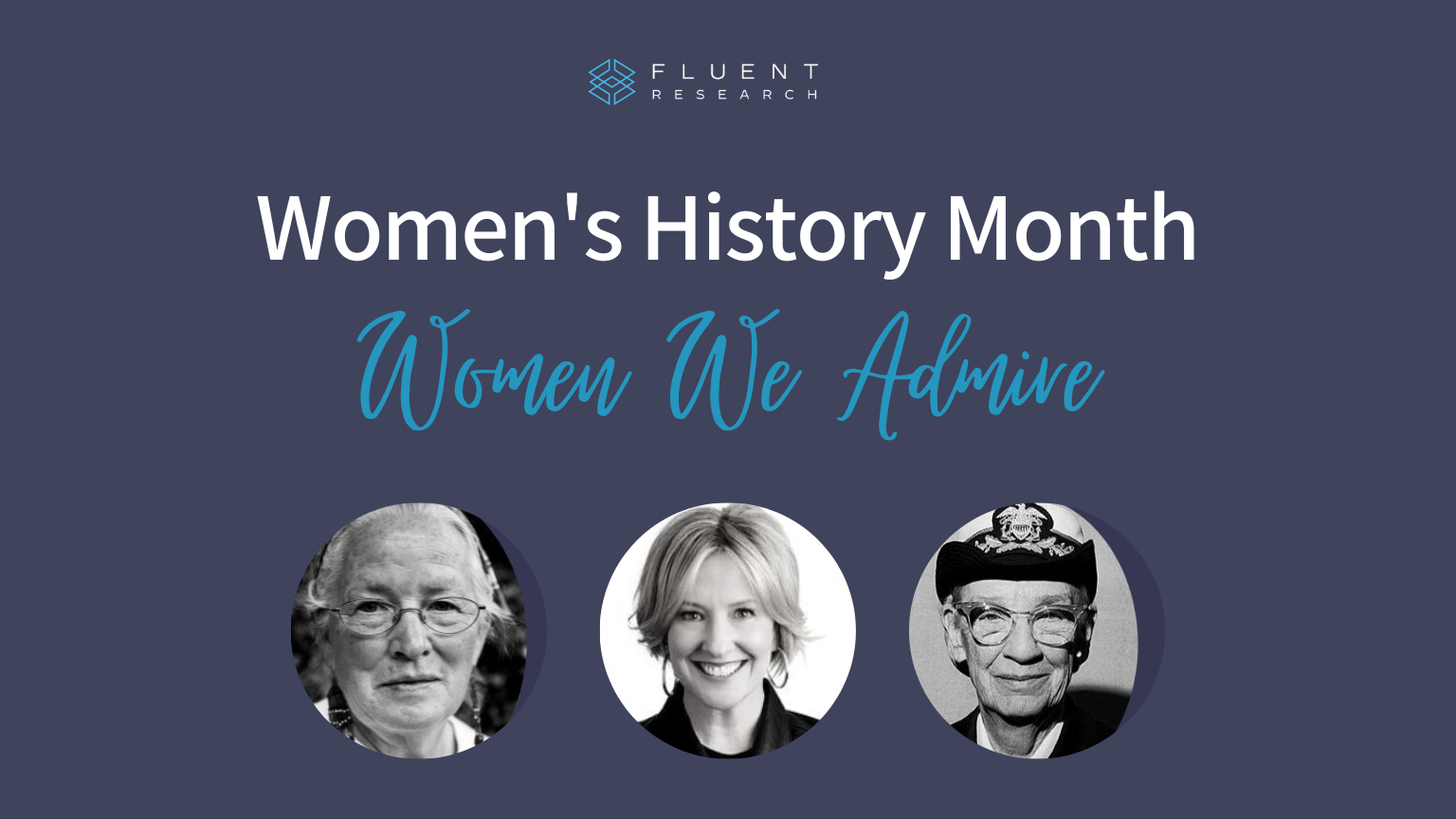
In celebration of Women’s History Month, we asked a few of our Fluent team members to write about the women who inspire them. From lauded professors to pioneering civil rights activists, read below to learn more about the important work and incredible achievements of the women we admire.

Quantitative Researcher Amber González on Joan Trumpauer Mulholland

In November 2016, I had the pleasure of meeting Joan Trumpauer Mulholland — a renowned activist. Joan participated in and helped organize some of the most influential moments of the 1960s Civil Rights Movement, including the Freedom Rides, Jackson Woolworth’s sit-in, the March on Washington, and the Selma to Montgomery March.

Despite her upbringing as a young white woman in the segregated South, being a child of segregationists, and a great-granddaughter of slave owners, Joan had an unwavering dedication and commitment to challenge racial segregation. She shed light on the repercussions of her involvement, including being disowned by her family, imprisoned and placed on death row, and hunted by the KKK for execution. It was truly inspiring to hear a first-hand account of stories from an unlikely hero of the 1960s Civil Rights Movement, whose devotion to the cause required the utmost conviction and courage.

Her legacy does not end there. To this day she continues to challenge racist ideology through the efforts of her organization, the Joan Trumpauer Mulholland Foundation whose mission is to educate youth about the Civil Rights Movement and inspire others to make a difference through activism in their community.

Reflecting back, I’m grateful I crossed paths with Joan when I did, during my senior year of college, one week after the 2016 election. It was a period marked by an uptick in incidents of racist and xenophobic harassment on my college campus and across the country, and her inspiring story and words of wisdom reinvigorated me to remain engaged in activism on and off campus.

Senior Researcher Sylvia Rusnak, Ph.D. on Brené Brown

One woman that inspires me is author and professor Brené Brown. She researches courage, vulnerability, shame, and empathy. I admire her because her research has real-world impact; her work helps us understand ourselves and create meaningful change in our lives.

Brené is a storyteller and communicates her work in a way that resonates. As a researcher, I strive to conduct research that ultimately improves the lives of others and communicate it in a way that clicks.

Brené’s work also has importance for how we show up in our lives for ourselves, for others, and also for how we work. Vulnerability at work allows for creativity and meaningful conversations. Her work inspires me to try to be brave: to show up to take action, rather than to stand by on the sidelines, simply observing or commenting on the actions of others.

Senior User Experience Researcher Farrah Brensinger on Grace Hopper

If you have ever noticed and reported a ‘bug’ to software developers, you have Grace Hopper to thank for this offbeat way to describe a software glitch. Hopper minted the label after a bonafide moth got stuck in her computer and caused it to go haywire.

Hopper’s influence in software goes far beyond adding the unusual term to our everyday computer lexicon. The first woman to receive a Ph.D. in Mathematics from Yale, she went on to create A-O, a ‘compiler’ program that translated mathematical terms into machine-readable computer code. She later invented a compiler that made machine-readable code from English-language inputs, enabling mainstream computer usage for those with non-programming backgrounds. She received the 1991 National Medal of Technology from President George Bush, recognizing her technological impacts on ‘open[ing] the door to a significantly larger universe of users.’

When asked about her most important accomplishments, she listed training young people right alongside her programming triumphs. Undoubtedly, Grace Hopper would be pleased to see so many young women entering the computer science field today, ready to push the boundaries of programming, just as she did.

Grace Hopper’s story inspires me to innovate for good and look for additional opportunities to get life-changing technologies into the hands of as many people as possible.


As I reflect on my first year working at Fluent Research, I am grateful for the valuable lessons I have learned from my colleagues who work in market research. Their expertise and experience have given me a new perspective on the industry and helped me grow as a marketer. Here are some of the key things I have learned from my market research colleagues in my first year in marketing.

1. Understanding the customer

My colleagues in market research have taught me that the key to successful marketing is understanding the customer. They have shown me that the customer is not just a demographic, but a unique individual with unique needs, wants, and motivations. To truly understand the customer, it is essential to go beyond simple data analysis and dive into their experiences, emotions, and behaviors.

2. The power of data

Data is the backbone of market research, and my colleagues have taught me the importance of using data to inform marketing decisions. They have shown me that the key to unlocking the power of data is to approach it with a critical eye, asking questions and looking for patterns and relationships that can inform decision-making.

3. The importance of collaboration

Day in and day out, I see my colleagues working together as if marketing research were a team sport. They have shown me that the best insights and recommendations come from working with others and combining different perspectives and skill sets. Whether it’s working with designers, product managers, or other researchers, collaboration is essential for producing high-quality research that leads to actionable insights.

4. The need for creativity

Market research is not just about gathering data, but also about interpreting it in a meaningful and compelling way. My colleagues have taught me the importance of presenting findings and recommendations in a way that resonates with stakeholders, using creative and visually engaging methods.

5. The importance of staying current

The market research industry is constantly changing, and staying current with new techniques and technologies is essential for success. My market research colleagues have taught me the importance of attending conferences, reading industry publications, and engaging with other researchers to stay up-to-date and continuously improve my skills.

My first year as a marketer in the market research industry has been a journey of learning and growth, thanks in part to the valuable lessons I have learned from my colleagues. Their expertise and experience have given me a new perspective on the industry and helped me grow as a marketer. I am eager to continue learning and collaborating with my colleagues in market research, and I am confident that the next year will bring even more exciting opportunities and insights.

By Stefanie Cousins.


While on vacation with his family last week, Fluent’s Director of Youth Development & Education, Dan Warren, took some time to share his thoughts about choices, endings and beginnings as the summer ends and he looks towards the start of the school year and returning to work.


The only true voyage of discovery, the only fountain of Eternal Youth, would be not to visit strange lands but to possess other eyes, to behold the universe through the eyes of another, of a hundred others, to behold the hundred universes that each of them beholds, that each of them is. – Marcel Proust


It is common to hear the phrase, “We are often blind to the things we are blind to.” We have choices about the way that we view the world, but choice is work.  Viewing choice as work is something that denotes intentionality. We must be conscious that we have choice not necessarily on how the world is but how we think about our world. The reality is that often the world shifts away from our preferences to areas of unwelcome novelty whose arrival was beyond our control.

What may be more relevant than our opinion on the shift is how we respond to the change. How we decide to turn our choices and awareness into action recognizing that we are part of a system that is social and interconnected is a large part of that process. Taking simple steps toward appreciating and capitalizing on fundamental things in life illuminates the wisdom in simplicity.

Sometimes our recognition of options is obscured by deeply engrained self-imposed and/or cultural practices. Stepping outside convention and chasing the “what if” down the rabbit hole, especially when considering those aspects of life that are most precious, can be a valuable exercise to test assumptions, biases, and opportunity.

As we weigh our choices, our own rubric for comparison may prove helpful. Occam stated that “Entities should not be multiplied without necessity,” arguing that, all other things being equal, the simpler answer is the better one.  Shifting between choices is often conceptually simple but practically challenging because it involves accommodation. This discomfort, even in the most welcomed changes, is worth our attention and patience.

Regardless of the work associated with change, it is worthwhile to be vigilant about noticing when and why our choices are now qualitatively different. New technologies, for example, can stretch horizons beyond anything that we could have previously anticipated and things that were not effective in the past are now possible in the future of now.

Even when we have made giant leaps personally, recognizing that we are embedded in a social system can illuminate that our priorities and resulting choices create intentional and unintentional experiences for others. If it is our intent for others to experience and explore the world in wondrous ways, then we must live in mindfulness that we affect and are affected by the choices and priorities of others.  The major downside of choice is that failure is always a real possibility. How people decide to determine and digest failure is a key to growth.

Dan Warren is Director of Youth Development & Education at Fluent Research