


Technology

Family wellbeing is a guiding pillar of our work at Fluent. It guided our work with Google on the Digital Wellbeing of Families, our research for the Jed Foundation on Mental Health, and our award-winning documentary series, “Family Strong”. Most recently, family wellbeing guided us to a new and exciting collaboration with a kindred spirit, Kinsome.

A member of AARP’s AgeTech Collaborative™, Kinsome has the audacious but, we believe, achievable goal of leveraging technology to strengthen family relationships across generations. Their heart-centered technology is a creative and concrete response to the U.S. Surgeon General’s 2023 alarm bell, signaling an epidemic of social isolation and loneliness. Isolation and loneliness fundamentally affect mental and physical health, which have been deteriorating in the U.S. and abroad for some time, even prior to the Covid-19 pandemic. An increasing number of young people report feelings of persistent sadness and hopelessness, and anxiety and depression are widespread for all age groups.

Well families are the wellspring of human health and optimal development. And at the heart of family wellbeing are strong and vibrant relationships, from the beginning of life through the end of life. Those relationships are not a “nice to have”. Human health and optimal development across the lifespan are completely dependent on them. Early in life, development is so rapid that our species evolved a “village of stable care” to meet the abundant needs of infants and children for comfort, affection, and play. Multiple responsive caregivers, such as grandparents, were readily on-hand for guidance and mentoring. While our village of care obviously benefited young life, it was just as vital to the wellbeing of older life. For humans of all ages need strong—welcoming, responsive, and supportive—relationships.

Human connection—the essential mechanism for strengthening family wellbeing—is the focus of Kinsome’s mission and AI-powered app. Today families are spread out across time and space. They have competing demands and call different places and time zones home, making strong and vibrant family relationships immensely difficult to maintain. Kinsome envisioned a technology with the power to help families transcend time and space, reduce the challenges of distance in the grandparent-grandchild bond, and strengthen human connection across generations.

All of us at Fluent are thrilled to be partnering with Kinsome and their deeply creative and caring founders, Eben Pingree and Mike Gerbush. We launched our collaboration in earnest this past February with a couple fun and productive sessions at Research Camp. Campers took a break from the woods to form design teams and create ways for kids and grandparents to stay close when they are not together. Through the lens of children, we got to examine intergenerational bonds and how best to strengthen them. The sessions were as much affirming of Kinsome’s vision as they were informative about how to dial-in the child’s experience so that every shared story and laugh brings them closer to their grandparents. We are grateful and excited to be on this journey with Kinsome, strengthening human connection and family wellbeing through heart-centered tech.

By Amy Warren, Senior Child Development Researcher

References:

U.S. Department of Health and Human Services (2023). New Surgeon General Advisory Raises Alarm about the Devastating Impact of the Epidemic of Loneliness and Isolation in the United States.

National Research Council (2013). U.S. Health in International Perspective: Shorter Lives, Poorer Health. Washington, DC: The National Academies Press.

Organization for Economic Cooperation and Development (2009). Doing better for children. Paris: OECD Publishing.

UNICEF (2007). Child poverty in perspective: An overview of child well-being in rich countries, a comprehensive assessment of the lives and well-being of children and adolescents in the economically advanced nations, Report Card 7. Florence, Italy: United Nations Children’s Fund Innocenti Research Centre.

See Global Wellness Institute for an array of Happiness and Wellbeing Indices.

Centers for Disease Control and Prevention (2023). Youth Risk Behavior Survey: Data Summary and Trends Report, 2011-2021.

U.S. Department of Health and Human Services Substance Abuse and Mental Health Services Administration (1999). Mental health: A report of the Surgeon General. Rockville, MD: Center for Mental Health Services, National Institutes of Health, National Institute of Mental Health.

See Narvaez, D., & Bradshaw, G.A. (2023). The Evolved nest: Nature’s Way Of Raising Children And Creating Connected Communities. North Atlantic Books.

Narvaez, D., Valentino, K., Fuentes, A., McKenna, J. J., & Gray, P. (Eds.). (2014). Ancestral landscapes in human evolution: Culture, childrearing and social wellbeing. Oxford University Press.

Hrdy, S. B. (2001). Mothers and others. Natural History, 110(4), 50-62.

Hrdy, S. B. (2015). Allomothers across species, across cultures, and through time.

Narvaez, D. (2014). Neurobiology and the Development of Human Morality: Evolution, Culture and Wisdom. Norton Professional Books.

Narvaez, D. (2022). Allomothers: We were never meant to mother alone. Kindred Media.

Narvaez, D. (2019). What Wise Elders Know. Psychology Today.

Meehan, C.L. (2014). Allomothers and Child Well-Being. In A. Ben-Arieh, F. Casas, I. Frønes, & J. Korbin (Eds.), Handbook of Child Well-Being. Springer, Dordrecht.


Recently, we attended the Digital Media and Developing Minds International Scientific Congress in Washington, DC, which was organized by the Children and Screens Institute of Digital Media and Child Development. This unique event brought together clinicians, advocacy leaders, teachers, and researchers. Expertise among attendees included medicine, developmental psychology, and experimental psychology. The conference aimed to foster collaboration and exchange of ideas concerning children’s health and safety in relation to digital media use.

Key Themes

During the three-day event, which featured more than 15 talks and panels, several key themes emerged:

The Impact of Screen Media on Minoritized Youth

Discussions revolved around both the positive and negative effects of screen media on LGBTQ youth and youth of color.

Challenges of Under-Connected Youth

There was a focus on the limitations faced by under-connected youth and the need for equitable access to digital resources in the global south.

Data Deficiency on Young Children

Participants noted the lack of comprehensive data on young children’s digital media usage.

Privacy and Security Concerns

Topics included discussions on data ownership (parents vs. children) and the need for improved privacy and security measures for children online.

Updated Policies

There was a consensus that the Children’s Online Privacy Protection Act (COPPA) is outdated and that age gates alone are insufficient to safeguard children in today’s digital landscape.

Mental Health Implications

Speakers addressed the impact of digital media on the mental health of youth, including externalizing behaviors and bidirectional effects.

Youth Advisory Panels

Experts highlighted the value of involving youth in decision-making processes and participatory design research.

Parental Support and Contextual Influence

Panelists discussed how the context of home environments has impacts on children’s media use and potential dependence on screen time.

We found the conference  thought provoking and inspiring. It was a great opportunity to listen to interesting figures in the field and gain new perspectives that will inform our future work. This event served as a reminder that stepping away from daily tasks to attend conferences may lead to new ideas.


By Allison Caplovitz & Tiffany Salone

Have you noticed vibrant color schemes, unconventional patterns, curated clutter, and an eclectic mix of styles popping up in your social media feed lately? If so, then you may be familiar with Gen Z maximalism— a bold and expressive design aesthetic that exemplifies the motto, “more is more.” Let’s take a dive into this recent trend.

Gen Z maximalism is a far departure from minimalism, popular among millennials. Whereas the millennial generation prefers simplicity and functionality through clutter-free spaces, clean lines, and neutral colors, Gen Z prioritizes vibrancy, creative self-expression, and constant stimulation.

The rise of Gen Z maximalism is due, in large part, to the impact of the pandemic. With extended periods of quarantine and stay-at-home orders, young people spent more time indoors cultivating living spaces that emanated warmth and inspiration. Gen Z turned to maximalism as a way to infuse their homes with the energy, joy, and personality that reflect their unique tastes. The aesthetic goes beyond interior design. Gen Z’s maximalist effect on fashion and beauty subverts conventions and tradition with an eclectic style of bold patterns, textures, and colors.

In our work at Fluent Research, we often explore how digital products empower the creativity of young people around the globe. Gen Z maximalism reflects the unique ways in which this generation seeks to express their individuality, creating unique content that stands out in the crowded digital landscape. This aesthetic encourages personalization and unabashed exploration of various styles and modes of expression. We must ensure that Gen Z continues to have access to the latest digital platforms, innovations, and tools that empower them to customize and personalize their experiences and express their creativity.

By Natalia Belchikov


Individuals who may be struggling with loneliness, depression, or anxiety and are in need of immediate relief or support are increasingly looking to apps as a middle-path tool when a mental health service provider may not be the most expedient solution. This BBC article explores the innovative possibilities of a chatbot therapist app called Replika, aimed at providing AI-generated counseling services to its users. Lia Abrams and Charlotte Beatty, two researchers at Fluent, consider the following to be important areas of research to investigate:

1) The consequences of around-the-clock access to chatbots. In face-to-face therapy, skill development often hinges on the time a patient spends away from a therapist; that is, the time patients spend in day-to-day life putting their coping skills into practice. While around-the-clock care could be useful for individuals who need immediate support, it’s important to consider how constant access to a chatbot could facilitate patterns of depending on the resource in times of stress instead of developing personal resilience.

2) The commitment to equitable mental healthcare. The technology described in this article primarily addresses the wider population of individuals with mild to moderate mental health issues. However, it is necessary to consider how the smaller population of people with severe mental illness could utilize the service. These individuals face significant stigma, present a more complex set of challenges, and potentially need more support and funding for their healthcare.

3) The ability of AI to replicate natural human skills and instincts. An important component of therapy is the ability to read a patient’s body language and facial expressions. Will an AI chatbot be able to pick up on the intricacies of a patient’s energy? How will this work if there is no prior knowledge of who the patient is, their personality, or their mannerisms?

4) The security of patient information and the quality of data mining. One important part of therapy is the confidentiality agreement that therapists sign, prohibiting them from disclosing patient information outside of sessions. How can chatbot therapy services ensure that patient data is not misused? In addition, if the data that chatbot algorithms draw on is skewed or doesn’t cover a wide enough demographic of people, then can algorithms truly care for all individuals as they see fit? There is substantial evidence that mental health experiences vary significantly across demographic lines like gender, race, ethnicity, and sexuality. How can AI and chatbots truly cater to the needs of each individual’s intersectional identity?

Here at Fluent, we prioritize research that amplifies voices of underrepresented communities. While the possibility of AI-generated mental healthcare offers significant benefits for increased accessibility to self-help practices, the above are factors that should be addressed and researched in order to ensure that platforms such as Replika can reach and serve a wide range of individuals.

By Lia AbramsCharlotte Beatty

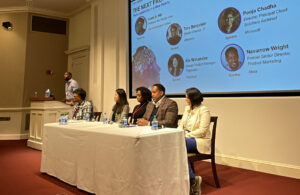
Earlier this year, I had the privilege of attending the 31st Annual Tech Conference at Harvard Business School. The goal of the conference was to bring together business leaders, students, and key tech stakeholders to discuss how technology is shaping society across industries, nationalities, and public and private spheres. It was a great opportunity to hear from some of the most innovative and influential people in the tech industry.

Throughout the day, there were four keynote presentations and several breakout panel and workshop options that focused on topics such as Artificial Intelligence/Machine Learning, entertainment tech, and Fintech, among others. Since I am interested in how to leverage technology to achieve positive social good, I chose to attend the breakout sessions on education, climate, and diversity in tech.

(Watch a TikTok of Evelin’s experience here.) 

Ed Tech

During the EdTech breakout session, the panelists stressed the importance of prioritizing diversity in UX research panels and studies to ensure the development of equitable, inclusive, and accessible products for all learners and educators. When asked about priority areas for innovation, the panelists agreed that EdTech companies should focus on developing products that enhance student-teacher communication, particularly using machine learning methods. One panelist gave an example of creating a product that allows schools with larger teacher-to-student ratios to ‘clone teachers.’ Essentially, educators could create a 1-on-1 video or tailored messages for their students who may be struggling with attendance or any other issue impacting their engagement. This would enhance their relationships and ensure students do not fall behind. Interestingly, the panelists also discussed the need to embrace new AI technologies like ChatGPT rather than seeing them as a threat. According to them, these tools are already helping overwhelmed teachers create lesson plans, promoting self-directed learning, and inspiring students to pursue STEM careers.
Climate Tech

Some of my favorite breakout sessions at the conference were about climate tech, which refers to technologies and innovations that aim to reduce greenhouse gas emissions to mitigate the impact of climate change. The key areas of innovation include clean energy (development, efficiency, and storage), carbon capture & storage, sustainable food & agriculture, and smart transportation. At this moment, investors say that climate tech is hot in venture capital because of its potential to help with foreseeable climate challenges that will arise in the next 20 years. According to them, “climate tech can be a billion dollar business with a trillion dollar impact in the world.” The climate tech companies represented at the conference reflected on their own journeys and identified gaming, energy discovery, and the cooling crisis as areas where their ventures are gaining investor endorsement. Here are a few examples:

      • Companies like Carbon Counts are addressing climate change through Play-to-Plant™ gaming, where players grow forests in-game and the company plants, grows and protects trees in the real world on their behalf.
      • Zanskar is using AI, big data, and advanced sensing techniques to discover geothermal energy because it is a key component of a 100% carbon-free electric grid.
      • Therma is using data science and machine learning to eliminate food and energy waste, all to address the cooling crisis. They are already working with major chain restaurants and other businesses to reduce their carbon footprint.


Diversity in Tech

As someone who identifies as Latinx and first-generation, issues of diversity and inclusion are especially important to me. With the rise of the tech industry, diversity in tech is a crucial area that needs attention. Historically, the tech industry has struggled with a lack of diversity, inclusion, and representation. The panelists reflected on the many barriers to entry for BIPOC communities who are first generation with limited networks, including unconscious bias in hiring and a lack of diversity in positions of leadership. Further, many of the panelists have experienced feelings of impostor syndrome, or the persistent inability to believe that one’s success is deserved or has been legitimately achieved as a result of one’s efforts or skills. Unfortunately, impostor syndrome disproportionately affects high-achieving individuals from underrepresented communities. To alleviate these challenges and foster a more diverse and inclusive industry, the panelists suggested establishing mentorship programs to support BIPOC students or career-changers, reevaluating hiring practices, and supporting aspiring tech entrepreneurs and BIPOC startups, among other things.

Overall, the 31st Annual Tech Conference at Harvard Business School was a unique opportunity to learn about the latest trends and innovations in the tech industry.

As technology and our dependence on it continue to grow, it is increasingly important that products, programs, and services we help develop as researchers are not only profitable but also contribute to a more equitable and sustainable future. Attending this conference has equipped me with valuable knowledge and insights that I can apply in my role as a UX Researcher to take a more impact-driven approach.

By Evelin Garcia

A wise and dear professor once told me, “The medium is not the message. The message is the message.” And when television was the medium, that was certainly true. But is that still the case with the proliferation of interactive media for children taking hold? Does the interactivity of the medium outweigh the content being delivered on it?

In the podcast series, Chasing Life, Dr. Sanjay Gupta delves into the science behind the impact of technology on our brains. This particular episode, Inside a Lab Studying Toddlers and Touchscreens,” explores the impact of interactive touchscreen technologies on very young children. Dr. Dimitri Christakis, a pediatrician and director of Seattle Children’s Research Institute, explains how his research is finding that children between the ages of 18 and 24 months struggle to disengage from an app in comparison to a traditional toy. This knowledge triggers questions for both parents of young children as well as the technology companies that create these apps. What can parents and tech companies do to prevent adverse effects on children’s young brains from this relatively new technology?

As a parent myself, I see in my teenagers how the interactivity and stimulation of technology keeps them fully engaged and immersed. And in my role as Director of Content Research and Evaluation at Fluent Research, I help technology and media companies understand how children and parents experience apps, games, and other products so designers and producers who create digital content for kids do so with their wellbeing in mind. This is more important than ever as technology continues to evolve and draw in the attention of a generation. As Dr. Christakis says, “Every program is educational. The question is, ‘What is it teaching?’” We need to do better for our children.

By Allison Caplovitz, PhD

Award-winning filmmaker and Fluent Productions head Heath Cozens, landed in Sao Paulo, Brazil earlier this month where he began the first leg of a seven-country adventure around the globe filming a documentary for a tech client. We’ll be posting Heath’s postcards throughout the summer on our social media channels so make sure to check in to find out #WhereHeathIsNow?

In late October, Mark Zuckerberg announced the naming of his umbrella company, Meta. The name was specifically chosen to closely identify the premier force that is shaping the metaverse. Facebook describes the metaverse as “a set of virtual spaces where you can create and explore with other people who aren’t in the same physical space as you. You’ll be able to hang out with friends, work, play, learn, shop, create and more. It’s not necessarily about spending more time online — it’s about making the time you do spend online more meaningful.”

Comments and editorials have been and will be flooding news outlets, social media, and conversations around the remaining water coolers. Early reactions have focused on the companies facilitating this change rather than the potential that this evolution may unlock for society’s greatest challenges. It would be naïve to think that the emergence, development, and cultivation of the metaverse has been or will be rooted in altruism and concern for the public “good.” Judge it as you may, my point is not to persuade you to think this is a “good” or “bad” thing, rather I aim, as a researcher does, to think about the ways that the metaverse will create impact and change and explore the lever by which it does this.

Because I study the development of educational programs, media, and technology, I would ask that you consider the role that the metaverse could play in the operation and support of kids and families. Simply stated, it may help us all as a society raise children more effectively. In my work over the past few years, I have specialized in understanding kids and families, especially when they interact with technology and media. I have had the privilege of working with world class companies that are in the business of creating solutions for kids and families that make their lives safer, richer, and easier. By engaging with these partners over time, I have come to know that they are not only incredibly talented in their skills but also genuinely strive to make the world a better place.

Let’s also recognize that the metaverse has the potential to level the playing field in a variety of disciplines by developing inclusive platforms from the outset. According to the Equity by Design proponents, inequity is designed into systems and with help and intent can be designed out of them. Designers should not focus their considerations on the bulk of the curve when designing but rather aim to create solutions for those in the margins of society. Solutions that are developed in this way, they claim, have historically created not only solutions for those in the margins but have also created unintended benefits for the greater society.

If we accept for the moment that the metaverse will be a reality and a large part of all our lives in the future, designing for the margins yields the biggest benefit for society as a whole. That means there is an optimistic and altruistic core of intent underlying the actions of those designing components of the metaverse for kids and families. I can’t help but wonder (in the truest sense of the word) about what could be possible as a result of this evolution.

Will it be possible for children of incarcerated parents to sit with an imprisoned mother or father and read books together at night? Could deployed soldiers take a few minutes to play catch with their daughters before they got on the bus for school? Could the field of education ∂be leveled by removing the barriers of geography, resources, and time?

The metaverse will never replace the “real” world. It lacks the palpable energy generated by bringing people together in a physical space. This is the kind of energy that all living things emit, and which connects us with our most prehistoric instincts. Conversely, the metaverse is, at its root, a futuristic cognitive experience which reengages emotional references and allows for implicit connection when the physical is impossible.

Research must be a fundamental part of the evolution into this new space. Social scientists must strive to understand how the metaverse and those who support the welfare of families can create a mutually beneficial relationship that fosters a healthier, happier, and more engaged society.

Dan Warren, Ph.D. is Director, Youth Development and Education at Fluent Research. Dan holds a doctorate in Human Development and Child Study from Tufts University and taught elementary school in Massachusetts for nearly a decade.