


Digital Wellbeing Tag

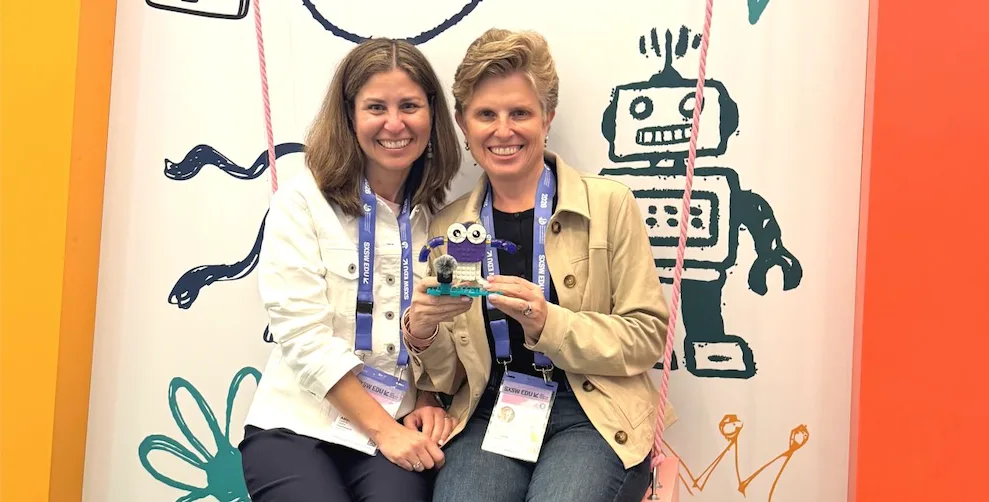
Earlier this month, Allison Caplovitz and Stefanie Cousins attended SXSW EDU in Austin, TX, where they explored the intersection of technology, early childhood education, human connection and wellbeing. The event offered a wealth of insights into how we can thoughtfully integrate AI and digital tools into the lives of young children while preserving the values that help them thrive.

Monica Sutton, a beloved educator and creator of the Ms. Monica YouTube channel, delivered a powerful message urging developers, policymakers, and families to rethink how technology is designed for young children. She emphasized the importance of bringing developmental specialists and child psychologists into the room during the creation process. Sutton also encouraged policymakers to slow down and carefully consider the long-term implications of digital tools, while reminding families to trust their instincts and wisdom when guiding their children. Her framework for evaluating technology for young learners is simple yet profound: Does it honor how young children learn? Does it support their growth and wellbeing? Does it help them thrive? And does it protect their curiosity and connection?

The role of AI in early childhood was another key theme at SXSW EDU. Interviewed by Michael Levine, Dr. Dana Suskind, a cochlear implant surgeon and co-director of the TMW Center for Early Learning & Public Health, highlighted the importance of nurturing connection, curiosity, and lifelong learning in an AI-driven world. She shared a striking observation about how quiet waiting rooms have become, as both parents and children are now glued to their devices. To help families and educators navigate the influx of AI tools, she introduced the DETECT framework, which encourages thoughtful evaluation of AI tools by asking questions like: Who is this designed for? Is there evidence it works? Do children have trouble with it? Does it promote ethical use? Does it protect children’s confidentiality? And does it teach in a way that is aligned with the values of the home or classroom?

The growing digital divide was another critical topic of discussion. While access to technology has expanded, the divide has shifted to who has access to opportunities for developing creativity and human-centered skills. Higher-income families are better positioned to prioritize these skills, while lower-income students often face more rigid, tech-mediated learning environments. This disparity raises concerns about equity and the long-term impact on children’s competence, agency, and resilience. Dr. Suskind also introduced another guiding acronym, HOPE, which underscores the irreplaceable value of human connection, the importance of owning AI’s imperfections, and the need to protect the foundational early years while using AI as a tool for enhancement, not replacement.

Several speakers likened the introduction of AI to the early days of social media, emphasizing the need to “get it right” this time. The stakes are high: relying too heavily on AI and removing opportunities for children to struggle and overcome obstacles could undermine their ability to build resilience and agency—qualities essential for wellbeing. Adeel Kahn, Founder and CEO of Magic School AI, shared an interesting lesson from his company’s journey. Initially, they anthropomorphized their AI bot for both teachers and students but quickly learned this approach wasn’t effective, underscoring the importance of thoughtful design in educational technology.

The conversations at SXSW EDU underscored a shared commitment to ensuring that technology serves as a tool for connection, creativity, growth, and wellbeing—not a replacement for the human touch. As Ms. Monica so eloquently put it, we must ask ourselves: Does this help children thrive? By keeping this question at the forefront, we can navigate the digital age with intention and care, ensuring a brighter future for the next generation.

By Stefanie Cousins, Vice President, Marketing & Communications, Fluent Research

By Nellie Gregorian

Last night, I peeked into my teenage daughter’s room. She was lying on her bed, phone in hand, earbuds in, completely absorbed in her digital world. Every few seconds, she’d laugh softly, shake her head, or roll her eyes.

A small, everyday moment. But it made me pause.

I realized that this moment encapsulates how millions of girls her age are experiencing the world today — part in-person, part online, part algorithmically curated. As a mother, I see her navigating friendships, social norms, and identity in ways I never did at her age.

For many years in my career, I had the privilege of collaborating with Girl Scouts of the USA, helping to advance research and programs designed to build girls’ leadership, confidence, and sense of possibility.

That work taught me something powerful:

Girls are remarkably capable when the environments around them are designed to support their growth.

Today, however, many of those environments are digital.

Girls today are navigating adolescence in ways previous generations never did. Their friendships, identities, and self-image are increasingly shaped in platforms designed to maximize engagement, visibility, and comparison.

  • Algorithms recommend content.
  • Filters reshape faces.
  • Metrics quantify popularity.

None of these systems were intentionally built to harm girls. But many were also not designed with girls’ developmental realities in mind.

So I can’t help but ask:

Are the digital worlds we are building helping the next generation of girls thrive or quietly shaping who they believe they need to become?

Research consistently shows that girls experience online spaces differently than boys:

  • Higher levels of appearance-based pressure
  • Increased social comparison
  • Greater exposure to harassment

Yet when we talk about gender equality in technology, we usually focus on who builds it — and that matters.

But we should also ask:

Who is technology being designed for?

Design choices are never neutral. They shape behavior, norms, and expectations.

When platforms consider age, developmental stage, and wellbeing, they create healthier experiences.

When they also consider gendered experiences, they can better anticipate pressures girls face online.

Designing the digital world with girls in mind doesn’t mean creating separate spaces. It means asking better questions:

  • How do social metrics influence identity formation?
  • How do recommendation systems amplify beauty standards?
  • How can safety systems better respond to harassment targeting girls?
  • What does healthy digital participation look like for adolescents?

These questions sit at the intersection of research, policy, and product design — and they are increasingly urgent.

If we want technology to truly empower the next generation of women, we cannot wait until adulthood to support them.

We need to think about girls — their development, wellbeing, and leadership — from the very beginning of the design process.

Because the digital environments girls grow up in today will help shape the leaders, creators, and innovators of tomorrow.

So here’s the question I think we should be asking this International Women’s Day:

If we were designing the digital world with girls’ wellbeing and leadership in mind from the start… what would we build differently?

Nellie Gregorian is the founder and president of Fluent Research.

In a world of endless scrolling and constant notifications, a growing number of young adults are asking a powerful question: what happens if we just stop? A recent study explored this concept, termed “digital quiet,” by asking 18 to 24-year-olds, a generation raised online, to take a one-week break from social media. The results were clear and immediate.

Even a short pause from the digital stream can significantly boost mental health. This finding aligns with years of research into how young people navigate complex online environments. They aren’t just passive consumers; they are actively managing emotional landscapes, setting boundaries, and learning to engage with technology in healthier ways. This post explores why taking intentional social media breaks is becoming an essential practice for well-being.

The Science Behind the Break: What a Week Away Can Do

The study, published in JAMA Network Open, split young adults into two groups. One group took a seven-day break from all social media platforms, while the other continued their use as normal. The findings from this digital detox were compelling.

After just one week, participants who took a break reported:

•  Lower levels of anxiety and depression.

•  A notable improvement in their overall wellbeing.

•  These positive effects were consistent for both young men and women.

For a generation that is exceptionally fluent in digital life, these results highlight a crucial reality: technical skill does not grant emotional immunity. The relentless pace and pressure of social media have tangible effects on mental health, even for the most savvy users.

Why a Digital Detox is So Effective

The benefits of stepping back from social media are rooted in how these platforms interact with our emotional and psychological needs. Our work with teens and young adults reveals several key dynamics that explain why a break can be so restorative.

It Interrupts Overwhelming Emotional Loops

Digital spaces can trigger rapid and intense emotional shifts. The constant flow of audio, video, and social feedback creates “emotional loops” that can become overwhelming, especially during stressful life periods. A digital detox breaks this cycle, giving one’s emotional system the space it needs to reset and recover.

It Creates Boundaries Where None Exist

Social media operates on a timeline without end. Conversations can be revived at any moment, and feeds refresh instantly with new content. This lack of natural endpoints creates an unspoken pressure to remain constantly available. Practicing digital quiet introduces a firm boundary that the platforms themselves do not provide, helping someone reclaim their time and attention.

It Pauses the Comparison Culture

The years between 16 and 24 are a peak period for identity formation, making young adults particularly sensitive to social comparison. Platforms filled with curated highlight reels can amplify self-doubt and fuel symptoms of anxiety and depression. Taking a break from social media interrupts these harmful comparison patterns, offering a chance to reconnect with one’s own sense of self-worth.

It Supports Developing Self-Regulation Skills

Even the most tech-savvy young adults are still developing crucial life skills like emotional filtering, boundary-setting, and self-regulation. These abilities are strengthened through practice. An intentional break acts as a training ground, supporting healthier and more mindful engagement when deciding to return to social platforms.

An Equal Opportunity Benefit for Mental Health

The study’s discovery that both young men and women benefit equally from a social media break is significant. With young women often using social feeds more and young men gravitating toward gaming, their online habits may differ, yett the core issues remain the same.

It isn’t a specific platform causing the strain. It’s the pace, the social pressure, and the unending demand for engagement that creates a heavy emotional load for everyone. A digital detox addresses these universal stressors, making it a valuable tool for all young adults.

Redefining the Relationship with Technology

It’s important to recognize that young people are not rejecting technology. They rely on digital platforms for connection, community, creative expression, and entertainment. They value what online life has to offer.

However, they also feel the significant weight of:

• Nonstop communication demands.

• Intense social expectations.

• Emotional and sensory overload.

• Poorly defined personal boundaries.

In response, many are already experimenting with ways to regain a sense of control. They are curating their feeds, silencing notifications, creating private online spaces, and taking intentional social media breaks. Digital quiet is not a top-down mandate; it’s a wellness strategy they are adopting for themselves.

How to Support and Encourage Digital Quiet

For parents, educators, and even platform designers, the conversation around social media and mental health is often framed as “good versus bad.” The reality is far more nuanced. Digital spaces can be sources of joy, learning, and support, but only when users have the skills and space to navigate them well.

Instead of advocating for total disengagement, a more helpful approach is to encourage balance. Here are some actionable ways to support young adults:

• Normalize periodic breaks: Talk about digital detoxes as a healthy and normal part of life, like taking a vacation from work.

• Promote self-regulation: Help young adults identify their own triggers for stress online and create plans for when to step back.

• Reduce the stigma: Frame social media breaks not as a sign of weakness, but as a proactive step toward better mental health.

• Advocate for better tools: Encourage the development of platform features that help users manage the intensity of their digital experiences.

Young people aren’t trying to escape their digital lives. They are learning how to use technology in a way that allows them to thrive both online and off.

The Takeaway: Reconnect with Yourself

Ultimately, digital quiet isn’t about disconnecting from the world—it’s about reconnecting with yourself. A week-long break may seem like a small action, but the research confirms its power. Even short pauses can reduce anxiety, improve mood, and help reset the emotional patterns tied to constant connection.

In a digital landscape defined by relentless feeds and the pressure to keep up, taking intentional social media breaks is emerging as an essential part of healthy living.

Stefanie Cousins is Vice President, Marketing & Communications at Fluent Research.

As a researcher specializing in media, technology and children, my work is informed by my interest in, and knowledge of, child development. At Fluent Research, we have collaborated with numerous media companies to provide insights into the evolving experiences of children and parents with digital media.

One recurring theme in our research is the desire of both parents and children to limit their screentime, but their inability to do so consistently. This discrepancy in knowledge and practice often stems from parents feeling overwhelmed by the plethora of media choices, and their fear that if they limit screens, their children might feel left out. For kids, the compelling nature of digital content, peer influences, the omnipresence of screens in their daily lives, and the algorithms that feed them more and more content make it extremely challenging to limit their use of digital media.

With the passage of the new Kids Online Safety and Privacy Act in the U.S. Senate this week, we are on our way to implementing some new protections for kids. It’s about time!

This new bill marries two different acts, The Kids Online Safety Act (KOSA) and the Children’s Online Privacy Protection Act (COPPA) 2.0. Both represent significant legislative efforts aimed at enhancing online safety and privacy for children. As this bill moves closer to passage, it is important to consider its implications.

• Kids Online Safety Act:

– KOSA aims to update and expand protections for children under 17.

– KOSA also provides guardians with more control over platforms, prevents features such as autoplay, and provides for stronger default privacy settings.

• Children’s Online Privacy Protection Rule 2.0

– COPPA 2.0, which is an extension of the original COPPA, was enacted in 1998 to regulate the collection of personal information from children under 13.

– This new version of COPPA 2.o would also expand protections for teens.

– The proposed updates in COPPA 2.0 also address targeted advertising, data retention practices, and the need for verifiable parental consent.

– COPPA 2.0 aims to provide stronger safeguards in this new era of media saturation.

The passage of KOSA in the Senate and future passage in the U.S. House of Representatives could mark a significant step forward in protecting children’s digital wellbeing. As someone working every day at the intersection of media, technology, and child development, I believe these legislative measures are long overdue. They not only aim to safeguard privacy but also to foster healthier digital habits among children. By creating a more regulated and child-friendly digital landscape, we can help kids and parents alike navigate the complexities of technology while minimizing potential risks. In this ever-polarized political landscape, we can all come together and agree that our kids are worth protecting!

By Allison Caplovitz, Director, Content Research and Evaluation