

WomensHistoryMonth Tag

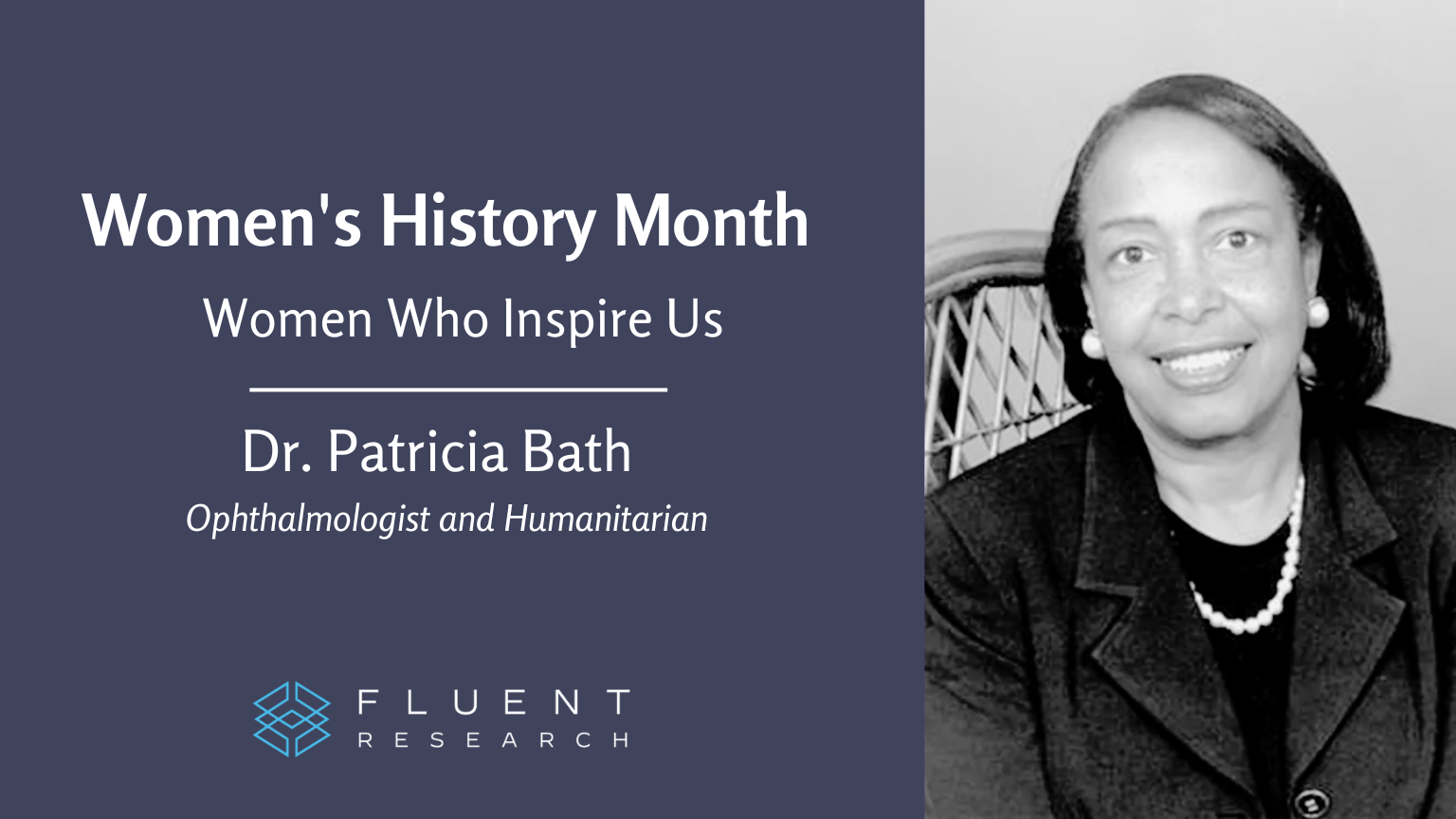
Bridging the gap between Black History Month and Women’s History Month, we celebrate the remarkable life and achievements of Dr. Patricia Bath. Millions around the world owe their restored vision to her groundbreaking ophthalmological work and early advocacy for new modalities of health care. 

A daughter of Harlem, Bath displayed scientific aptitude from a young age. While as a secondary student at Charles Evans Hughes High School she was named a National Science Foundation scholar, connecting her with researchers at Yeshiva University and Harlem Hospital Center. Her accompanying research studies explored the complex relationship between cancer, nutrition, and stress and further demonstrated her research acumen: By age 19, her research work was already being recognized in scientific journals and magazines like Mademoiselle. 

Bath continued her academic journey at Howard University and returned to New York City after graduation. While working at Harlem Hospital Center in the 1970s she observed double the rates of blindness in Black patients compared to white patients. This ignited her passion to help the blind and underserved and to develop new treatment methods. In 1976, Bath established the field of community ophthalmology, a discipline focused on preventing blindness in underserved populations through a mix of public health and community medicine initiatives. The National Institutes of Health described these efforts to make eye care more accessible through neighborhood hubs in this way: “Volunteers trained as eye workers visit senior centers and daycare programs to test vision and screen for cataracts, glaucoma, and other threatening eye conditions.” Bath also became the first African American resident in ophthalmology at New York University, a feat that marked the beginning of a series of historical firsts:

• First African American woman to serve on staff as a surgeon at the UCLA Medical Center.

• First woman to lead a post-graduate training program in ophthalmology.

• First woman elected to the honorary staff of the UCLA Medical Center.

• First African American female doctor to receive a patent for a medical purpose.

Eventually, her dedication to accessible eye care led her to co-found the American Institute for the Prevention of Blindness. The history of the Institute’s many efforts includes donating ophthalmological surgical equipment to developing nations like Pakistan and Nigeria, as well as distributing educational materials. 

Dr. Bath’s path was far from easy. While visiting as an honored guest on Good Morning America, she had this to say about being a woman of color in medicine: “I had a few obstacles but I had to shake it off…. Hater-ation, segregation, racism….”At one point in her career, the growing intensity of sexism and racism she faced in America forced Dr. Bath to temporarily relocate to Europe. There in France and Germany, she was able to continue her pioneering work in laser science. 

Beyond her extensive list of firsts, Dr. Bath is a holder of 5 patents. The Laserphaco Probe, her most celebrated invention, was a revolutionary technology in 1988. It used lasers to dissolve cataracts with ultrasonic waves in a transformative improvement over scalpel methods. In addition to inventions, Dr. Bath was an early champion of telemedicine, recognizing its potential to bridge healthcare gaps by bringing healthcare to the masses regardless of proximity to brick and mortar doctors’ offices. 

In the later years of her life, Bath was honored by the International Women in Medicine Hall of Fame, the American Academy of Ophthalmology Museum of Vision, and the Hunter College Hall of Fame. And in a cause close to this author’s heart, in 2009 she was selected by then-President Barack Obama to serve on a digital accessibility task force. 

While Dr. Bath passed away in 2019, her inspiring legacy continues to illustrate the power of women in STEM. When girls and women are empowered to pursue science, all manner of breakthroughs are possible. She had this to say about serving as a role model: “I want to pass the torch to young girls and have them do S.T.E.M. and have them do ophthalmology.” Today, we can remember Dr. Bath for her brilliance, determination, and courage, but also for her humanitarian devotion to preserving sight for all.

By Farrah Brensinger, Senior User Experience Researcher.

——–

Resources:

1: Lemelson-MIT Program. (n.d.). Patricia Bath. The Lemelson-MIT Program. Retrieved March 20, 2025, from https://lemelson.mit.edu/resources/patricia-bath

2: National Museum of American History. (n.d.). Patricia Bath papers, 1960-2019. Smithsonian Institution. Retrieved March 20, 2025, from https://americanhistory.si.edu/de/collections/archival-item/sova-nmah-ac-1585-ref110

3: ABC News. (2018, November 27). Revolutionary ophthalmologist Dr. Patricia Bath shakes off haters. Good Morning America. Retrieved March 20, 2025, from https://abcnews.go.com/GMA/Wellness/revolutionary-ophthalmologist-dr-patricia-bath-shake-off-haters/story?id=53357320

4: Anumula, V., Kanyadan, P., & Kanyadan, C. (2024, July 30). Patricia E. Bath: A luminary in ophthalmology. Cureus, 16(7), e65781. https://doi.org/10.7759/cureus.65781

5: National Library of Medicine. (n.d.). Patricia Bath, MD, ophthalmologist. Retrieved March 20, 2025, from https://cfmedicine.nlm.nih.gov/physicians/biography_26.html

6: Lottie. (2021, June 30). Patricia Bath biography for kids. Retrieved March 20, 2025, from https://www.lottie.com/blogs/strong-women/patricia-bath-biography-for-kids?srsltid=AfmBOoo7grMzWKUwJ_l0BXVggJVT6ek3gBFs_J56AxfFCxVzmPTWlPFY

7: Wikipedia contributors. (2025, March 20). Patricia Bath. Wikipedia. Retrieved March 20, 2025, from https://en.wikipedia.org/wiki/Patricia_Bath
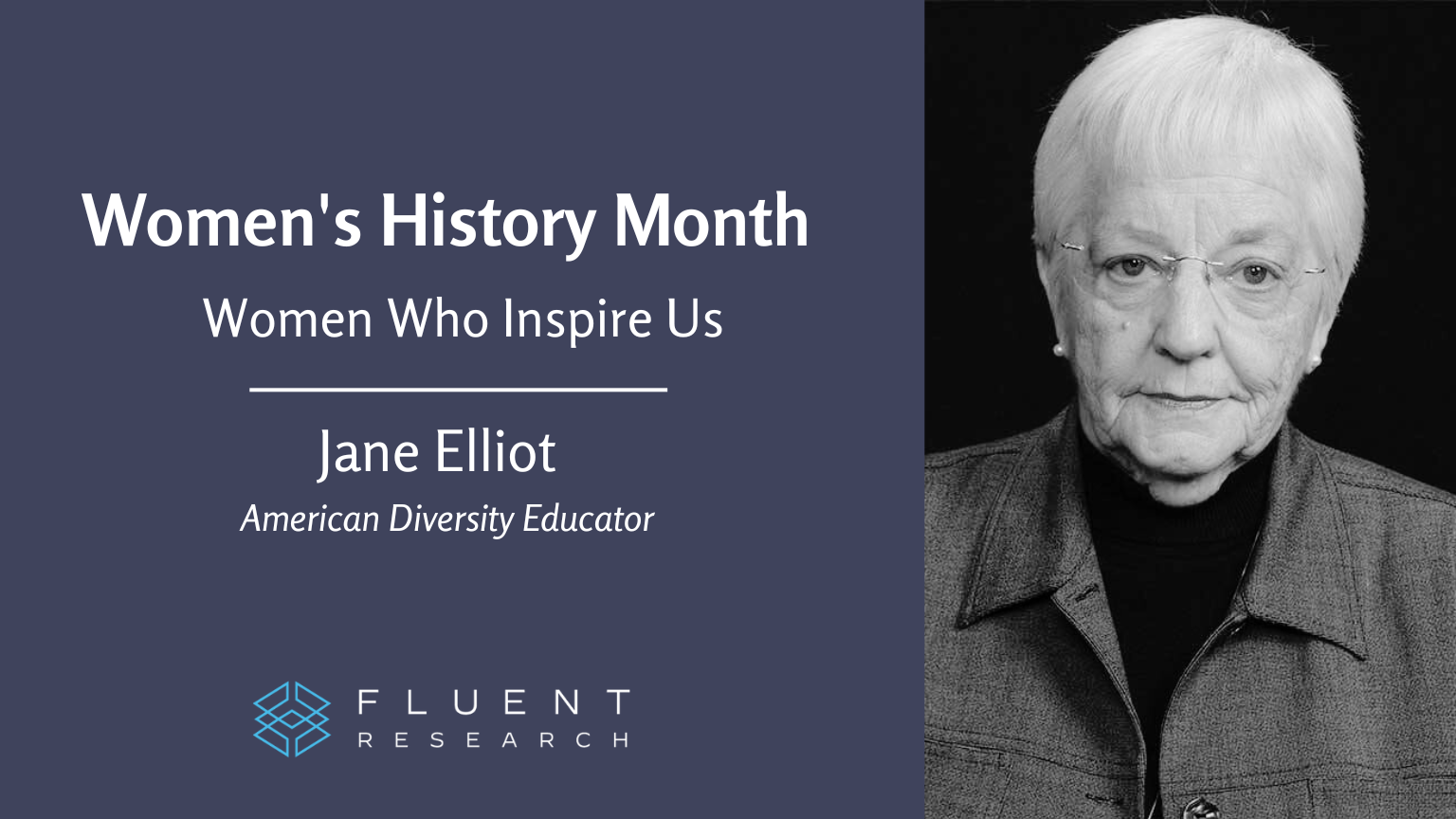
This Women’s History Month and we’re excited to share this post from Fluent’s Project Manager, Aeliya Ahemd, where she shares her admiration for Jane Elliot, a trailblazing educator.

A woman who inspires me is Jane Elliot, a powerhouse educator and anti-racist activist.

First coming across her work in a child development psychology course in college, I learned about her groundbreaking “Blue Eyes/Brown Eyes” classroom exercise with her third-graders to allow her students to see firsthand what experiencing discrimination could feel like. Fifty years later, her work is just as important as it was then.

Elliot’s ideas about race were not popular at the time, as they challenged the deeply ingrained attitudes of her small, predominantly-white town in Iowa, but despite criticism and backlash, Elliot didn’t shy away from being a tireless advocate for anti-racism education. She confronted injustice head-on — and continues to untill today, more than five decades later. Since her “Blue Eyes/Brown Eyes” classroom exercise, Elliot’s work has been dedicated to the pursuit of racial equity and justice. In 2019, Elliot gave a lecture at my college campus, and getting the chance to hear her speak ardently and witness her indomitable spirit was heartening.

Above all, I deeply admire Jane Elliot’s message on the transformative power of education. Through her work, she doesn’t just share knowledge; she instills empathy and compassion, shares meaningful actions we all can take to create a more equitable society, and challenges us to hold ourselves accountable. She’s teaching us how to be better people.

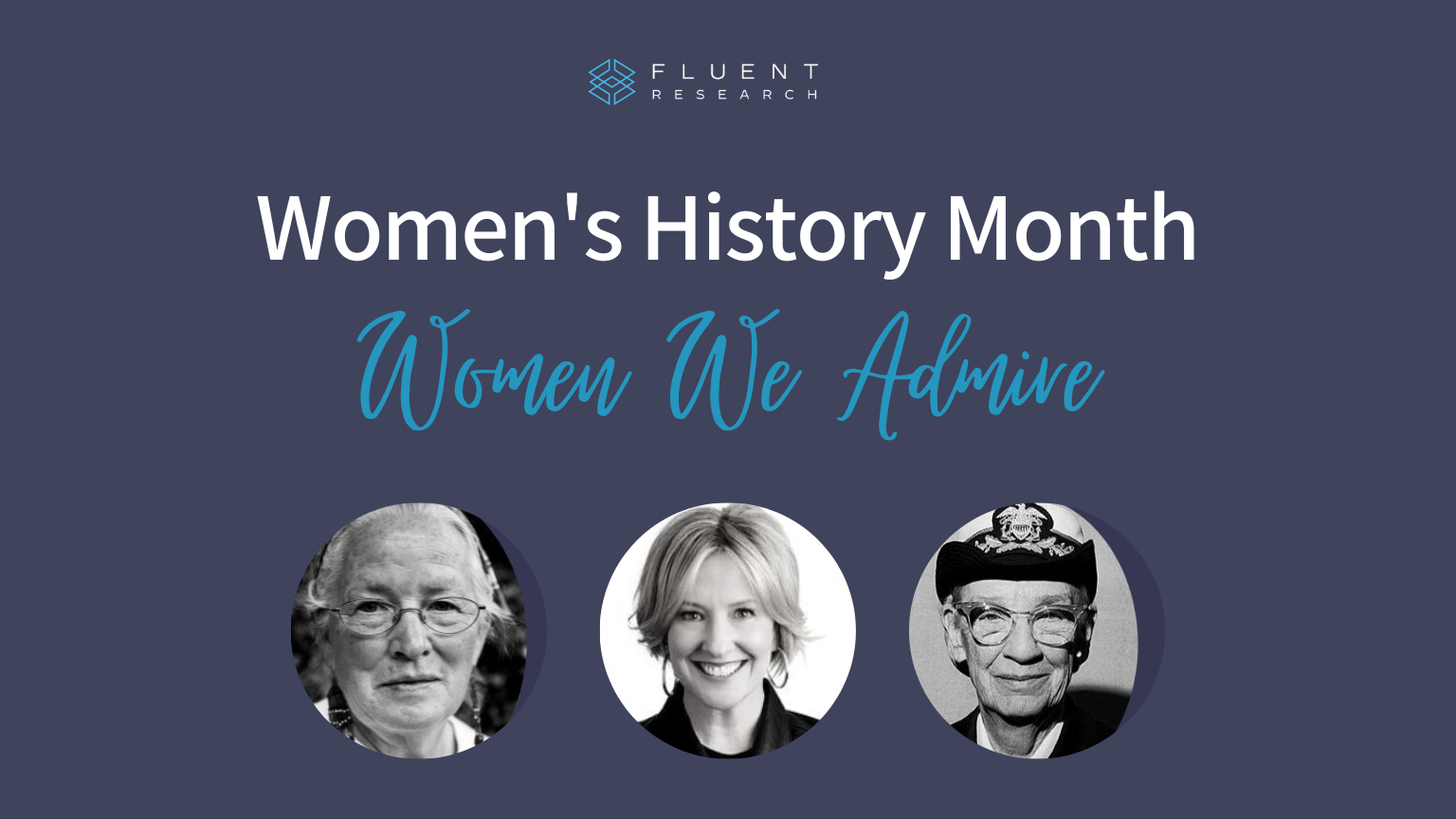
In celebration of Women’s History Month, we asked a few of our Fluent team members to write about the women who inspire them. From lauded professors to pioneering civil rights activists, read below to learn more about the important work and incredible achievements of the women we admire.

Quantitative Researcher Amber González on Joan Trumpauer Mulholland

In November 2016, I had the pleasure of meeting Joan Trumpauer Mulholland — a renowned activist. Joan participated in and helped organize some of the most influential moments of the 1960s Civil Rights Movement, including the Freedom Rides, Jackson Woolworth’s sit-in, the March on Washington, and the Selma to Montgomery March.

Despite her upbringing as a young white woman in the segregated South, being a child of segregationists, and a great-granddaughter of slave owners, Joan had an unwavering dedication and commitment to challenge racial segregation. She shed light on the repercussions of her involvement, including being disowned by her family, imprisoned and placed on death row, and hunted by the KKK for execution. It was truly inspiring to hear a first-hand account of stories from an unlikely hero of the 1960s Civil Rights Movement, whose devotion to the cause required the utmost conviction and courage.

Her legacy does not end there. To this day she continues to challenge racist ideology through the efforts of her organization, the Joan Trumpauer Mulholland Foundation whose mission is to educate youth about the Civil Rights Movement and inspire others to make a difference through activism in their community.

Reflecting back, I’m grateful I crossed paths with Joan when I did, during my senior year of college, one week after the 2016 election. It was a period marked by an uptick in incidents of racist and xenophobic harassment on my college campus and across the country, and her inspiring story and words of wisdom reinvigorated me to remain engaged in activism on and off campus.

Senior Researcher Sylvia Rusnak, Ph.D. on Brené Brown

One woman that inspires me is author and professor Brené Brown. She researches courage, vulnerability, shame, and empathy. I admire her because her research has real-world impact; her work helps us understand ourselves and create meaningful change in our lives.

Brené is a storyteller and communicates her work in a way that resonates. As a researcher, I strive to conduct research that ultimately improves the lives of others and communicate it in a way that clicks.

Brené’s work also has importance for how we show up in our lives for ourselves, for others, and also for how we work. Vulnerability at work allows for creativity and meaningful conversations. Her work inspires me to try to be brave: to show up to take action, rather than to stand by on the sidelines, simply observing or commenting on the actions of others.

Senior User Experience Researcher Farrah Brensinger on Grace Hopper

If you have ever noticed and reported a ‘bug’ to software developers, you have Grace Hopper to thank for this offbeat way to describe a software glitch. Hopper minted the label after a bonafide moth got stuck in her computer and caused it to go haywire.

Hopper’s influence in software goes far beyond adding the unusual term to our everyday computer lexicon. The first woman to receive a Ph.D. in Mathematics from Yale, she went on to create A-O, a ‘compiler’ program that translated mathematical terms into machine-readable computer code. She later invented a compiler that made machine-readable code from English-language inputs, enabling mainstream computer usage for those with non-programming backgrounds. She received the 1991 National Medal of Technology from President George Bush, recognizing her technological impacts on ‘open[ing] the door to a significantly larger universe of users.’

When asked about her most important accomplishments, she listed training young people right alongside her programming triumphs. Undoubtedly, Grace Hopper would be pleased to see so many young women entering the computer science field today, ready to push the boundaries of programming, just as she did.

Grace Hopper’s story inspires me to innovate for good and look for additional opportunities to get life-changing technologies into the hands of as many people as possible.