STEM

As a rising college freshman, about to embark on my first year at Northwestern University, I have been asked to write a number of essays over the last year on my desire to pursue a STEM field of study in college. I am aware of the challenges I will face as a woman in a male-dominated industry, and I have reflected on my disappointment that men occupy the majority of high-level positions in the field. As part of the next generation to enter the workforce, however, I am determined to change that statistic. 

A Summer Internship

This past spring, I applied to internships throughout New York City, including one with Fluent. Unaware of the transformative experience awaiting me, I walked into Fluent’s offices in June, excited to learn more in my field of study, despite the few female role models I thought I would find there.

At first glance, I had not even realized that women make up the majority of Fluent’s staff. After a few weeks of being in the office, I noticed that there were two women’s bathroom keys but only one key for the men’s bathroom. I looked around the office, noticing how hard everyone was working, and a smile appeared on my face. I felt proud of everyone around me, and how successful they have become. 

Looking back on my internship, I recognize how much the female representation at Fluent affected my work. I was constantly met with Dana’s welcoming in the morning, and Nellie’s kind words about my future. I felt comfortable and encouraged to ask questions, take breaks, and bond with the Fluent community, both in the office and virtually. I felt understood and welcomed by my colleagues, often engaging in conversations about college and beyond.  

Female Role Models

Fluent has given me more female role models than I could have predicted. At Fluent, I found that women are able to thrive in every discipline, whether it is marketing and recruitment or data collection and analysis. Many of Fluent’s high-level positions belong to women, meaning Fluent is often represented in meetings by women and thrives off of feminism. As a female intern at Fluent, I felt motivated to pursue my dreams because of my colleagues. In essence, Fluent has given me the opportunity and strength to be successful in my dreams. 

This type of introduction into the STEM field is so important for young women. As someone about to enter the intellectual and transformative years that college provides, having Fluent women as my inspiration will encourage my hard work and determination in school. I have felt supported by everyone around me at Fluent, and I will carry that support throughout my life.  

Fluent doesn’t just produce incredible research. It also promotes a community of belonging and support, and it’s this environment that has made my time here so extraordinary.

By Caitlin Powell

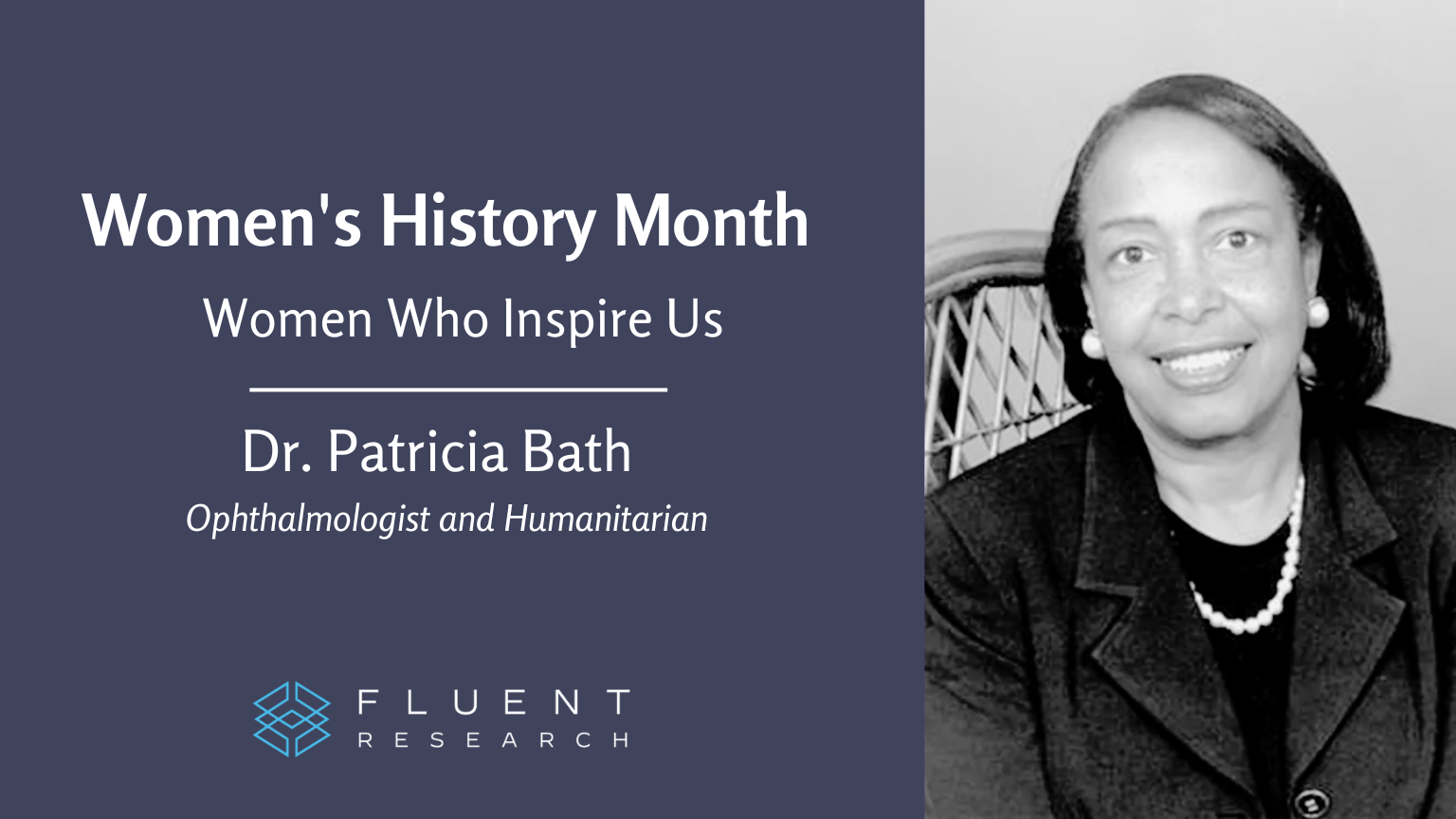
Bridging the gap between Black History Month and Women’s History Month, we celebrate the remarkable life and achievements of Dr. Patricia Bath. Millions around the world owe their restored vision to her groundbreaking ophthalmological work and early advocacy for new modalities of health care. 

A daughter of Harlem, Bath displayed scientific aptitude from a young age. While as a secondary student at Charles Evans Hughes High School she was named a National Science Foundation scholar, connecting her with researchers at Yeshiva University and Harlem Hospital Center. Her accompanying research studies explored the complex relationship between cancer, nutrition, and stress and further demonstrated her research acumen: By age 19, her research work was already being recognized in scientific journals and magazines like Mademoiselle. 

Bath continued her academic journey at Howard University and returned to New York City after graduation. While working at Harlem Hospital Center in the 1970s she observed double the rates of blindness in Black patients compared to white patients. This ignited her passion to help the blind and underserved and to develop new treatment methods. In 1976, Bath established the field of community ophthalmology, a discipline focused on preventing blindness in underserved populations through a mix of public health and community medicine initiatives. The National Institutes of Health described these efforts to make eye care more accessible through neighborhood hubs in this way: “Volunteers trained as eye workers visit senior centers and daycare programs to test vision and screen for cataracts, glaucoma, and other threatening eye conditions.” Bath also became the first African American resident in ophthalmology at New York University, a feat that marked the beginning of a series of historical firsts:

• First African American woman to serve on staff as a surgeon at the UCLA Medical Center.

• First woman to lead a post-graduate training program in ophthalmology.

• First woman elected to the honorary staff of the UCLA Medical Center.

• First African American female doctor to receive a patent for a medical purpose.

Eventually, her dedication to accessible eye care led her to co-found the American Institute for the Prevention of Blindness. The history of the Institute’s many efforts includes donating ophthalmological surgical equipment to developing nations like Pakistan and Nigeria, as well as distributing educational materials. 

Dr. Bath’s path was far from easy. While visiting as an honored guest on Good Morning America, she had this to say about being a woman of color in medicine: “I had a few obstacles but I had to shake it off…. Hater-ation, segregation, racism….”At one point in her career, the growing intensity of sexism and racism she faced in America forced Dr. Bath to temporarily relocate to Europe. There in France and Germany, she was able to continue her pioneering work in laser science. 

Beyond her extensive list of firsts, Dr. Bath is a holder of 5 patents. The Laserphaco Probe, her most celebrated invention, was a revolutionary technology in 1988. It used lasers to dissolve cataracts with ultrasonic waves in a transformative improvement over scalpel methods. In addition to inventions, Dr. Bath was an early champion of telemedicine, recognizing its potential to bridge healthcare gaps by bringing healthcare to the masses regardless of proximity to brick and mortar doctors’ offices. 

In the later years of her life, Bath was honored by the International Women in Medicine Hall of Fame, the American Academy of Ophthalmology Museum of Vision, and the Hunter College Hall of Fame. And in a cause close to this author’s heart, in 2009 she was selected by then-President Barack Obama to serve on a digital accessibility task force. 

While Dr. Bath passed away in 2019, her inspiring legacy continues to illustrate the power of women in STEM. When girls and women are empowered to pursue science, all manner of breakthroughs are possible. She had this to say about serving as a role model: “I want to pass the torch to young girls and have them do S.T.E.M. and have them do ophthalmology.” Today, we can remember Dr. Bath for her brilliance, determination, and courage, but also for her humanitarian devotion to preserving sight for all.

By Farrah Brensinger, Senior User Experience Researcher.

——–

Resources:

1: Lemelson-MIT Program. (n.d.). Patricia Bath. The Lemelson-MIT Program. Retrieved March 20, 2025, from https://lemelson.mit.edu/resources/patricia-bath

2: National Museum of American History. (n.d.). Patricia Bath papers, 1960-2019. Smithsonian Institution. Retrieved March 20, 2025, from https://americanhistory.si.edu/de/collections/archival-item/sova-nmah-ac-1585-ref110

3: ABC News. (2018, November 27). Revolutionary ophthalmologist Dr. Patricia Bath shakes off haters. Good Morning America. Retrieved March 20, 2025, from https://abcnews.go.com/GMA/Wellness/revolutionary-ophthalmologist-dr-patricia-bath-shake-off-haters/story?id=53357320

4: Anumula, V., Kanyadan, P., & Kanyadan, C. (2024, July 30). Patricia E. Bath: A luminary in ophthalmology. Cureus, 16(7), e65781. https://doi.org/10.7759/cureus.65781

5: National Library of Medicine. (n.d.). Patricia Bath, MD, ophthalmologist. Retrieved March 20, 2025, from https://cfmedicine.nlm.nih.gov/physicians/biography_26.html

6: Lottie. (2021, June 30). Patricia Bath biography for kids. Retrieved March 20, 2025, from https://www.lottie.com/blogs/strong-women/patricia-bath-biography-for-kids?srsltid=AfmBOoo7grMzWKUwJ_l0BXVggJVT6ek3gBFs_J56AxfFCxVzmPTWlPFY

7: Wikipedia contributors. (2025, March 20). Patricia Bath. Wikipedia. Retrieved March 20, 2025, from https://en.wikipedia.org/wiki/Patricia_Bath


On February 11, the world celebrates the International Day of Women and Girls in Science. This day is dedicated to recognizing the achievements of women in STEM (Science, Technology, Engineering, and Mathematics) fields. It is meant to inspire the next generation of girls to pursue scientific careers. Despite progress over the past few decades, women remain underrepresented in many STEM disciplines (i.e., engineering, physics, and computer science). 

For more than a decade, I’ve studied how exposure to STEM can shape the trajectory of a child’s aspirations. Early exposure to STEM and the representation of women in STEM are especially critical to helping girls seem themselves as scientists.

The Problem: Underrepresentation of Women in STEM

The underrepresentation of women in STEM is not just a question of current numbers. It is deeply tied to the ways in which girls perceive STEM fields from a young age. One well-known tool for measuring these perceptions is the “Draw-A-Scientist” test. This research method has been used for decades to analyze how children envision scientists. 

A meta-analysis of children’s drawings found that early elementary school children drew male and female scientists in nearly equal numbers. However, high school students depicted male scientists four times more frequently than female scientists. This trend was even more pronounced among girls. At age six, about 70% of girls drew female scientists, but by age 16, only 25% did (Miller et al., 2018).

When girls don’t see themselves reflected in STEM careers, they are less likely to believe they belong in those fields. This can affect their motivation to pursue advanced coursework in science and math, reducing the likelihood of a STEM career. But research also shows a solution. Early exposure to STEM learning opportunities and female role models can foster a lasting interest in STEM.

The Importance of Early STEM Exposure

Research has consistently demonstrated that early exposure to STEM concepts and experiences can shape children’s long-term academic success and career aspirations (Bustamante et al., 2023). So how can parents, teachers, and mentors help foster a love of STEM in girls? There are several evidence-based strategies that can make a real difference.

1. Build a Better STEM Foundation with Toys and Spatial Talk

Play is a powerful way for children to develop STEM-related skills without even realizing it. Everyday toys and games like blocks, puzzles, and Legos are powerful ways to promote spatial reasoning, critical thinking, and problem solving. Research shows that early spatial reasoning (the ability to mentally manipulate shapes and objects) is a strong predictor of later success in engineering and math.

Importantly, playing with kids rather than having them play alone helps to increase enjoyment and scaffold their learning. For example, adults and kids can try building a tower together and predicting when it will fall over. Then, they can problem solve together to figure out how to prevent it from falling over again. 

Using spatial language (e.g., words like “up” “small” and “flip”) can enhance children’s spatial reasoning skills during play. Studies have found that parents who use more spatial language with their children see improvements in their children’s spatial abilities, especially for girls (Pruden & Levine, 2017).

2. Choose High-quality STEM TV Shows and Games

Representation matters. Media that portrays women and girls as capable scientists can help normalize these roles and inspire young viewers. One notable example is PBS’s SciGirls, a show that follows real girls engaging in STEM, from designing technology to conducting environmental research. Similarly, PBS’s Odd Squad TV series and games introduce children to problem-solving concepts in a fun, detective-style format that spotlights female characters. 

Fluent Research has partnered with similar organizations to conduct research on the impact of exposure to math games on children’s math learning. We have found that such games had a positive impact on foundational math skills. TV shows and games focused on STEM not only promote these important skills, but can challenge stereotypes of girls in STEM fields.

3. Give Girls more Real-World STEM Experiences

Extracurricular STEM programs provide girls with opportunities to explore science and technology outside the classroom. Organizations like Girls Who Code offer free programs that teach girls how to code in supportive, collaborative environments. Similarly, STEM-focused exposure to programs like summer camps and science fairs provide hands-on experience to a variety of STEM concepts that can pique their interest.

Programs that bring scientists and engineers into classrooms can also have a significant impact. Schools and community organizations can invite female professionals to speak about their work as scientists, engineers, and data analysts. When girls meet women in STEM careers, they recognize that success in these fields is both attainable and important.

Supporting the Next Generation of Women in STEM

Supporting the next generation of women in STEM is crucial for expanding the roles women play in these fields. Promoting girls’ interest in STEM is not just about creating opportunities. It’s about challenging stereotypes, providing role models, and fostering environments where girls can build confidence in their abilities. At Fluent, we are dedicated to conducting research that supports children’s engagement with STEM. By supporting these initiatives, we help ensure that the next generation of scientists and leaders in STEM includes more girls.

Written by Kelly Sheehan, Senior User Experience Researcher at Fluent Research