

Youth Today Tag

“Don’t believe the hype.”
—Public Enemy

“Reading the world always precedes reading the word.”
—Paulo Freire

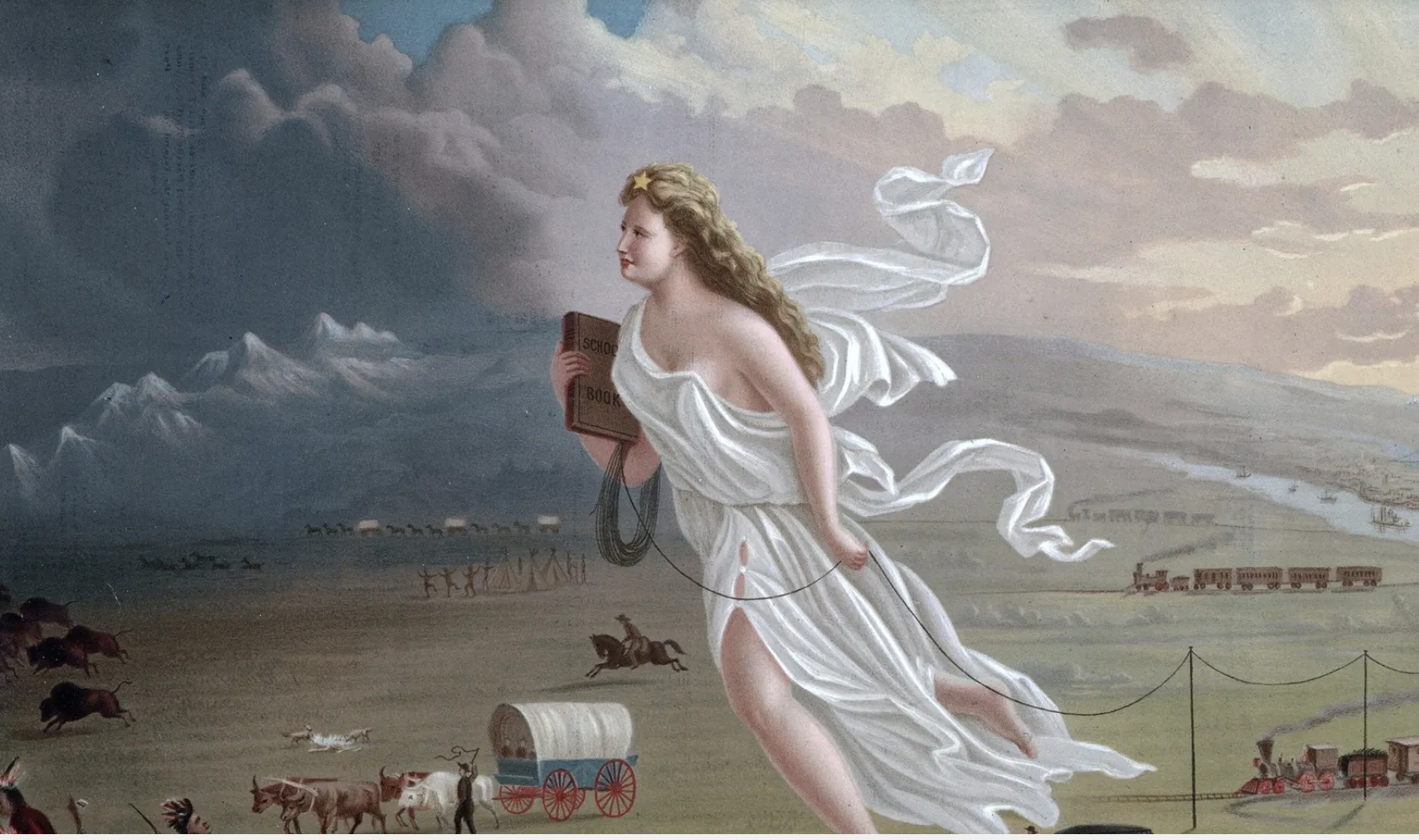
I remember seeing a painting in social studies class of a woman floating westward across the continent, glowing in white, carrying a book. Behind her were farms, ships, railroads, towns and light. Before her were Native people, buffalo, wild animals and darkness, all being pushed toward the edge of the frame. This was John Gast’s “American Progress.” What I didn’t know until recently was that the woman was Columbia, the female personification of the United States, and that she was carrying a telegraph wire in one hand and a book in the other. I assumed the book was the Bible. Upon closer inspection, it says “Schoolbook.” I was intrigued.

The message was now clear to me: Civilization is arriving. Communication is arriving. Schooling is arriving.

Educational historians like Joel Spring have noted that nineteenth-century schooling was not only a benign push for literacy. It was also a policy of denationalization, using schools to dismantle a people’s language, history and sovereignty and replace them with Anglo-American norms. For me, the schoolbook may be the most revealing object in the painting because it exposes the arrogance at the center of the image. Columbia is not simply bringing education. She is bringing a premade idea of Schooling: formal, institutional, book-based and settler-defined. The painting asks us to see that book as progress. It also asks us to ignore the forms of knowledge already present in the darkness.

The people living there were not uneducated. They were educated differently. Developmental psychologist Darcia Narvaez has argued that Indigenous worldviews begin from a radically different premise than the dominant Western one: human beings are not separate from nature, but nested within a living web of relationships, responsibilities and reciprocal obligations. That kind of education was carried through language, story, ceremony, observation, memory, practice and relationship. Children learned how to read weather, follow animals, understand plants, prepare food, honor kinship, recognize danger, share responsibility and live within the limits of a place. Education was not separate from life. It was how life continued.

Columbia’s schoolbook, then, does not simply symbolize learning. It symbolizes the dismissal of culture.

That dismissal matters because settlers moving west were entering environments many of them did not understand. A book from the East (U.S.) could teach reading, arithmetic, scripture, citizenship and national identity. But it could not, by itself, teach the daily work of making life possible in a new landscape. The knowledge most urgently needed in those places was often place-based, practical, ecological and communal. Much of it was already held by the people being displaced.

People have always migrated, traded, borrowed, taught, married, adapted and learned from one another. There were surely things settlers knew that could have been useful to Native communities, just as there were countless things Native communities knew that settlers urgently needed to understand.

That is the ordinary and humane version of cultural exchange: people meeting one another with curiosity, humility and practical need. That is dialogue.

But that is not what “American Progress” shows. The painting does not imply mutual learning. It moves in only one direction. Columbia does not arrive as a neighbor. She arrives as a teacher. She does not ask what is already known. She assumes need and want.

That is the real failure of Columbia’s schoolbook: she brought education without listening. Settlement without humility becomes possession. Education without listening becomes conquest.

That pattern has not disappeared. It has only changed direction. Today, the imposition is from well-resourced (and well-intentioned) “American-dream groups” to under-resourced communities. Adults, institutions, philanthropies and policymakers arrive with their own schoolbooks: everyone should go to college, every child needs a laptop, every school needs the same pathway to success, every community needs the same innovation.

Some of these ideas are useful. College can open doors. Technology can expand access. Credentials can matter. But when these solutions arrive already written, they can repeat Columbia’s mistake. They assume the problem is absence: absence of aspiration, absence of knowledge, absence of tools, absence of culture. They do not always begin by asking what is known and what is meaningful.

The geography has changed, but the posture can remain the same. What I see resulting from this are “successful” young people who have learned how to succeed inside school rather than how to live well outside it. They may know how to perform the rituals and routines of a stranger’s vision, yet feel disconnected from their bodies, communities, environments and practical responsibilities.

Environmental educator David Orr famously argued that the planet does not need more “successful” people in the narrow institutional sense; it needs people who know how to inhabit a place well. Modern education often separates knowledge from place and people. It teaches students to master symbols while losing fluency in the living systems that sustain them.

A different book may have been better. Or perhaps it would not have been a book at all. It might have been a seasonal calendar, a bundle of stories, a set of tools, a map drawn by those already there, a packet of seeds, an empty notebook. It might have taught reading and writing, but also tending, repairing, growing, observing, sharing and belonging.

Columbia’s mistake was that she brought a book already written. She should have brought an empty one — and learned how much was already known.

Oh, I should probably acknowledge that there are no hip-hop references here. Sorry.

***

By Dan Warren, Director, Youth Development & Education, Fluent Research

This article was originally published in Youth Today on July 16, 2026 as part of the series Dan writes called Pass the mic: Where hip-hop meets human development. Each month, he brings scholars and rappers into dialogue to spark new ways of seeing youth, culture and change.

Previous pieces in the Pass the MIc series:

“Styles upon styles upon styles is what I have.”
—Beastie Boys

“People believe they have learning styles, and they try to think in their preferred style, but doing so doesn’t help them think.”
—Daniel Willingham

My music app thinks it knows me. Most days it does.

I went on a streak of listening to 1970s and early 1980s New York rap a month ago. Must have listened to Funky 4+1’s “That’s the Joint” fifty times over the course of a week, and my algorithm noticed.

At first, that feels good. The algorithm gets me. It recognized my taste and responded to feed me some more tasty stuff with similar flavors. But after a while, the recommendations can feel less like discovery and more like confinement. It keeps giving me the same music, when what I liked was bigger than the songs themselves.

Maybe I wasn’t only drawn to “old-school NY rap.” Maybe I was drawn to the party atmosphere, the call-and-response, the group vocals, the dance-floor pulse, the funk and disco underneath it. A smarter algorithm might hear those deeper qualities and move outward: go-go, house, electro, club rap or later records that sampled and reimagined that early energy (e.g., the Beastie Boys’ Paul’s Boutique).

The problem is not that the algorithm knows I like Funky 4+1. The problem is that it may not know why.

That, in my opinion, is also the problem with learning styles.

For years, there has been a strongly held popular belief that people (especially young people) have a specific way they learn best: visual, auditory, kinesthetic or some other style. Throughout my frequent conversations with teachers, I hear this distinction frequently about the students they teach and an inevitable declaration about their own learning style. The idea comes from a good place. It sounds respectful. It tells young people, especially those who have struggled in school, “You are not bad at learning. You just learn differently.”

While it stems from a generous and well-meaning instinct, the popular focus on fixed learning styles can be more restrictive than helpful.

Educators and youth workers should notice a difference. But Daniel Willingham, a cognitive psychologist at the University of Virginia, is one of the leading researchers challenging the claim behind learning styles that students learn better when instruction is matched to a fixed personal style.

Willingham reinforces the point that students are not all the same. He echoes the feeling that preferences are real and powerful. But he is also saying that preference is not destiny. The best way to teach something depends less on a learner’s label and more on the content, the task, prior knowledge, attention, practice and what the student is asked to think about.

A map may help with geography because geography is spatial. Hearing pronunciation matters when learning a language. Physical practice matters in dance or sports. But none of that should compel us to believe that a person is permanently one kind of learner. It only proves that good teaching matches the strategy to the material.

Learning styles become dangerous when they start to operate like a shallow algorithm.

A student says: “I like seeing things that I am learning about.”

The system responds: “You are a visual learner! We will give you visuals.”

The student concludes: “I am a visual learner.”

The system narrows further: “Then we will avoid methods that do not match your style.”

Then the student begins to wield the label too: “Yes, I will also avoid methods that do not match my style.”

This is where the label becomes more than a description. It becomes a form of agency. The young person now has language to explain discomfort, defend preference and opt out of unfamiliar learning situations. That may feel empowering at first, but over time it can shrink the learner’s range. Reading feels foreign. Lecture feels impossible. Discussion feels inefficient. Writing feels like punishment. Practice feels boring.

What began as recognition becomes restriction.

The better response is not to ignore preference. Preference matters. If a young person says they like visuals, we should listen. But then we should ask what is underneath that preference. Do they need structure? Examples? Pattern? A model before they try?

Those are different needs. They call for different supports. Calling all of them “visual learning” may be as crude as calling Funky 4+1 only “old-school rap.” It is accurate enough to feel useful and crude enough to become harmful.

Although such simple labels are lovely in their own way, youth work should be more expansive than that. When a young person tells us what feels comfortable, we can treat that as a doorway, not a diagnosis. We can begin where they are, but we should not leave them there.

The goal is not learning style. The goal is learning range. It is dynamic.

A good youth-serving professional, like a good DJ, widens the mix. They invite young people to talk, read, move, build, listen, perform, revise, reflect and try again. They honor and celebrate what youth prefer while helping them discover what else they can do.

People are not visual learners, auditory learners or kinesthetic learners. They are learners.

Our job is not to build a smaller playlist around their preferences. It is to hear the deeper pattern, widen the mix and help them discover capacities they did not know they had.

And if we didn’t know that before — well, now we do.

***

By Dan Warren, Director, Youth Development & Education, Fluent Research

This article was originally published in Youth Today on July 16, 2026 as part of the series Dan writes called Pass the mic:Where hip-hop meets human development. Each month, he brings scholars and rappers into dialogue to spark new ways of seeing youth, culture and change.

Previous pieces in the Pass the MIc series:

“When it’s real, you’re doing this even without a record contract.”
— Nas

“Sparks — when illuminated and nurtured — give young people joy, energy and direction.”
— Peter Benson

When I was in graduate school, I taped to the wall in my office an image of Nas (from a Rolling Stone illustration) along with the lyric above. To some degree, it mocked me. I often felt that the only reason I chained myself to that desk was for the letters that would follow my name when I was done. Anyone who has gone through doctoral training can probably attest to that kind of crisis, and Nas got a front row seat to mine. I still cannot fully explain why I went through that process, but I am pretty sure it was not because of a deep love of learning. I snowboarded, played hockey, worked in my garden and played music because of the joy I felt while doing them, not because I expected recognition or reward. Graduate school felt different, and Nas and I knew it.

What makes that line resonate with me is partly what it meant and partly that Nas said it to open Illmatic, his critically acclaimed debut studio album, released in 1994, which is widely regarded as one of the greatest hip-hop albums of all time. It stays with me because it offers a definition of realness that has very little to do with recognition. It points instead to a kind of commitment that exists before validation arrives. The contract comes later. The applause comes later. The proof comes later. What comes first is the relationship between a person and the thing they feel called to do. It involves passion and faith.

That raises an important question for those of us who care about young people:

Are we helping them develop a genuine relationship with the process of doing something, or are we surrounding them with environments that teach them to care mostly about the outcome?

Nas is a useful example because his story makes that distinction visible. Before the acclaim, before Illmatic, before the industry confirmed his value, there was a young person in Queens who had already found something that mattered to him. Hip-hop was not initially a product or a career path. It was a place to put his mind, his observations, his hunger and his craft. The record contract formalized something that already had life. It did not create the life itself.

Peter Benson had a beautiful word for this kind of energy: sparks. He used it to describe the talents, interests and passions that give young people a sense of direction and aliveness. A spark is more than competence. A person may be skilled at many things and feel deeply connected to only one or two of them. I was a much better student than a gardener. A spark has heat. It draws a person back. It makes effort feel worthwhile.

That question applies as much to school as it does to youth programs. Schools often speak the language of curiosity and growth, yet students quickly learn that much of the system revolves around grades, ranking, compliance, deadlines and visible achievement. Youth programs can fall into a similar pattern through leadership outcomes, portfolios, showcases and other measurable indicators of growth. None of those things are unimportant.

The problem begins when the structure surrounding the activity becomes so dominant that the activity itself loses its inner pull.

Edward Deci and Richard Ryan’s Self-Determination Theory helps explain why some environments nourish motivation while others thin it out. They argue that people are more likely to stay deeply engaged when three conditions are present: autonomy, competence and relatedness. Young people need room to exercise ownership. They need the experience of becoming more capable. They also need to feel connected to other people and to some larger sense of meaning.

William Damon’s work on purpose shows what can happen when a spark survives long enough to mature. Purpose is not a passing interest. It is a stable and meaningful commitment that matters to the self and also reaches beyond the self. A spark begins as energy. Intrinsic motivation sustains that energy over time. Purpose gives it direction and weight.

Seen through that lens, Nas’s line captures the beginning of a developmental arc. If it is real, you are doing it before anyone confirms that it is worthwhile. You are still there when the work is repetitive, when no one is watching and when the result is uncertain. That is what makes the contract meaningful in the first place.

For schools and youth programs, the practical implication is clear. We should care about outcomes, but we should also pay attention to the quality of a young person’s engagement along the way. We should ask whether they are becoming more curious, more self-directed, more absorbed and more connected to what they are doing.

This feels especially urgent in a culture that constantly invites people to bypass process. The deeper concern, though, is older than any current tool. When process loses its meaning, passion begins to thin out. When passion thins out, purpose becomes harder to form.

The task, then, is helping young people stay lit from within. It is to notice the early spark, to build schools and programs that support intrinsic motivation and to respect the long, uneven process through which a real interest becomes a real calling.

Nas was right. If it is real, you are doing it anyway.

And if we didn’t know that before — well, now we do.

***

By Dan Warren, Director, Youth Development & Education, Fluent Research

This article was originally published in Youth Today on May 21, 2026 as part of the series Dan writes called Pass the mic:Where hip-hop meets human development. Each month, he brings scholars and rappers into dialogue to spark new ways of seeing youth, culture and change.

Previous pieces in the Pass the MIc series:

My brother-in-law is a potter. Not as a hobby. That is actually his job, and he is very good at it. Over the years he has explained a fair amount about his craft. One of the things that he explained has always stuck with me: if a piece becomes too perfect, it can lose its life. It becomes less interesting. More sterile.

I have always liked that idea, mostly because I use it as an artistic justification for my own sloppiness. Clearly this is not what he was referring to. But I have borrowed that idea more than once to justify my own rough edges.

Still, I think he was pointing toward something real. Life often comes from a certain kind of imperfection. Not carelessness, but a refusal to overprocess. Something left a little rough can feel more open to the unexpected. It can feel more human.

I saw something similar when I was an elementary school teacher. The lessons I had most meticulously orchestrated, usually the ones delivered under observation, often came up short of their promise. Everything was in place. The timing was tight. The plan was polished. Yet the energy in the room was often flat.

Meanwhile, the days when I had a clear sense of direction but less precision in the script were often the ones where something real happened. Students asked surprising questions. The conversation shifted. Someone took the idea somewhere I had not anticipated. The room felt alive.

When both structure and control are high, everything depends on the person getting it exactly right. There is very little room for deviation, and when your audience is young people, deviation is part of the point, not a design flaw.

For me, this difference shows up clearly if you compare two legendary hip-hop producers: Dr. Dre and RZA.

Dre is famous for precision. His tracks are polished, balanced and exacting. Every layer feels intentional. Every sound is refined until it lands exactly where it should. The final product is smooth and controlled, and that is part of what makes it impressive to me.

His perfectionism even extends beyond the studio. Dre helped build a headphone and speaker company designed to preserve the sonic effort for the listener. The idea was simple: If you put that much care into crafting the sound, you want to make sure none of it gets lost in delivery.

RZA, especially in the early Wu-Tang Clan years, built something very different. His beats were raw, gritty and sometimes almost unstable on first listen. The mixes sounded dusty. The edges stayed exposed. Nine different voices entered the track with their own rhythms, tones and personalities. Yet the songs held together. Underneath the roughness was a structure strong enough to carry all that unpredictability without collapsing. The beat created a frame that allowed the energy to move.

Both producers understood structure. The difference is what they did with it.

• Dre used structure to perfect the product.

• RZA used structure to hold the energy.

I would argue that distinction matters for youth programs.

Sometimes, those designing or working with young people assume that strong programs require tight control. We have all heard, “Proper planning prevents poor programs.” Schedules must be precise. Activities must run smoothly. Behavior must be carefully managed. In this mindset, success looks like order. The room is quiet. Transitions are efficient. Everything is running according to plan.

From the outside, this can look impressive. But youth development does not always flourish in perfectly polished environments.

Young people do need structure. They need clear expectations, shared norms and a sense of safety. They need adults who are paying attention and creating space for the experience.

What they may not need is an environment where every move has already been predetermined. Nor should youth practitioners aspire to such perfection.

Those feelings emerge when they have room to contribute ideas, influence the direction of the group and bring something of themselves into the space. That kind of engagement is rarely perfectly smooth. It involves experimentation, negotiation and the occasional moment of friction.

In other words, it looks a little more like a RZA track than a Dre experience.

A strong youth program has rhythm. Expectations are clear. Adults hold the environment steady. But within that frame, young people are allowed to bring their own voices forward. Their personalities remain visible rather than polished away.

If young people are quiet and following directions, we assume the program is working. But compliance and engagement are not the same thing. A room can be orderly and lifeless at the same time.

Real engagement has more texture. It shows up in curiosity, debate, humor, invention and the willingness to take risks. It shows up when young people begin to see themselves not just as participants but as contributors. That kind of energy requires a structure strong enough to hold difference but flexible enough to allow it.

Just as RZA built the beat underneath the music, youth practitioners play a critical role in shaping youth environments through establishing norms, maintaining safety and holding the larger vision, not by controlling every note.

Sometimes the most powerful thing an adult can do is create a frame strong enough that young people can bring their full voices into the room.

The structure holds and life emerges inside it.

And if we didn’t know that before — well, now we do.


By Dan Warren, Director, Youth Development & Education.

This article was originally published in Youth Today on March 31, 2026.

Gratitude is often treated as a polite habit, a personal virtue or a wellness practice. Simple and straightforward. Young people are encouraged to say thank you, write gratitude lists or focus on what they have.

Developmental psychology tells a story that’s a bit more complicated. In this context, gratitude is a developmental capacity that goes beyond a behavior or a feeling. It is the ability to recognize how one’s life has been shaped by others, to understand one’s impact in return and to feel a sense of responsibility that grows out of that awareness. Gratitude matters because it reflects an important shift in how people see themselves from isolated actors toward participants in a greater system of relationships, influence and obligation.

In my opinion, few public figures provide us a clearer example of this shift than Adam Yauch, better known as MCA of the Beastie Boys.

MCA’s legacy is often remembered through music, activism and cultural impact. But seen through a developmental lens, his story offers something else: a clear example of how gratitude can emerge alongside maturity, identity and purpose.

Gratitude Is Not Where We Start

From a developmental perspective, this matters. Erik Erikson argued that adolescence and early adulthood are dominated by the task of identity formation, which involves figuring out who you are, how you belong and how you are seen. At this stage, identity is often performed outwardly. It is loud, experimental and sometimes reckless. The goal is differentiation, not reflection.

Early success can intensify this dynamic. When young people are rewarded for bravado, transgression or shock value, those attributes become reinforced because they are effective, not because they are grounded. Identity gets shaped by feedback loops rather than reflection.

The early Beastie Boys fit squarely within this developmental reality. Their rise was rapid, their visibility immense and their personas rewarded for being provocative and boundary-pushing. That combination of intense recognition arriving before perspective had fully formed created an environment where experimentation and bravado were not just encouraged but publicly amplified. This is not an indictment; it is a developmental observation. When identity is still taking shape, high visibility and cultural reward can make immature decisions more likely, more consequential and harder to undo. Identity work at this stage is provisional, and the stakes are often much higher than young people are equipped to manage.’

Gratitude rarely shows up here as an influence. Not because young people are ungrateful, but because gratitude requires something identity formation has not yet fully developed: perspective over time.

The Developmental Turn: Looking Back Without Freezing

One of the most striking aspects of MCA’s evolution is that he did something many people, especially public figures, struggle to do: he looked back honestly.

He publicly acknowledged the harm in some of his earlier lyrics, took responsibility without deflection and changed how he showed up as an artist and cultural figure. Importantly, he did not disown his past or pretend it never happened. He integrated it.

This distinction matters. Erikson described healthy identity not as a clean break from earlier selves but as an integration of experience. Growth relies heavily on memory.

This is where gratitude begins to take shape. The first step is recognition. Recognition of influence, recognition of impact, recognition of who and what shaped you and who may have been affected along the way. Recognition alone is not gratitude, but it makes gratitude possible. Gratitude emerges when that awareness deepens into appreciation and responsibility.

The Influence of Purpose

William Damon’s work on purpose helps clarify what happens next. Damon defines purpose as a stable intention to accomplish something meaningful to the self and consequential to the world beyond the self. Purpose marks a developmental shift from self-definition to contribution.

Gratitude and purpose are closely connected, but they are not the same. Gratitude reflects growing awareness of influence, interdependence and responsibility. Purpose reflects what people do with that awareness over time. In this sense, gratitude can be understood as a developmental foundation for purpose. Once people recognize what they have received from communities, cultures, collaborators and predecessors, the question naturally changes from “Who am I?” to “What do I owe?”

MCA’s later life reflected this shift. His activism, particularly around Tibetan freedom and anti-war efforts, was purposeful. It was sustained, values-driven and embedded in how he used his platform. This was gratitude expressed through responsibility and long-term commitment.

Why This Matters for Youth Work

For those who work with young people, this framing has real implications.

First, it reminds us not to freeze youth in their worst moments. Identity formation involves experimentation, missteps and revision. It’s messy, and when systems respond to adolescent missteps with permanent labels or exclusion, they interrupt development rather than support it.

Second, it challenges shallow approaches to character education. Gratitude cannot be forced on a timeline. It emerges when young people are supported in reflection, accountability and repair, not when they are instructed to be thankful.

Third, it asks us to design environments that make growth through messiness possible. MCA’s evolution was not inevitable; it was enabled by time, reflection, community and the freedom to change course. Youth systems should offer the same conditions.

Gratitude, understood developmentally, is not about manners. It is about moral eyesight, which requires the ability to recognize interdependence, impact and responsibility.

Growing up in Public

MCA grew up in public. He made mistakes in public. And he modeled what it can look like to mature publicly without pretending to be perfect. That may be his most enduring lesson.

Gratitude is not a starting point. It is something people arrive at when identity stabilizes, purpose takes shape and responsibility becomes unavoidable.

And if we didn’t know that before — well, now we do.

By Dan Warren, Director, Youth Development & Education.

This article was originally published in Youth Today on February 19, 2026.

We often talk about “systems change” in youth work, but we rarely slow down to ask what real change actually looks like. One of the most helpful thinkers on this topic is historian and philosopher Thomas Kuhn, who argued that progress doesn’t usually unfold gradually. Instead, we move through paradigm shifts or moments when the old way of understanding no longer fits, and a new model takes its place.

Kuhn found that:

Change begins with anomalies — ideas that don’t fit the old model but point toward something better.

Crisis is part of growth — when old approaches no longer meet new needs.

Paradigm shifts reorganize what’s possible — replacing the old frame with a more useful one.

Kuhn’s ideas can feel abstract, but hip-hop gives us a grounded way to see them clearly. And it begins with DJ Kool Herc, widely regarded as the founder of hip-hop. In the early 1970s, Herc pioneered the breakbeat style of DJing, extending the instrumental “breaks” in records so dancers could keep moving, and built community-centered parties in the Bronx that became the foundation of the entire culture. If Herc represents the original paradigm of hip-hop (i.e., local, joyful and built on movement and connection), then the genre’s biggest innovations become examples of the anomalies and shifts Kuhn described.

Below are three of Kuhn’s core concepts, each illustrated through how hip-hop evolved from Herc’s foundation.

Anomalies: The moments that don’t fit

Kuhn argued that major change begins with an anomaly, a new idea or approach that doesn’t fit the established model. At first, anomalies can seem like outliers, but they plant the seeds for transformation.

In early hip-hop, DJ Kool Herc’s paradigm centered on celebration, dance and community connection. His parties created joy and belonging at a time when young people desperately needed both.

Then came Grandmaster Flash & the Furious Five’s “The Message” (1982). Flash took Herc’s structure and turned it in a different direction. Instead of reflecting the joy of the party, he described the poverty, pressure, violence and systemic neglect going on in the world outside of it. It didn’t fit the celebratory model. But it reflected lived reality.

This was an anomaly. The paradigm had not changed yet, but a new possibility had appeared.

Paradigm crisis: When the old model isn’t enough

Kuhn believed that once enough anomalies appear the existing paradigm enters crisis. This doesn’t mean collapse; it simply means the old explanation can’t account for everything happening around it.

In hip-hop, this crisis took shape when Public Enemy arrived. They took the honesty of “The Message” and amplified it into a full-scale analysis of policing, media and systemic racism. Their work wasn’t just storytelling, but rather sharp critique intended to educate and mobilize. They pushed hip-hop toward a purpose that Herc’s original model may not have anticipated.

Suddenly, the idea that hip-hop existed only for partying and dancing was no longer big enough. A new purpose was emerging: hip-hop as truth-telling and political engagement. The field expanded because it had to.

This is what crisis looks like: the old frame can’t contain the new reality.

Paradigm shift: A new model takes over

A paradigm shift, in Kuhn’s terms, happens when a new model replaces the old one and becomes the dominant way of understanding the field.

For this, we look again to Herc as the root: hip-hop as local, street-based and community-built.

Then we look to Run-DMC, who represented hip-hop’s cultural and commercial possibilities. They didn’t simply extend Herc’s model, they introduced a new one:

Their Adidas partnership opened the door for hip-hop fashion as global business.

Their presence on MTV broke racial barriers that had kept rap off the airwaves.

Their “Walk This Way” collaboration with Aerosmith expanded the audience for hip-hop dramatically.

Their arena tours demonstrated that hip-hop could operate at stadium scale.

This wasn’t incremental growth. It was a new paradigm: hip-hop as global culture and commercial force. Herc gave hip-hop its foundation and then Run-DMC and their massive fan base redesigned the structure built upon it.

Why this matters for people who work with youth

I assume that you aren’t reading this to learn about philosophy or music history. You’re probably reading it because many who work with young people are trying to understand change. More specifically, how to support it, how to recognize it and how to help create it.

Right now in youth work, I see several emerging and encouraging anomalies that may signal the next paradigm:

Schools and afterschool programs are beginning to collaborate more intentionally, creating 360° support around young people rather than operating in silos. This stands in contrast to the long-standing paradigm where schools focused narrowly on academics and afterschool programs were treated as optional add-ons, often working with different staff, goals and communication systems. The new coordination doesn’t fit that old model and may signal an emerging shift toward integrated youth ecosystems.

Youth voice is moving from “input” to genuine partnership, challenging long-standing adult-driven decision-making models. For decades, the dominant paradigm positioned young people as participants to be guided and consulted “when appropriate,” with adults designing programs, policies and priorities on their behalf. The growing number of youth advisory boards, youth-led research teams and shared decision-making structures represents a clear break from that tradition and may point toward a future where youth are true co-creators.

Mental health supports are being integrated into everyday youth spaces, not reserved for moments of crisis. This contrasts sharply with the conventional paradigm in which mental health was addressed only when young people were in acute distress and required referral to outside specialists. Embedding wellness practices into classrooms, afterschool programs and community settings departs from that crisis-response model and may indicate a shift toward proactive, holistic mental health support.

These ideas may seem small, scattered or inconsistent, but that’s exactly what anomalies look like in the beginning. They don’t fully fit the old framework, but they signal the edges of a new one.

Hip-hop shows us that the next paradigm rarely starts in the center. It begins at the margins: a block party, in a small studio, in the voices doing something that doesn’t quite match what came before.

If we can learn to recognize those moments in our youth systems and nurture them we may help create the next shift.

And if we didn’t know that before…well, now we do.

Dan Warren is Director, Youth Development & Education.

This article was originally published in Youth Today, on December 3, 2025.

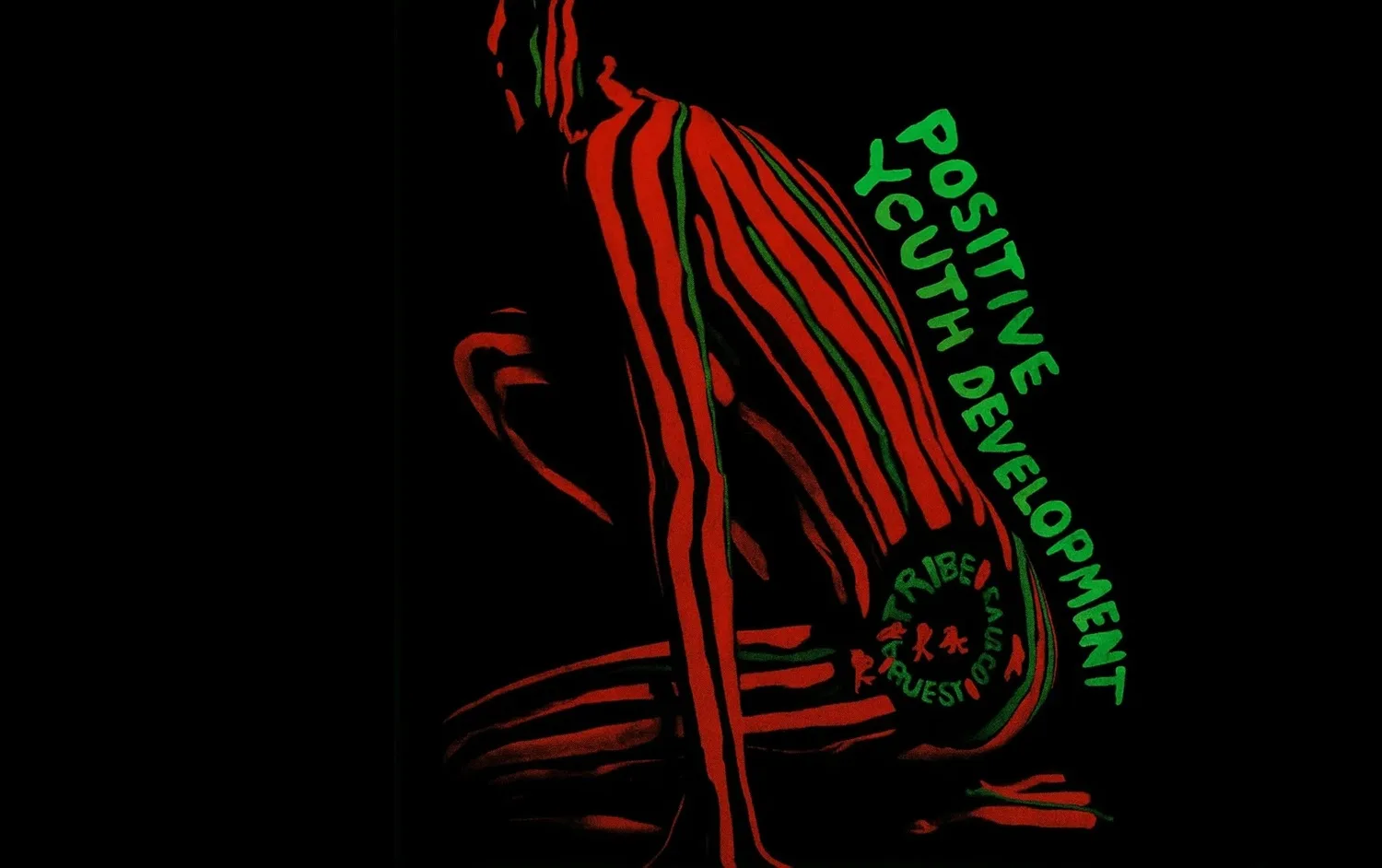
At first glance, Positive Youth Development and the Native Tongues might seem to live in different worlds — one grounded in research and youth policy, the other born from hip-hop’s playful, inventive spirit. Look closer and you see the same heartbeat: Young people thrive when we recognize their strengths, connect them to community and give them real opportunities to contribute.

The Birth of PYD

Positive Youth Development (PYD) emerged in the late 20th century as a response to deficit-based models of adolescence. Too often, young people were seen as problems waiting to happen, defined by risks like delinquency, dropout or substance use.

Developmental psychologist Richard Lerner, Ph.D., helped flip that script. His research identified the Five Cs of thriving youth: competence, confidence, connection, character and caring. Similarly, Peter Benson, Ph.D., of the Search Institute emphasized the power of developmental assets (i.e., relationships, skills and opportunities) that allow young people to ignite their “sparks.”

Together, these scholars (along with many others) advanced a movement that was not just about preventing harm but about promoting growth, leadership and well-being.

The Native Tongues as a living PYD case study

In the late 1980s and early 1990s, the Native Tongues — including A Tribe Called Quest, De La Soul, Jungle Brothers and Queen Latifah — modeled a youth-positive culture long before PYD was a common acronym. They offered a countercurrent to cynicism and narrow definitions of “realness,” centering curiosity, humor, Afrocentric imagery and community. The cipher wasn’t just a performance — it was a classroom, a lab, a family.

Through that lens, you can see the principles of Positive Youth Development in motion:

• Aiming for positive outcomes: The Native Tongues didn’t build their movement around fear or scarcity. They built toward something: connection, creativity, pride and contribution. They showed that the best way to keep young people from harm is to give them something powerful to move toward.

• Using a strength-based approach: Their music celebrated what was already strong in their communities (i.e., language, rhythm, humor, intelligence and culture) and turned it into an engine for self-expression and growth.

• Promoting youth engagement and voice: They didn’t wait for permission to lead; they created their own platforms and spoke in their own voices. Collaboration and co-creation were the rule, not the exception. This was authentic youth-adult partnership before the term existed.

• Utilizing inclusive strategies: Their art welcomed everyone into the fold. Black, white, brown, queer, straight, nerdy, street, spiritual … it didn’t matter. The goal was to bring more people into the circle, not to draw lines around who belonged.

• Fostering collaborative, long-term community engagement: They worked together across crews, neighborhoods and generations to create a lasting cultural shift that valued mentorship, belonging and contribution over competition.

They didn’t reject struggle; they transformed it. Their legacy reminds us that Positive Youth Development isn’t about denying what’s hard but rather about creating spaces where joy, dignity and possibility can thrive alongside it.

Culture as a Pathway

The Native Tongues’ influence extended through the music and messages of affiliated artists. Queen Latifah, with her anthem “U.N.I.T.Y.”, elevated self-respect and empowerment, especially for young women in spaces where their voices were too often marginalized. Afrika Baby Bam from the Jungle Brothers celebrated the strengths that he saw in his context when he said, “We weren’t trying to separate ourselves from the street. We were trying to lift it up.”

These artists carried forward the same developmental ideals that scholars like Lerner and Benson articulated: youth need opportunities to express themselves, to contribute to something larger, and to be affirmed as valuable members of a community.

From deficits to strengths

As Karen Pittman reminds us, “problem-free is not fully prepared.” Both PYD and the Native Tongues rejected the notion that young people should only be measured by what they avoid: violence, drugs, failure. Instead, they emphasized what young people can become: leaders, creators, community-builders.

Consider a modern youth center. A deficit approach might emphasize control and surveillance, aiming only to “keep kids out of trouble.” A PYD approach, inspired by both research and hip-hop culture, would instead provide mentorship, leadership opportunities and creative outlets that help young people prepare not just to stay safe, but to thrive.

Seeing the bigger picture

Neither PYD nor the Native Tongues ignored the realities of poverty, racism or trauma. But both refused to let those forces define young people. They insisted on seeing talent, resilience and possibility. That shift from deficit to possibility is what allows youth programs, cultural movements and whole communities to move from survival to thriving.

Learning from the Native Tongues

The Native Tongues show that PYD isn’t only a framework, it’s a way of building culture. It’s a set of practices that turn individual sparks into community light.

If we want youth to thrive, let’s do what both the research and the records tell us: invest in competence, connection and contribution; honor identity and creativity; build spaces where joy and rigor live side by side.

In other words, let’s recognize what the Native Tongues already knew: When young people are given real chances to express their gifts and lift each other up, they don’t just survive, they thrive. And if we didn’t know before … well, now we do.

Dan Warren is Director, Youth Development & Education.

This article was originally published in Youth Today, on November 11, 2025.

By Dan Warren, PhD


“If you don’t know, now you know.”
-The Notorious B.I.G.


“Witness the American ideal: The Self‑Made Man. But there is no such person … If, as adults, we can lay claim to competence and compassion, it only means that other human beings have been willing and enabled to commit their competence and compassion to us …”
-The Urie Bronfenbrenner P.H.D.


I doubt Urie Bronfenbrenner ever listened to Biggie Smalls. But if he had, I imagine he would have nodded along — not just to the rhythm, but to the deeper truths hidden in Biggie’s stories. Biggie’s lyrics painted a vivid picture of complexity — family struggles, neighborhood pressures, and the larger systemic forces shaping his life and community. Similarly, Bronfenbrenner, a renowned developmental psychologist, created a framework to help us understand how young people grow and thrive within layered, interconnected environments.


Unfortunately, when many of us design experiences or create policies for young people, we tend to overlook this complexity. Instead, we often rely on broad generational labels, such as “Gen Z,” to describe large groups of youth. While this practice may seem harmless and convenient, it actually limits our understanding of young people’s true needs and can inadvertently create barriers rather than meaningful engagement.


Both Bronfenbrenner’s research and Biggie’s storytelling remind us of an essential truth: real understanding requires looking deeper.

The Limits of Generational Labels

Today, much of our talk about young people is framed in generational terms. Marketers, educators and even policymakers rely on shorthand like “Gen Z” or “Gen Alpha.” These categories offer an easy way to describe broad groups of youth who came of age in a shared historical moment.


To be fair, this framing does capture something important: it acknowledges the power of the influence of time and history on development or, as Bronfenbrenner put it, the chronosystem. It reminds us that kids who grew up with smartphones or social media inhabit a different world than kids who didn’t.


But the concern is that generational labels stop there. They collapse all the developmental phases within that generation into one big block. A 12-year-old navigating the first steps of adolescence and a 22-year-old entering the workforce may both be “Gen Z,” but their developmental needs, capabilities, and vulnerabilities couldn’t be more different. Relying only on generational categories risks oversimplifying, stereotyping and overlooking the specific supports young people need at each stage.

Bronfenbrenner’s Lens: Seeing the Layers

Bronfenbrenner’s ecological systems theory provides a clearer and more nuanced view. He explains that multiple, interconnected layers of influence shape a child’s development:


• Microsystem: Immediate environments, such as family, school or peers. (Think about Biggie’s mother, his close friends in Brooklyn.)

• Mesosystem: Interactions between different microsystems, like the relationship between home life and school experiences. (Biggie struggled with conflicting expectations at school versus the streets.)

• Exosystem: Broader influences like community resources, local economics or media portrayals. (Biggie was deeply influenced by neighborhood conditions and systemic economic pressures.)

• Macrosystem: Societal and cultural beliefs, norms and structures such as racism or expectations about success. (Biggie often criticized these larger societal forces in his music.)

• Chronosystem: The ways experiences and environments change over time. (Biggie’s narratives shifted from youthful experiences toward reflections on adulthood.)


This layered approach makes clear why it’s not enough to say “Gen Z is like this.” The historical context matters, yes, but it intersects with family life, community resources, cultural expectations and developmental stage. Bronfenbrenner shows us how these forces work together in real young people’s lives.

Youth Programs Through Different Eyes

Consider an afterschool program serving young people from middle school through early adulthood.


• Generational thinking: Program leaders might say, “Gen Z loves tech,” and fill the program with tablets, apps and social media tie-ins. This captures the chronosystem, the reality that today’s youth are digital natives, but it doesn’t account for age-specific needs.

• Developmental thinking: Leaders would design different experiences for different age groups. Younger adolescents might get structured activities that support peer relationships and safe identity exploration. Older youth might be given leadership roles, career mentoring or opportunities to use tech for advocacy and creativity.

• Integrated thinking: The strongest programs do both. They recognize the generational context (digital fluency, cultural touchpoints), but they tailor how that reality is engaged depending on the developmental stage. Tech might be used for collaborative digital storytelling with middle schoolers, while for older youth it might support internships, skill-building or college preparation.


This layered approach acknowledges the broad cultural moment while honoring the developmental realities of different ages. The result: programs that are not only relevant, but also developmentally supportive and ethically responsible.

Seeing Clearly Together

Biggie understood something profound: real life isn’t simple. It’s shaped by layers of relationships, environments and systems. Bronfenbrenner shared this understanding, giving us a powerful lens to see beyond surface-level assumptions.


If we genuinely care about creating meaningful, supportive experiences for youth, we must move beyond labels and into deeper understanding. Let’s commit to designing, teaching and leading with an awareness of the developmental realities that define young people’s lives.


In other words, let’s learn to see youth as clearly as Biggie and Bronfenbrenner did.

And if we didn’t know before — well, now we do.


Dan Warren is Director, Youth Development & Education.

This article was originally published in Youth Today, on September 2, 2025.