

Documentary Film Tag

It’s Boston, January 2021, and I am standing in the middle of an empty schoolyard, with an audio recorder strapped to my belly. I’m holding a long boom pole with a big fluffy microphone, and my face just lost the ability to convey expression. It is, as we locals say, “wicked cold”.

My colleague, Fluent’s Director of Productions Heath Cozens, is pointing his camera at a focus mark on the ground, messing around with various buttons, knobs, and attachments. What we both know is that a slew of kids are about to come outside and, since they can’t stay out long due to the dangerous cold, and we have limited time to film them, there’s no room for mistakes with this shot.

Snow starts to fall, the wind picks up, and I raise my pole and call out to the gymnasium door for our first kid. Without hesitation, a seven-year-old girl runs up to her mark, displays her painting to the camera, says her name and age, and bolts back inside to comfort.

Personally, I love the cold, and I’m always happy to step out of my comfort zone. In this case, I’m working with a seasoned professional director, capturing some closing visuals for a documentary film, kicking off a professional collaboration and friendship that’s not only expanded my skillset but also given me an entirely new perspective on the world of data gathering, analysis, and reporting.

One of the truly unique aspects of Fluent and the vision of the President and founder, Nellie Gregorian, has been the way that video is used as a storytelling device to bring research to life and create the opportunity for deep connection with the people that we study. Initially, I regarded this approach as creative embellishment. Really cool stuff, but it was an add-on to the “real” research that it was being connected to. As I delved deeper and had the privilege of collaborating with our Director of Productions, Heath Cozens, I came to understand that it was far more than mere aesthetic flourish.

What struck me was the uncanny parallel between Heath’s documentary creation process and the research work I was familiar with. He meticulously compiled questions and goals, collected data, analyzed those data, and then wove a compelling narrative grounded in the data. This process felt very familiar, connecting easily to my training as a researcher.

What was new to me, or at least underdeveloped in me, was the artistry of his process. At each stage of production, Heath was unwavering in his pursuit of aesthetic excellence and in ensuring that the stakeholder’s experience was nothing short of exquisite. He would patiently wait for the perfect conditions, fine-tune lighting incessantly, and bear the physical strain of holding a camera up for what seemed like an eternity, all in the name of capturing an enlightening conversation between two eight-year-olds on a chilly January day. In the realm of academia, where I trained to be a researcher, scientific rigor was the sole beacon.

But Heath taught me that we need not sacrifice the artistry of our work for the sake of scientific rigor. This shift in perspective has breathed new life into my work and offers valuable insights for all researchers:

1) Always stand poised to seize a moment and be prepared to immerse yourself in it, however long it may take.

2) Ensure you do not overshadow the voice of the participant; their narrative should shine unhindered.

3) Recognize that every facet of the process holds significance, and each step should be executed with meticulous care and artistic flair.

4) And, at the very least, stay out of the shot!

As I continue to work with Heath, I look for new ways to learn from him and think not only about how we can incorporate more video into our reporting but also about how his methods can help our whole Fluent team see things through a different lens.

By Dan Warren, Director of Youth Development & Education. 

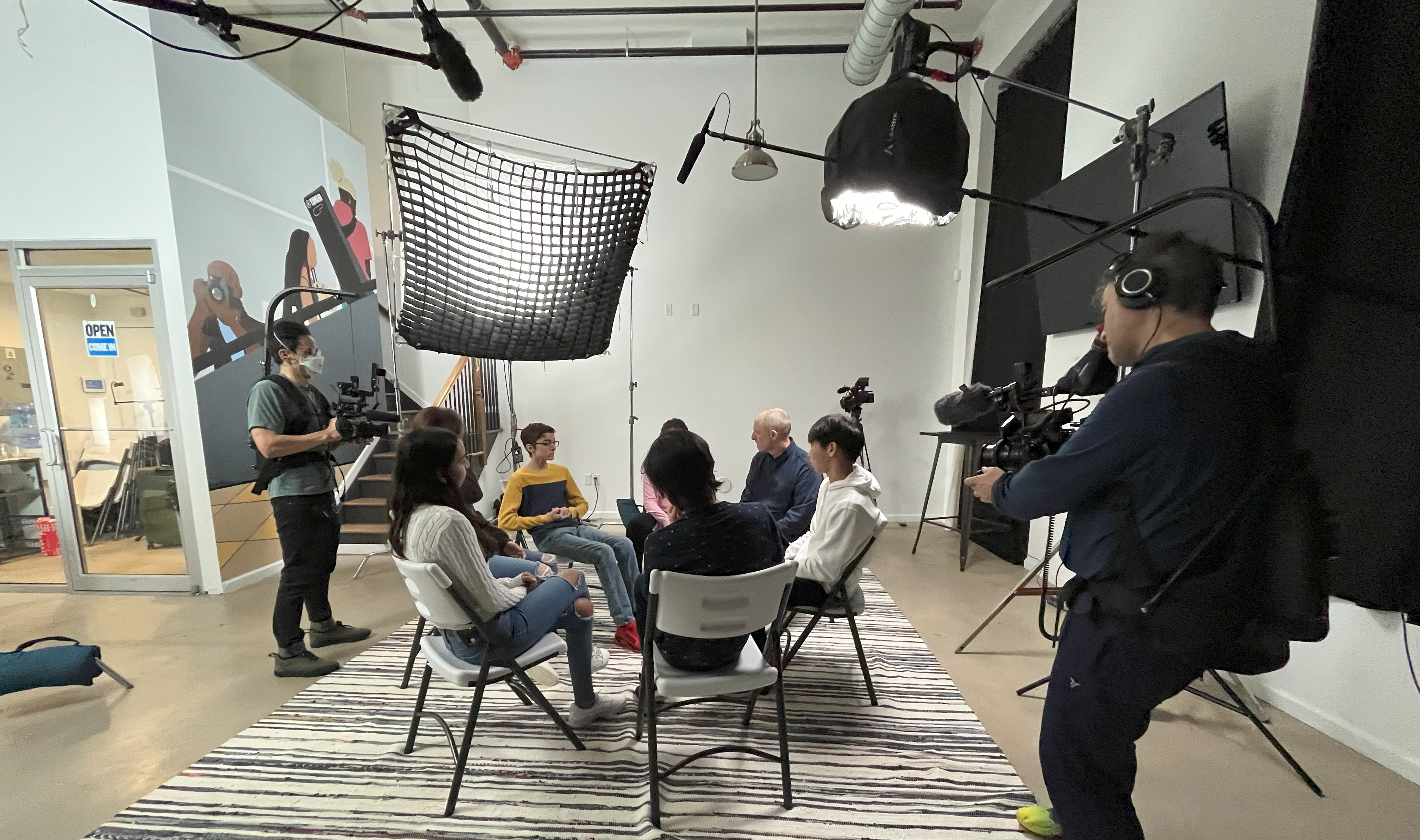
Image: Cinematographer Michael Werner (left) and director Heath Cozens (right) film a discussion led by Dan Warren (center).

At Fluent Research, we capture, distill and communicate authentic insights to help our clients make data-driven decisions and develop successful business strategies. In recent years, we’ve also been implementing a uniquely powerful way to explore and express these insights: bespoke, broadcast-quality documentary films.

The documentaries we create seek to foster understanding, cultivate empathy, and spark a profound connection with the lives and values of the individuals our clients serve.

We use a wide range of documentary styles, but one approach, in particular, is a perennial favorite. We call it the Deep Dive.

In a typical Deep Dive, we select diverse candidates within a specific demographic (e.g., users of Product X, ages 13-18) and make a series of character-based short films that place audiences within their worlds. Like with home-visit ethnographies, the aim is to capture subjects’ lives in a holistic way. We travel with a small, minimally-invasive crew across the US, and sometimes across the globe, capturing each subject’s lives and the people in their lives.

But how do products and services come into play? What about Product X?

The answer lies in the hero’s journey, the narrative structure identified by Joseph Campbell that drives classical storytelling. In the hero’s journey, an individual strives to reach a goal (Defeat the tyrant! Find true love! Win the spelling bee!) but must first face challenges along the way (Rally the forces! Prove one’s worth! Memorize the dictionary!)

Our approach to storytelling mirrors this journey. Each subject is guided by some goal, care, or concern. The question we seek to answer is: what role does our client’s product or service play in the journey? Is it the sword that empowers them, or is it, perhaps, a double-edged blade?

This is, of course, a simplification. Human lives are messy, and there might be multiple goals, sometimes in conflict with each other. Unintended consequences may arise, and so on. In our documentary Deep Dives, we strike a balance that honors life’s complexity, yet preserves narrative clarity. As a result, the stories that we produce are nuanced, sometimes bittersweet, and always compelling.

For example, one series of short documentaries that we produced was about entertainment and technology usage within a certain demographic. One of those films features an older woman, living alone. Having recently lost her husband, she uses her entertainment tech to remember him, motivate her fitness routine, and to stay socially and spiritually engaged. When her daughter pays a visit, she cautions her mother against “overdoing it.” A gentle disagreement ensues. As her daughter leaves, our heroine reveals her reluctance to burden her children. Her media and tech usage helps her maintain physical and mental health — and her independence.

• Goal: self-reliance

• Challenge: aging

• Product role: serving her goal

In the same series, we meet a father who delights in digital entertainment in all its forms. He castigates himself for watching movies and listening to podcasts instead of working–especially in front of his two sons, who he’s trying to keep on the digital straight-and-narrow.  He announces plans for a phone-monitoring app to monitor their screen time and is met with loud protestations. Our hero feels conflicted, modeling behavior that he doesn’t condone. But later, when the family joins Dad to watch a nostalgic concert film, the boys enjoy it with him, and communication flows. Despite Dad’s concerns, watching TV together becomes a positive experience for all.

• Goal: being a good dad

• Challenges: self-sabotage/ self-doubt

• Product role: it’s complicated

When we create Deep Dives, we take a collaborative approach with the subjects who guide and suggest directions to explore. Of course, while their voices are valued, there’s a directorial guiding hand to maintain balance in the narrative.

The process often begins with an in-depth on-camera interview, during which we work together to identify the key elements of the story. Before wrapping up the interview, subjects have the opportunity to add information or set the record straight, should they feel the emerging narrative is inaccurate. Together, we then make a rough plan to establish what organic scenes we can capture that best tell the story.

When filming these scenes, we go with the flow, capturing whatever authentic, fresh moments might unfold. Unplanned scenes are also captured, and diversions from the plan are welcomed. While this approach may take a little longer to bear fruit, the end result is a richer, more genuine portrayal of our participants’ hopes, battles, and victories. As a rule, we schedule two days per finished minute for editing, which is then followed by post-production tasks like audio mastering and color-grading.

The Deep Dive is but one tool in our kit. But whether the format is more emotive, essayistic, or expository, every documentary we produce is built upon a foundation of trust. We’re deeply grateful to our subjects and clients for entrusting us on our quest to tell these rich, authentic human stories, through film.

By Heath Cozens, Director of Productions, Fluent Productions

Award-winning filmmaker and Fluent Productions head Heath Cozens, landed in Sao Paulo, Brazil earlier this month where he began the first leg of a seven-country adventure around the globe filming a documentary for a tech client. We’ll be posting Heath’s postcards throughout the summer on our social media channels so make sure to check in to find out #WhereHeathIsNow?