


21 May True Inclusion Can’t Be Automated: Why Accessibility Needs Human Insight
The distinct cadence of a computerized voice echoing across the room was part of my early introduction to the world of accessibility. I was working in the disability services office at a university, and the robotic narration of JAWS (a screen reader) from a colleague’s desk had become part of the daily office foley. To me, the previously uninitiated, it was compelling to witness how much difference a piece of technology could make in enabling independence in the workplace and demonstrating inclusion.
Fast forward to today, where we all seem to be hurtling toward a future where, for many of us, our workplace and greater world will be heavily mediated by screens and all manner of artificial intelligence. Assistive technologies like JAWS, frankly, seem old hat by comparison. My news and professional feeds are regularly dotted with stories about how AI is poised to revolutionize technologies and bring more independence, more accessibility, and more equity.
This Truly is the Stuff of Sci-Fi Movies
Multimodal AI: We are in an era where AI can “read” text on a screen. But what happens when AI operates multimodally? Authors Nithish Kumar and Aishwarya Srinivasan mention the myriad of possibilities for increasing accessibility in their article “The Sensory Revolution.” When AI can “smell” the sweetest strawberries at the grocery store, “see” the shortest checkout line, or “feel” the weight of the shopping bag, it can drastically support the experience of the built world for anyone who has a sensory limitation.
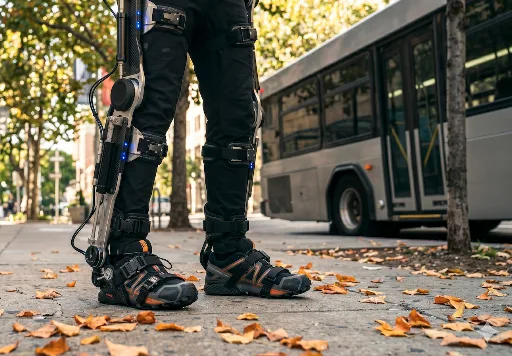
Wearable Technologies: Researchers are developing robotic exoskeletons to assist people with neuromuscular disorders (e.g., spinal cord injuries, stroke recovery). In-built AI systems could potentially provide “personalized control algorithms that could improve human–machine coordination” for these exoskeletons, according to a December 2025 article in Nature Communications. And jumping to a different type of wearable technology, Meta recently published an article about how its wearable glasses can be used, with AI assistance, to find lost keys, read restaurant menus, or get real-time captions.
New Robotics: Tatum Robotics is developing devices that can translate both words and images into tactile sign language and help deaf-blind users better communicate.
Trends in Product Development for Accessibility
At first glance, it all sounds pretty good. But as exciting as these developments may be, we still need to examine the means and ways these tools are developed. This need is made even more poignant by the fact that AI is not merely the final objective with these and similar new technologies; it is increasingly being deeply woven into the very fabric of product development and testing protocols. While I can’t speak to the development of the specific products described above, there are greater trends at play.
According to Applause’s 2026 State of Digital Quality in Accessibility survey that surveyed more than 500 software development, QA, product, compliance and accessibility professionals, 79% reported that the organizations where they work use AI to improve digital accessibility in their websites and applications.. This, according to a large swathe of survey respondents, could look like “using AI coding tools to address/remediate accessibility issues” or “scan sites or apps for accessibility issues.”
One of the many issues with this is that many major LLM systems were not necessarily designed to be foremost disability-cognizant. Jackie Leah Scully reminds us in her article for Science, that “most AI developers have little formal knowledge of disability and are not taught about accessibility or inclusion during their training, while courses on AI ethics that discuss bias or diversity tend to focus on sex/gender and race, rather than disability” (Scully, 2018). If you are depending on AI to find the accessibility issues on your website, you must take into account that AI, historically, has been trained largely on websites that are not accessible and are then at risk of reproducing, as Eric Bailey described for GitHub, “accessibility antipatterns.” Moreover, AI models are trained on data that largely ignores the lived experiences of people with disabilities, which means their outputs frequently exhibit a lack of representation. This isn’t just a technical glitch; it’s a systemic deficit that can end up reinforcing existing biases. AI, simply put, cannot serve as be-all, end-all authority on accessibility.
Inclusion: “Nothing About Us Without Us”
These issues highlight a truth that the accessibility community has preached for decades: Product designers and technology developers must co-create with people with disabilities. This is not a new thought (“nothing about us without us”), but the increasing dependency on AI in product development makes the call to action all the more urgent. We cannot outsource the responsibility of designing accessible technologies to AI or synthetic participants, and people with disabilities cannot be brought in at the end-of-product design process for what amounts to token rubber-stamp approval. People with disabilities must be active stakeholders, present from the very first brainstorming session through the entire development pipeline. Yes, one could theoretically argue that the solution is just better AI. Yet, as our built environment rapidly transforms, the necessity of genuine human feedback becomes all the more important. AI systems, as aforementioned, are constrained by their training data, and therefore lack the agility to navigate cutting-edge built environment developments or offer the nuanced, lived responses that only a real person can provide.
From a researcher’s perspective, these shifts underscore the necessity of intentional preparation to engage with the disability community during the research process. This Global Accessibility Awareness Day, I am reminded to reflect on my practice as a researcher in this age of AI, where the building of products is moving fast and there is more pressure to accelerate the research timeline. In my context of conducting research, this may mean advocating for the participation of individuals with disabilities, and holding the line when there is pushback. This may mean more time investment in finding people with disabilities to participate in research. It may mean dynamically adapting research instruments to meet the diverse needs of participants with disabilities. Or it may mean incorporating more flexibility within research sessions to meet differing needs. While these steps require time, resources, intentionality, and caution, the end result is worth it if it means a more thoughtfully designed, and genuinely accessible, technological future. As Debra Ruh famously said, “accessibility allows us to tap into everyone’s potential.” We must honor our responsibility—to those with disabilities, to those without disabilities who may or may not eventually develop disabilities, and to all technological progeny—to build things well.
By Farrah Brensinger, Senior User Experience Researcher