


Blog Tag

In 2021, Chris McCarthy, the president and CEO of Viacom-CBS and MTV Networks, launched the Mental Health Storytelling Coalition and the publication of the Mental Health Media Guide. The purpose of the guide is to teach content creators how to develop more positive mental health storylines that include a diverse range of experiences. With the release of “Wolf Pack,” the first scripted series using the guide’s recommendations, Fluent’s UX Researcher Charlotte Beatty shares her thoughts about the impact of media on teen wellbeing and the implications for the guide on developing storylines that change the narrative on mental health.

“Wolf Pack” is the first scripted series from MTV Entertainment Studios to incorporate the guide. The writers room also worked with consultant Courtney Knowles, senior media advisor for The JED Foundation (JED), a Fluent client and a nonprofit geared toward protecting emotional health and preventing suicide that is particularly geared toward teens.

Most of us will never forget the movies, TV shows, music, and media that made an impact on us as teenagers. Adolescence is a period where individuals are searching for meaning and self-discovery, and nothing feels better than finding a piece of art that makes you feel seen. For about half of the population, adolescence is also a period where mental illness symptoms begin to appear, typically anywhere between ages 14-24.

At Fluent, we talk to teenagers every day about experiences with growing up, mental health, and the media for clients such as JED. In recent years, shows like Euphoria, 13 Reasons Why, and Stranger Things have captured the attention of teenagers across the nation because of the different ways the shows tell stories about mental illness. Storytellers have experimented with a range of portrayals — from painful hyperrealism, as seen in Euphoria, to personifying mental illness with monsters and fantasy world building, such as with Vecna in Stranger Things. Reported rates of mental illness among teenagers have been on the rise, so it’s no wonder that these shows have garnered so much attention, whether it be praise or criticism.

In a post-pandemic world where teenagers are more tapped into media than ever before and having an “emotional support show” has become a regular turn of phrase, it’s exciting to dream of new ways that research can support production development in the film and television space. MTV and its collaborators are breaking exciting ground with their Mental Health Media Guide as they broach one of the most prominent and topical areas of contemporary television for teens. This progress builds on the legacy of research in media, initiated by researchers at The Joan Ganz Cooney Center and Sesame Workshop, but turns the conversation towards adolescence and mental wellbeing with a focus on considering realistic, positive solutions, and problem-solving when it comes to mental health storytelling.
By Charlotte Beatty

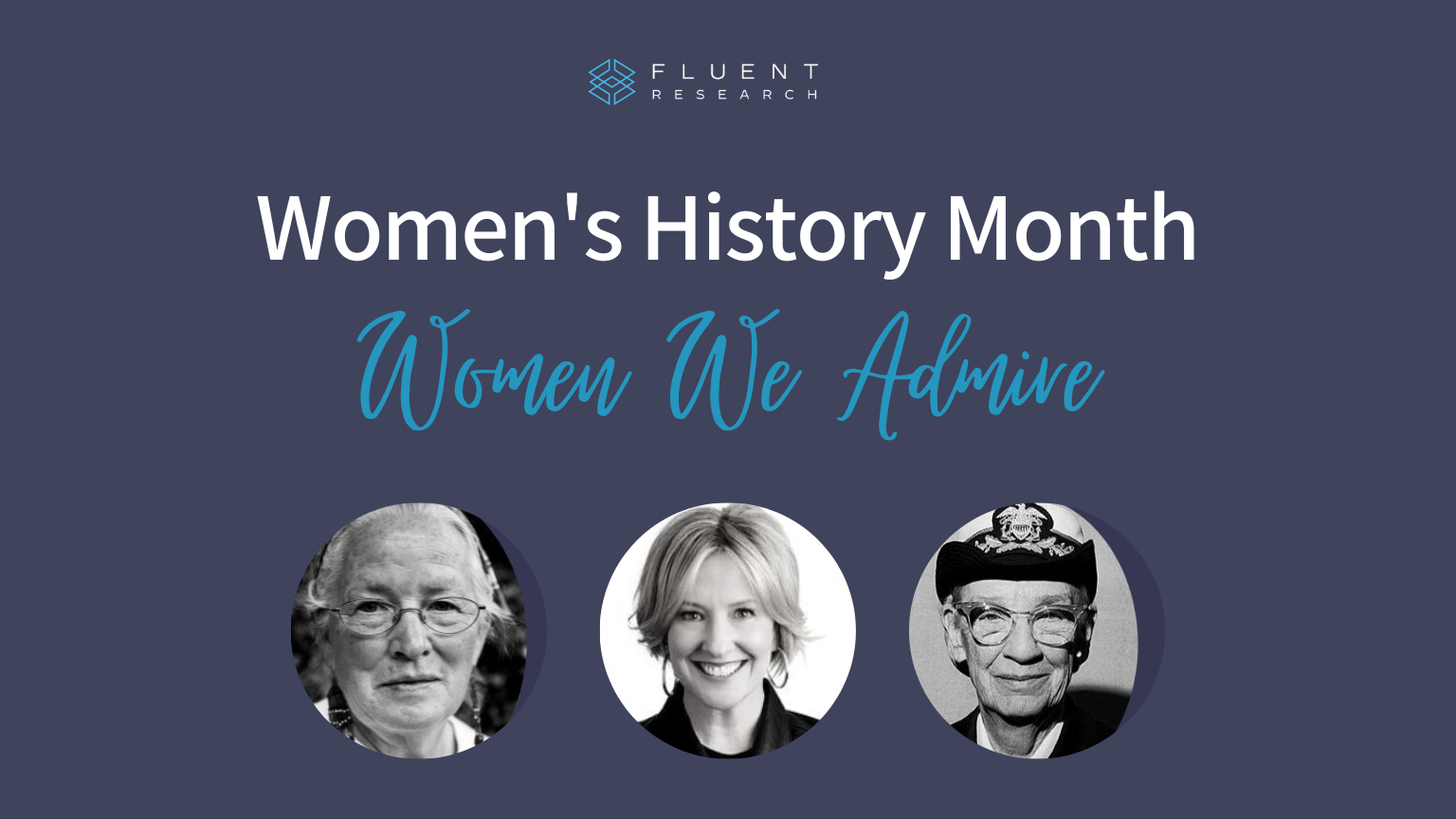
In celebration of Women’s History Month, we asked a few of our Fluent team members to write about the women who inspire them. From lauded professors to pioneering civil rights activists, read below to learn more about the important work and incredible achievements of the women we admire.

Quantitative Researcher Amber González on Joan Trumpauer Mulholland

In November 2016, I had the pleasure of meeting Joan Trumpauer Mulholland — a renowned activist. Joan participated in and helped organize some of the most influential moments of the 1960s Civil Rights Movement, including the Freedom Rides, Jackson Woolworth’s sit-in, the March on Washington, and the Selma to Montgomery March.

Despite her upbringing as a young white woman in the segregated South, being a child of segregationists, and a great-granddaughter of slave owners, Joan had an unwavering dedication and commitment to challenge racial segregation. She shed light on the repercussions of her involvement, including being disowned by her family, imprisoned and placed on death row, and hunted by the KKK for execution. It was truly inspiring to hear a first-hand account of stories from an unlikely hero of the 1960s Civil Rights Movement, whose devotion to the cause required the utmost conviction and courage.

Her legacy does not end there. To this day she continues to challenge racist ideology through the efforts of her organization, the Joan Trumpauer Mulholland Foundation whose mission is to educate youth about the Civil Rights Movement and inspire others to make a difference through activism in their community.

Reflecting back, I’m grateful I crossed paths with Joan when I did, during my senior year of college, one week after the 2016 election. It was a period marked by an uptick in incidents of racist and xenophobic harassment on my college campus and across the country, and her inspiring story and words of wisdom reinvigorated me to remain engaged in activism on and off campus.

Senior Researcher Sylvia Rusnak, Ph.D. on Brené Brown

One woman that inspires me is author and professor Brené Brown. She researches courage, vulnerability, shame, and empathy. I admire her because her research has real-world impact; her work helps us understand ourselves and create meaningful change in our lives.

Brené is a storyteller and communicates her work in a way that resonates. As a researcher, I strive to conduct research that ultimately improves the lives of others and communicate it in a way that clicks.

Brené’s work also has importance for how we show up in our lives for ourselves, for others, and also for how we work. Vulnerability at work allows for creativity and meaningful conversations. Her work inspires me to try to be brave: to show up to take action, rather than to stand by on the sidelines, simply observing or commenting on the actions of others.

Senior User Experience Researcher Farrah Brensinger on Grace Hopper

If you have ever noticed and reported a ‘bug’ to software developers, you have Grace Hopper to thank for this offbeat way to describe a software glitch. Hopper minted the label after a bonafide moth got stuck in her computer and caused it to go haywire.

Hopper’s influence in software goes far beyond adding the unusual term to our everyday computer lexicon. The first woman to receive a Ph.D. in Mathematics from Yale, she went on to create A-O, a ‘compiler’ program that translated mathematical terms into machine-readable computer code. She later invented a compiler that made machine-readable code from English-language inputs, enabling mainstream computer usage for those with non-programming backgrounds. She received the 1991 National Medal of Technology from President George Bush, recognizing her technological impacts on ‘open[ing] the door to a significantly larger universe of users.’

When asked about her most important accomplishments, she listed training young people right alongside her programming triumphs. Undoubtedly, Grace Hopper would be pleased to see so many young women entering the computer science field today, ready to push the boundaries of programming, just as she did.

Grace Hopper’s story inspires me to innovate for good and look for additional opportunities to get life-changing technologies into the hands of as many people as possible.