



09 May Harvard Business School Tech Conference Review
Earlier this year, I had the privilege of attending the 31st Annual Tech Conference at Harvard Business School. The goal of the conference was to bring together business leaders, students, and key tech stakeholders to discuss how technology is shaping society across industries, nationalities, and public and private spheres. It was a great opportunity to hear from some of the most innovative and influential people in the tech industry.
Throughout the day, there were four keynote presentations and several breakout panel and workshop options that focused on topics such as Artificial Intelligence/Machine Learning, entertainment tech, and Fintech, among others. Since I am interested in how to leverage technology to achieve positive social good, I chose to attend the breakout sessions on education, climate, and diversity in tech.
(Watch a TikTok of Evelin’s experience here.)
Ed Tech
During the EdTech breakout session, the panelists stressed the importance of prioritizing diversity in UX research panels and studies to ensure the development of  equitable, inclusive, and accessible products for all learners and educators. When asked about priority areas for innovation, the panelists agreed that EdTech companies should focus on developing products that enhance student-teacher communication, particularly using machine learning methods. One panelist gave an example of creating a product that allows schools with larger teacher-to-student ratios to ‘clone teachers.’ Essentially, educators could create a 1-on-1 video or tailored messages for their students who may be struggling with attendance or any other issue impacting their engagement. This would enhance their relationships and ensure students do not fall behind. Interestingly, the panelists also discussed the need to embrace new AI technologies like ChatGPT rather than seeing them as a threat. According to them, these tools are already helping overwhelmed teachers create lesson plans, promoting self-directed learning, and inspiring students to pursue STEM careers.
Climate Tech
Some of my favorite breakout sessions at the conference were about climate tech, which refers to technologies and innovations that aim to reduce greenhouse gas emissions to mitigate the impact of climate change. The key areas of innovation include clean energy (development, efficiency, and storage), carbon capture & storage, sustainable food & agriculture, and smart transportation. At this moment, investors say that climate tech is hot in venture capital because of its potential to help with foreseeable climate challenges that will arise in the next 20 years. According to them, “climate tech can be a billion dollar business with a trillion dollar impact in the world.” The climate tech companies represented at the conference reflected on their own journeys and identified gaming, energy discovery, and the cooling crisis as areas where their ventures are gaining investor endorsement. Here are a few examples:
-
-
- Companies like Carbon Counts are addressing climate change through Play-to-Plant™ gaming, where players grow forests in-game and the company plants, grows and protects trees in the real world on their behalf.
- Zanskar is using AI, big data, and advanced sensing techniques to discover geothermal energy because it is a key component of a 100% carbon-free electric grid.
- Therma is using data science and machine learning to eliminate food and energy waste, all to address the cooling crisis. They are already working with major chain restaurants and other businesses to reduce their carbon footprint.
-
Diversity in Tech
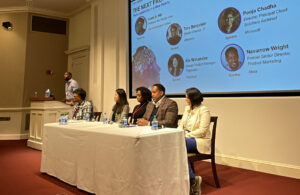
As someone who identifies as Latinx and first-generation, issues of diversity and inclusion are especially important to me. With the rise of the tech industry, diversity in tech is a crucial area that needs attention. Historically, the tech industry has struggled with a lack of diversity, inclusion, and representation. The panelists reflected on the many barriers to entry for BIPOC communities who are first generation with limited networks, including unconscious bias in hiring and a lack of diversity in positions of leadership. Further, many of the panelists have experienced feelings of impostor syndrome, or the persistent inability to believe that one’s success is deserved or has been legitimately achieved as a result of one’s efforts or skills. Unfortunately, impostor syndrome disproportionately affects high-achieving individuals from underrepresented communities. To alleviate these challenges and foster a more diverse and inclusive industry, the panelists suggested establishing mentorship programs to support BIPOC students or career-changers, reevaluating hiring practices, and supporting aspiring tech entrepreneurs and BIPOC startups, among other things.
Overall, the 31st Annual Tech Conference at Harvard Business School was a unique opportunity to learn about the latest trends and innovations in the tech industry.
As technology and our dependence on it continue to grow, it is increasingly important that products, programs, and services we help develop as researchers are not only profitable but also contribute to a more equitable and sustainable future. Attending this conference has equipped me with valuable knowledge and insights that I can apply in my role as a UX Researcher to take a more impact-driven approach.