

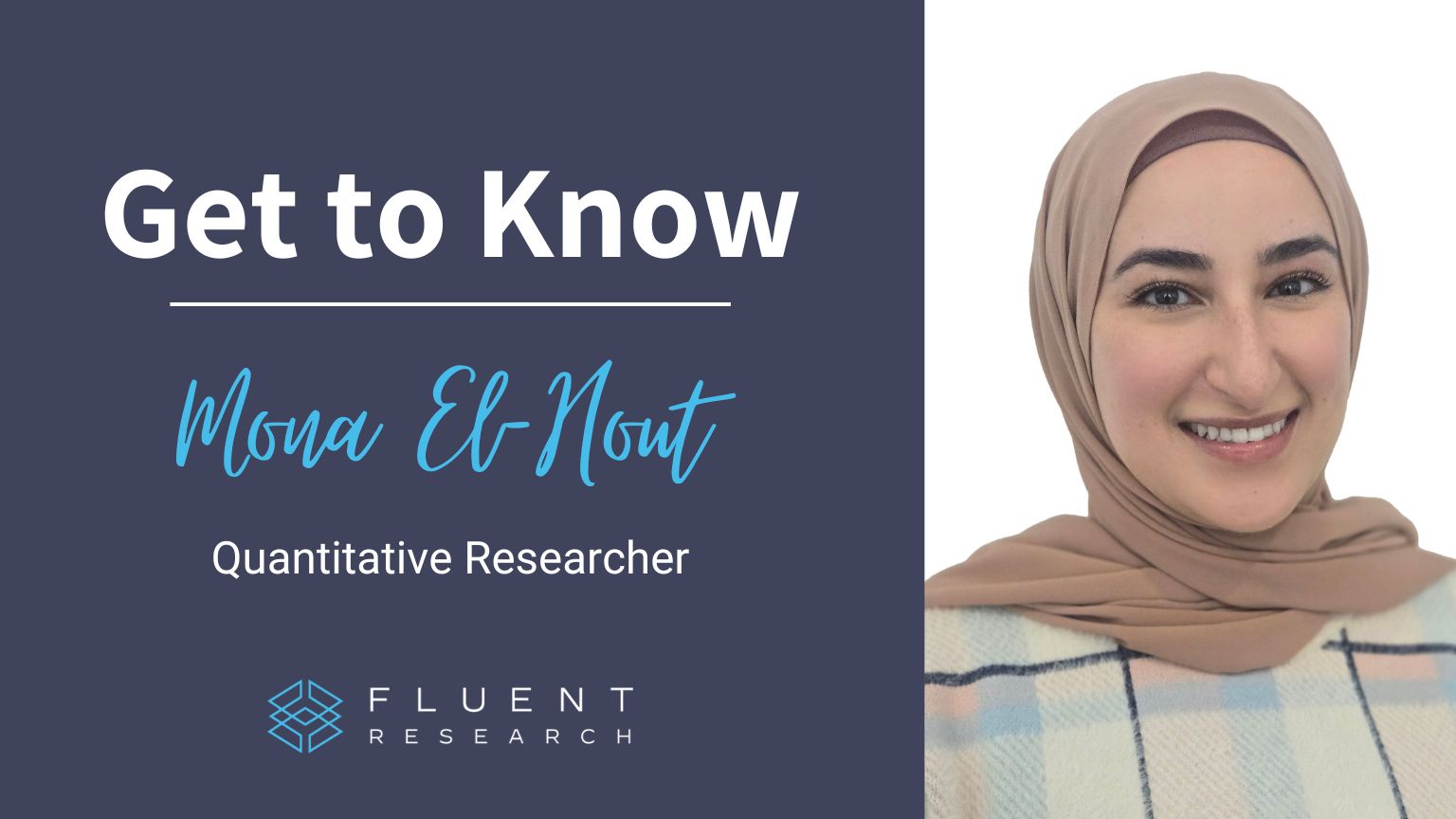
27 Aug Get to Know Quantitative Researcher Mona El-Hout
We’re so happy to have Quantitative Researcher Mona El-Hout on the Fluent team! With a diverse background in psychology, statistics, and research design, she brings a wealth of knowledge and experience. In this interview, we learn about Mona’s journey from academia to the world of quantitative research and the challenges she faced along the way.
1) Tell us a bit about your career journey. What inspired you to become a quantitative researcher? How did you navigate your path to Fluent Research?
My journey started the way most students begin their undergraduate degrees — with no clue what I wanted to do in the future. I took a wide variety of courses over the first couple of years and worked in different research labs through a work-study program. During this time I realized that the classes and research I found most engaging and interesting were all happening in the Psychology Department.
I went on to earn my M.S. in Health Psychology and my PhD in Social Psychology with the intention of one day becoming a professor. I spent two years as a Research Scientist at the University of Washington, where I conducted research on stereotypes, discrimination, and labor market outcomes. I also taught leadership and DEI courses to burgeoning engineers. As much as I enjoyed my time in that position, I realized that my skills, interests, and work-life balance desires were better suited to an industry position.
After a few months of reworking my resume, partaking in informational interviews, making connections with peers and recruiters, and putting my name out there, I landed my first industry position as a Quantitative Researcher with the Reliability User Research team at Apple. My time there was invaluable. It gave me my first taste of the world outside of academia. However, I knew that I wanted to be in a field that would allow me to experience and learn about diverse sectors and work on unique projects.
I began to seek out opportunities in market research. When I got the job alert for a Quantitative Researcher position at Fluent, I knew immediately that this was the job I had been looking for. I connected with our Founder and President Nellie Gregorian on LinkedIn after cold-applying for the position, and the rest is history. I genuinely could not be more thrilled to be one of the newest members of this incredibly intelligent, supportive, and hardworking team.
2) What’s a unique challenge you’ve faced in your career as a quantitative researcher and how did you overcome it?
There were two main challenges I had to overcome on my path to becoming a quantitative researcher. First, I had spent nearly a decade studying and working with the sole intention of one day becoming a professor. Choosing to switch gears away from academia took a lot of time, mental energy, and pros-and-cons lists. It felt like an identity crisis and a huge decision to make after what felt like a sunk-cost experience in the last decade of my life. Once I made the decision, though, I felt extremely relieved and I was able to focus on my new path forward.
What I didn’t anticipate was the next major challenge on my journey: the extremely tough job market I was entering that only got tougher as the years went by. Major layoffs were happening at massive and impressive tech companies, filling the job market with thousands of experienced individuals. Getting noticed in such a crowded market felt nearly impossible. Nevertheless, I knew that my time would come if I kept applying for jobs, making personal connections, and showcasing my skills, passion, and commitment to excellence.
3) With your extensive background in psychology, statistics, and research design, what advice do you have for those looking to pursue a career in quantitative research?
My first piece of advice is to acquire the necessary skills for a career in quantitative research. This could be through higher education courses focused on research design, methods, statistics, etc. It could also be through free or low-cost self-paced online courses, certificate programs, or even free websites and YouTube videos with tons of helpful tutorials and examples. There are a multitude of ways to learn quantitative research skills right at our fingertips. Take advantage of whatever opportunities are available to you to learn what you need to get your foot in the door.
My second piece of advice is not to give up when it starts feeling impossible and to think more broadly about companies and positions that would benefit from the skillset researchers offer. Coming out of academia, the only non-academic career path I ever heard about was UX Research, so that’s what I looked for when I began my job search. But there are so many ways to apply research skills across different industries, and a multitude of job titles other than UX Researcher that conduct impactful research and utilize the same skillset. Do your research (it’s what we’re good at, after all) and figure out what keywords to look for on your job search that will land you the career you want. Also, don’t be afraid to reach out to others for help along the way.
4) What’s your go-to hobby or activity outside of work that brings you joy?
I like to consider myself a dabbler in a lot of hobbies. I love to read or listen to audiobooks. I picked up painting during the pandemic. I used to do a lot of hiking when I lived in the Pacific Northwest. Lately, I’ve been really enjoying baking and experimenting in the kitchen. My favorite thing to do, though, is to travel with my husband, exploring new countries and cities. With the right person, even a coffee shop down the road that we have yet to try or a trip to the grocery store can be fun.
5) What are you most excited about in your new role at Fluent Research?
The work that Fluent has done and continues to do is so impactful, both to our clients and their users. A great portion of our work directly benefits families, children, and their collective wellbeing. The Fluent team is also extremely supportive of professional growth and learning opportunities, which is one of the things that attracted me to this position. It’s wonderful to be a part of a firm that cares about its clients, users, and team members. I am excited to dive into a wide variety of projects all the while learning from my talented colleagues!
Connect with Mona on LinkedIn!