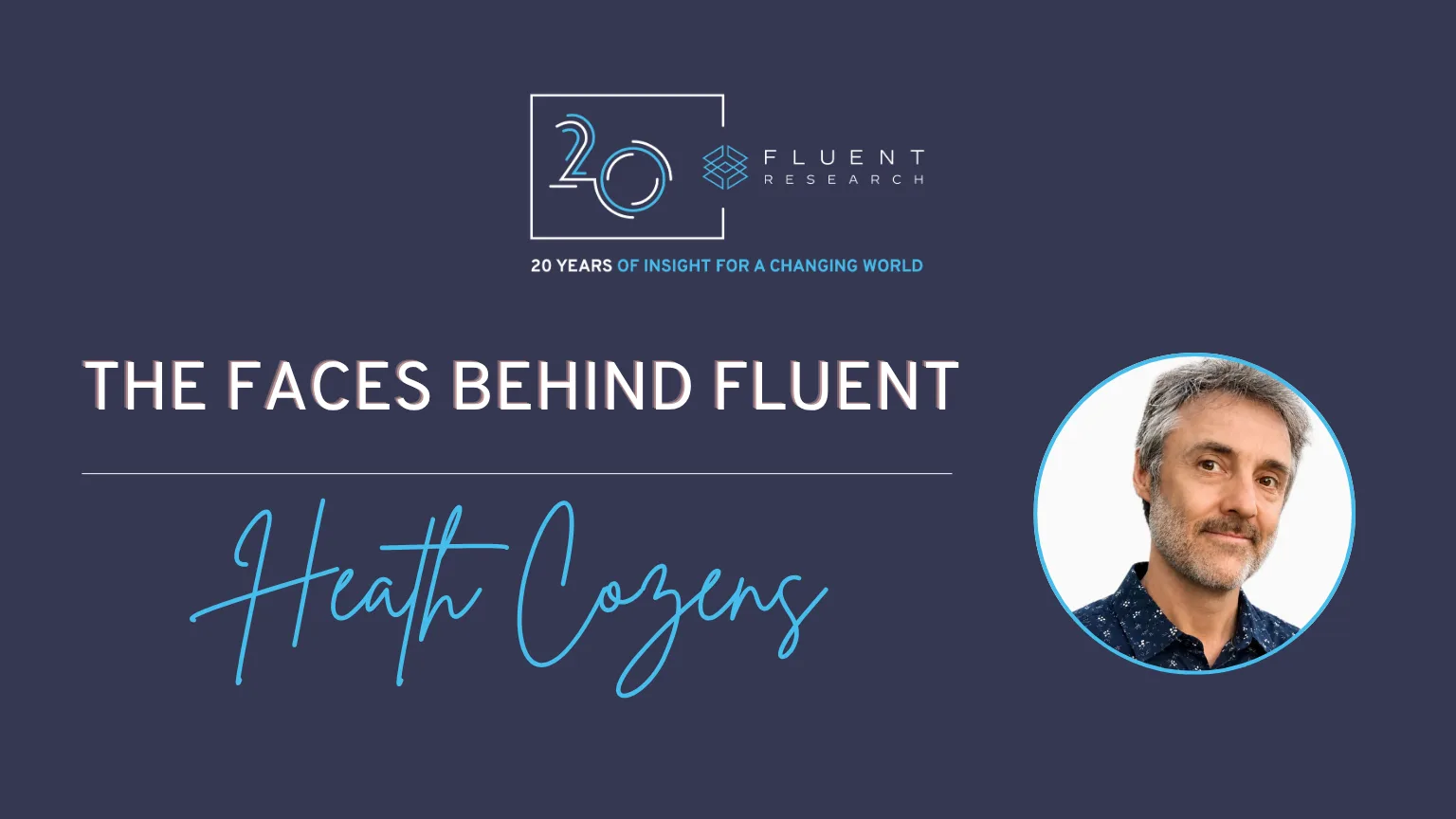
As part of Fluent Research’s 20th anniversary celebration, we’re introducing the people whose perspectives, talents, and curiosity have shaped the organization. This week, we’re featuring Heath Cozens, Director of Productions.
Heath uses documentary filmmaking to bring research to life, creating films that reveal what people care about and how they experience the world. Drawing on a career that has taken him from New Zealand to Malaysia, Japan, and the United States, he approaches every project with curiosity, cultural fluency, and a commitment to representing participants’ stories honestly.
Read below to learn how Heath found his way to Fluent, why he sees the camera as an exploratory research tool, and how he hopes filmmaking can foster deeper human connection.
1) What inspired you to join Fluent Research?
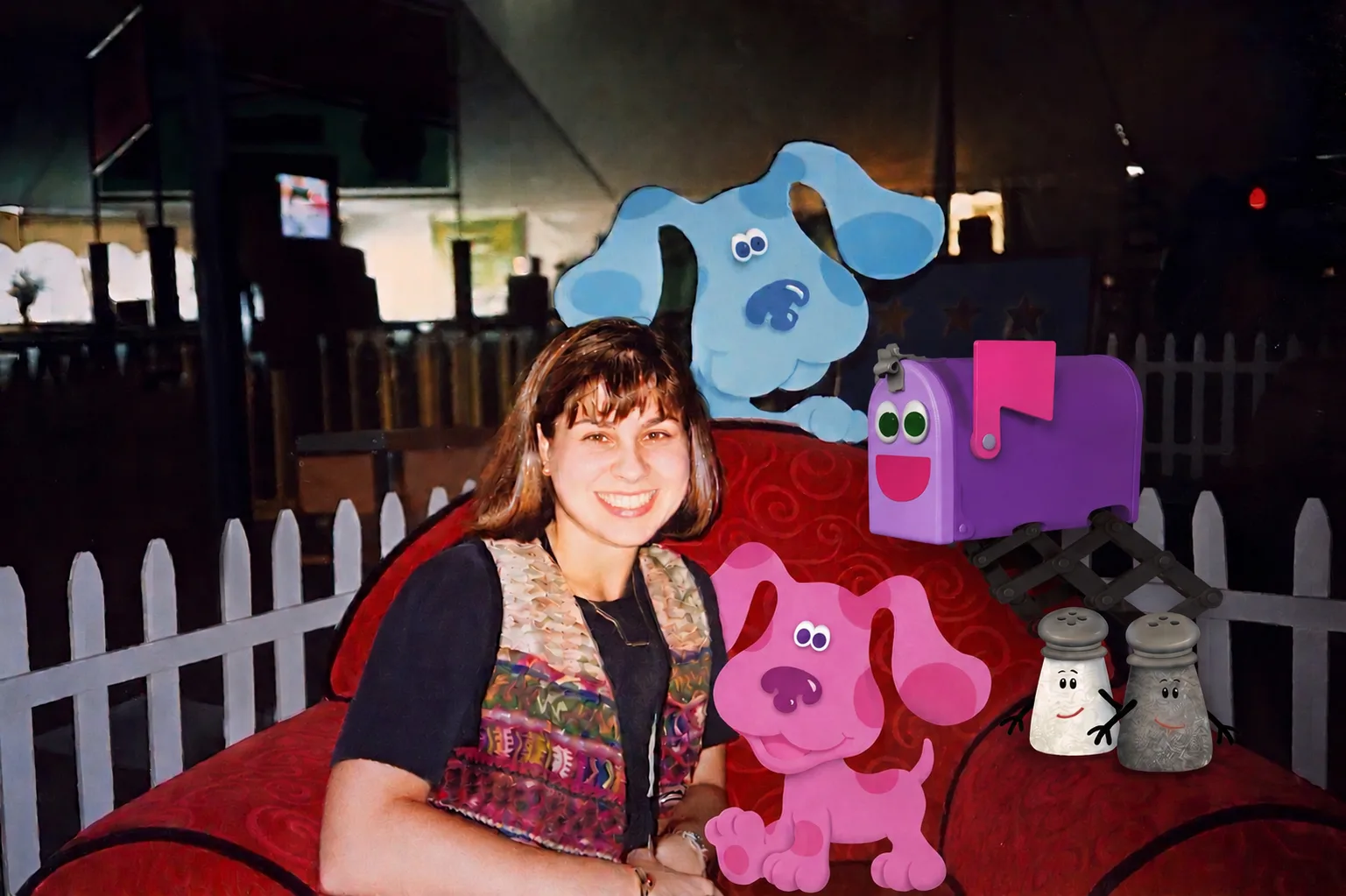
I’d been a freelance filmmaker for most of my working life, focusing on documentaries. One of the first projects Nellie and I made together was a video capturing preschoolers responding to the pilot for a Fred Rogers children’s show. It was a modestly scaled project, but I took a story-based approach—capturing not just the viewing experience itself, but the moments that book ended the narrative. The resulting film captured the kids’ transformation from their perspective and was, in its own modest way, moving and beautiful. The client’s positive response led to more documentary work around the country, and soon, around the world.
Having worked in news, advertising, corporate and broadcaster-commissioned documentaries, I really appreciated the autonomy I was given at Fluent. I could use the camera as an exploratory tool and follow the evidence wherever it led. That’s what really inspired me to stay: being trusted to tell real stories that matter, without an agenda, collaborating with the participants, and creating work for attentive, intellectually curious clients.
2) What’s your role at Fluent, and what does a typical day look like for you?
I’m Fluent’s Director of Productions. There’s really no typical day.
In preproduction, I talk with the client to understand the research objectives and intended audience, ensure that an alarming number of batteries are charged, and check that every element of my camera rig—what our Executive Director, William Sandy, calls a “Rube Goldberg machine”—is in order, down to the last screw and washer. I prepare exhaustively so that I’m ready for any eventuality and can remain flexible on the day.
Before I film, I sit down with the participants first and get a feel for what matters to them, what they’re comfortable sharing, and how they think we should capture it. The basic approach is: “This seems important. How could we show it?” Having this chat in advance means that when the camera is rolling, I can be ready for anything and preserve as much spontaneity as possible.
Then comes editing, the part where I return from a shoot slightly high on the whole experience and suddenly remember that I have to turn many hours of footage into a film. I often work with trusted freelancers and other members of the Fluent team to find the moments that illuminate the research.
Ultimately, we’re trying to make films that entertain and engage both heart and mind. We want to show our clients what their stakeholders care about and keep the work nuanced, clear, and, above all, real.
3) What’s been your most memorable project or moment at Fluent?
One of my favorite projects involved families and technology. Working with Dan Warren, Director of Youth Development & Education, I developed a form of scenario-based ethnography. We gave family members situations and asked them to show us how those moments might play out at home.
The approach was partly inspired by Sons, a 1996 film in which the members of a real Beijing family reenact events from their own lives without a hint of performance. They weren’t acting so much as reliving moments.
Just as participants in a home ethnography might show a researcher how they use a device, these families showed us how they interacted. They weren’t inventing characters or performing; they were showing us family dynamics that they knew intimately.
Often, while I was presenting a hypothetical scenario, somebody would interrupt and say, “Actually, this really did happen.” “Could you show me how that played out?” I’d ask. That was when things became fascinating.
I spent a full day with each family, capturing fresh, authentic conversations, negotiations, and unexpected revelations about technology, behavior, and wellbeing. At the end, we reviewed what we’d filmed and cross-checked it with each family: Was that true to form? Is that really how everyone reacts when there isn’t a camera around?
The client had understandable questions about the method at first, but the results were powerful enough to inspire a day-long workshop, with the film at its center. Workshop participants raved about the film, and we’ve since developed the approach into something we can offer again, which is very satisfying.
4) How has Fluent evolved since you joined?
When I first started working with Nellie, Fluent was something like four people, including a small group of trusted freelancers. It has since grown into a full team of roughly two dozen people.
Much of this growth happened around the COVID-19 pandemic. The scale, pace, and scope of research expanded very quickly. Nellie went from running a small operation to leading a much larger organization, which has been quite extraordinary to watch.
5) What’s one thing you’ve learned about research that surprised you?
What surprised me was how deeply anthropological research can be. At Fluent, we spend our time learning what people actually care about, how they live, what frustrates them, and what might genuinely improve their lives. That understanding allows our clients to serve people better.
6) What’s your favorite part of working at Fluent?
There’s an underlying theme at Fluent of speaking truth to power. Giving people a voice supports their agency, and finding fun, authentic ways to represent human needs and behavior to our massively influential clients is really gratifying.
We’ve been fortunate to work with clients who genuinely want to understand people’s experiences, including findings that might be uncomfortable or unexpected. I value being trusted to tell those stories honestly.
7) What’s a fun fact about you that most people don’t know?
Here are a few:
• My first proper job was as a puppeteer, touring schools in Southland, New Zealand, teaching children disability awareness.
• I recently learned to drive again after about 35 years, which has been both liberating and mildly terrifying.
• I speak fluent Japanese.
• I’m the former bassist of New Zealand’s premier Velvet Underground-inspired improvisational lo-fi psychedelic folk band.
• I’m related to Charles Darwin… but only by marriage, which gives me very dubious evolutionary credentials, especially given the disconcertingly high concentration of Neanderthal DNA in my genome.
8) If you could have dinner with any public or historical figure, who would it be and why?
The Buddha. I’d invite him to a vegan degustation at CERN. We’d commandeer an imaginary mess hall overlooking the ATLAS detector and talk physics and philosophy.
9) What’s a book, movie, or podcast you’d recommend to everyone?
Animals have far richer cognitive and emotional lives than we’ve given them credit for. Ants recognize themselves in mirrors and perform first aid on wounded comrades. Bees experience joy and PTSD. Cats have hundreds of facial expressions. Birds combine phonemes into word-like forms, then combine those into phrases.
Animal sentience has always fascinated me, but Aza Raskin’s presentation about using AI to decode animal communication absolutely blew—nay, obliterated—my mind. I won’t spoil the talk, except to say that it includes one of the clearest explanations I’ve encountered of how large language models work. It then demonstrates how the same “shapes” used to map relationships among words in human languages can be mapped onto animal vocalizations—suggesting that perhaps the big barrier between us and other species is partly a translation problem that we’ll soon solve.
10) What’s your go-to productivity hack?
The one I’m using to answer these questions.
Basically, I hit record, mind-dump at length without organizing any of it, ask AI to extract and order the salient points as bare-bones bullet points, and then to reform those points back into my own words. That allows me to think aloud without worrying about whether my tangents make sense to other people.
11) If you weren’t in research, what career would you have pursued?
Fiction filmmaking would be one possibility.
The documentary form allows you to fire on all cylinders at once. It involves people, technology, storytelling, observation, communication, physicality, artistry, and improvisation. It also carries a serious responsibility toward the people whose lives you’re filming. Sometimes I’m attracted to the freedom of being able to let my imagination run free.
My other answer is working in the field of animal cognition. I’d love to work on using AI to communicate with animals (watch that talk!)
Perhaps technology will enable these tools to merge: The dream project? To interview a farm animal. To ruminate with a ruminant. To produce the bovine version of My Dinner with Andre, if you will.
An anniversary naturally encourages you to look backward, but forgive me if I forgo the commemorative Tupperware. What matters to me is what 20 years of accumulated experience makes possible now.
I think of Fluent as a conduit: connecting clients with customers, organizations with the people affected by their decisions, and potential knowledge with insights people can act on. The questions have always been there; experience helps us ask better ones.
For me, our history is alive, informed by the past and in constant forward motion.
13) How do you see Fluent evolving in the next 20 years?
I’d like Fluent to become a hub for authentic, evidence-based human connection.
I think we’ll find increasingly creative ways to engage people and create immersive, potentially transformative experiences. These could allow our clients to connect with customers and stakeholders as actual human beings, and to build relationships that are transparent, meaningful, and mutually beneficial.
I can also imagine Fluent expanding what we’ve learned beyond conventional commercial research, perhaps in conflict resolution, international relations, or other areas where people have stopped understanding one another.
Technology and commerce should empower everybody. Society is facing some fairly serious divides, and I’d love Fluent to play a part in de-escalating them by revealing shared interests, making people feel heard, and highlighting the connections that bind us all.
14) What’s one word you’d use to describe Fluent Research? Why?
Connection.
We’re connected in ways that aren’t always immediately visible. Good research and honest storytelling can spark that moment of recognition when a pattern suddenly becomes clear and people realize how much they share.
15) What’s your favorite way to unwind after a busy day?
I enjoy shared writing sessions with friends overseas. We turn on our computers, say hello, and then sit together writing without stopping. That unbroken stream-of-consciousness part is really gratifying.
16) If you could travel anywhere in the world, where would you go and why?
I fantasize about remote, high-altitude places: the Hindu Kush, the Patagonian Highlands, the South Pole.
I’d love to spend time somewhere with an enormous landscape, no distractions, and a completely different relationship to time. Learning Tibetan dream yoga somewhere in the Himalayas, perhaps.
17) What’s your favorite snack or drink to have while working?
Black coffee.
18) What’s a hobby or activity you’re passionate about outside of work?
Prismatic photography.
With prism photography, I’ll begin with a conventionally beautiful image and then fracture or layer it in camera with arbitrary compositional elements: flares, reflections, and refractions.
Recently I’ve started to build contraptions that allow me to program three-axis movements of multiple prisms and diopters. The prototype is starting to resemble a robotic insect, feeding itself light. I call it the MantisCam. It also looks vaguely ridiculous, which I kind of like. Rube Goldberg, eat your heart out!