

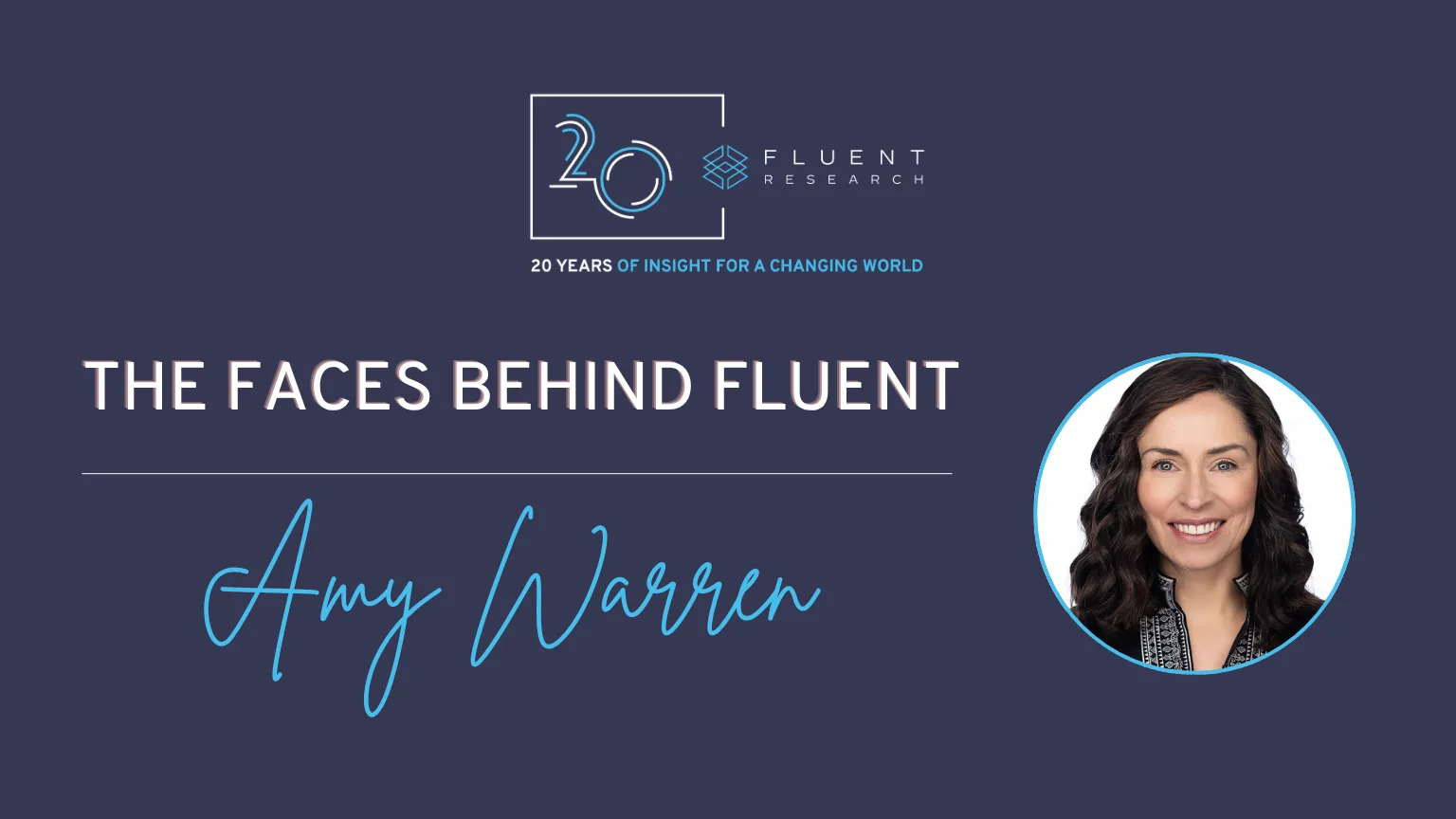
29 Jul The Faces Behind Fluent: Amy Warren
To celebrate Fluent Research’s 20th Anniversary, we’re highlighting the people who have helped shape the organization along the way. This week, we’re featuring Amy Warren, PhD, Fluent’s Senior Child Development Researcher.
For Amy, meaningful research begins with human connection. Her work explores how children, families, and communities develop, and how research can help create the conditions people need to thrive. At Fluent, she brings a lifespan developmental perspective to projects spanning education, family life, technology, and wellbeing, helping clients translate insights into thoughtful action.
Read below to learn what drew Amy to applied research, why she believes people must feel fully seen and heard, and how she hopes Fluent can keep human development at the center of technological change.
1) What inspired you to join Fluent Research?
I was drawn to Fluent because it is a place where developmental science can be put to work in the real world. As an applied developmental scientist, having spent time in academe, I was eager for work that shortens the lag between research and application. My career has centered on understanding how people positively develop within families, communities, and larger systems, and Fluent gave me the opportunity to bring that perspective to organizations creating experiences for children and families.
I was also drawn to Fluent’s combination of intellectual rigor, creativity, and care. Our work is methodologically serious, but we never lose sight of the human beings behind the data. That balance is deeply aligned with how I believe research should be done.
2) What’s your role at Fluent, and what does a typical day look like for you?
I am a Senior Child Development Researcher, and I bring a lifespan developmental perspective to Fluent’s work. A major part of my role is helping organizations understand children, young people, parents, and educators, how they develop, and what they need in order to flourish.
My days vary widely. I may be designing an interview guide, moderating a conversation with a teacher or teen, analyzing qualitative data, developing a developmental framework for a client, or helping translate research findings into practical guidance for the people designing experiences and services. I especially value creating developmental guides that help clients make decisions in ways that honor children and families as whole, developing people. My translational role builds on a career spanning research with infants, families, adolescents, educators, and communities.
3) What’s been your most memorable project or moment at Fluent?
It is difficult to choose just one. Research Camp and in-home ethnographies have given me some of my most memorable experiences at Fluent because both allow research to become deeply relational and grounded in real life.
For Fluent’s first Research Camp, my colleague Evelin Garcia and I used a grassroots recruitment approach with Latinx families in Greater Boston and Providence. Armed with flyers, sunscreen, and a map of community gathering places, we visited bodegas, restaurants, laundromats, salons, schools, and local organizations. We listened to people’s stories, shared food, and began building trust long before formal data collection started.
That experience reflects something I believe deeply: The process of uncovering insight begins with genuine human connection. Recruitment is more than assembling a sample. It is the beginning of the research, the relationships that enable insights.
In-home ethnographies offer a similar richness. During a recent study, spending time in families’ homes alongside the client allowed us to notice details that would never have emerged, even in an in-depth interview. Our conversations between visits—comparing observations, testing interpretations, and workshopping ideas together—felt like action research in its truest sense.
4) How has Fluent evolved since you joined?
Since I joined Fluent, I have seen the company deepen its ability to build knowledge across studies. This is especially evident in our ongoing education work, where multiple projects begin to function as a genuine program of research. We are able to carry insights forward, ask more sophisticated questions, and help clients build an increasingly nuanced understanding of students, teachers, learning, and emerging technologies.
I have also seen Fluent continue to engage directly with a changing social and technological landscape. Our Founder and President Nellie Gregorian always has her eye on the broader socio-political moment. I deeply respect how she, and we as a company, face the full context head on and then ground our work in care, rigor, and purpose, for our clients and for one another.
5) What’s one thing you’ve learned about research that surprised you?
I am not sure it surprised me, but research has continually confirmed something I have long believed: Human understanding begins with human connection.
The most powerful research begins when people feel respected, when trust has been established, and when researchers enter a conversation with genuine humility and curiosity. Connection is the root of our capacity to influence, understand, and act together, so it makes sense that it is also the root of meaningful research.
Methods matter enormously, but methods become most powerful when they create the conditions for people to be fully seen and heard.
6) What’s your favorite part of working at Fluent?
My favorite part is the opportunity to translate knowledge into action alongside thoughtful colleagues and clients. I love the moment when a finding becomes more than an interesting observation and begins to shape what someone will design, communicate, or do differently.
I also value the continuity Fluent has allowed me to build across projects. In our education work, for example, one study has often informed the next, allowing us to build institutional knowledge and become stronger research and consulting partners over time. That ongoing learning feels much more developmental, and much more valuable, than approaching research as discrete projects.
Just as important is the flexibility and trust Fluent has extended to me. I am able to be deeply engaged in meaningful work, while also making space for my family, the nature-based elementary school Dan Warren and I co-founded, and the other interconnected parts of my work.
7) What’s a fun fact about you that most people don’t know?
One thing people may not know is that, alongside my work as a developmental scientist, I am also trained as a postpartum doula, lactation counselor, and Reiki Master practitioner. My interest in maternal-infant health has been present throughout my career, beginning with research on early family systems and infant development.
More recently, I have trained as a Nesting Ambassador, someone who translates the transdisciplinary science of the Evolved Nest into practical ways of supporting human development. I am in the process of developing a perinatal education program designed to help parents and professionals build a whole ecology of care around mothers, babies, and families.
8) If you could have dinner with any public or historical figure, who would it be and why?
Jane Goodall and Fred Rogers.
Jane Goodall has profoundly shaped how I think about both science and change. Her research transformed our understanding of chimpanzees by first understanding them within the ecological and social systems they evolved in. But I also admire how she worked for change. Rather than standing outside existing systems, she partnered with governments, businesses, conservation organizations, and local communities to help those systems become part of the solution. That combination of scientific rigor, hope, and practical collaboration is something I aspire to in my own work. I recently wrote a piece about Jane for Resurgence and Ecologist, where I argue that her work laid the foundation not only for conserving chimpanzees, but for understanding any species, including ourselves, within the ecological conditions needed to thrive.
Fred Rogers has influenced me just as deeply. His observation that “love is at the root of everything…or the lack of it” captures a conviction that has guided my life’s work. From a very early age, I have been drawn to understanding and mending the “splits” that separate people from one another and from the natural world. I began by studying political science and genocide, trying to understand the consequences of disconnection, dehumanization, and moral exclusion. Eventually, I realized those problems often begin much earlier, in our earliest relationships, where love or the lack of it lays a foundation for everything that follows. That led me to developmental science and, especially, to a focus on the pivotal transitions in human development (e.g., infancy, matrescence, adolescence). Whether I am working as a researcher, educator, or doula, that thread continues to guide me.
9) If you weren’t in research, what career would you have pursued?
I suspect I would still have found my way to work involving human development, education, writing, or maternal-infant health. My professional life has taken many forms—developmental scientist, educator, postpartum doula, school co-founder, writer, and advisor—but they are all expressions of the same work: helping create the conditions in which people can develop well.
So I am not sure I would have chosen an entirely different career. But I might have taken a different entry point into “the work.”
10) What does Fluent’s 20th Anniversary mean to you?
Fluent’s 20th Anniversary is a chance to recognize the relationships, trust, and accumulated knowledge that have made the longevity of this company possible.
Although I have been part of Fluent for only a portion of those 20 years, I feel connected to the larger story. Fluent has created a culture in which researchers can bring their full intellectual and human capacities to the work. For me, the anniversary is both a celebration of what has been built and an opportunity to consider how our research can continue to meet this moment with care and purpose.
11) How do you see Fluent evolving in the next 20 years?
I see Fluent continuing to become an increasingly important bridge between human understanding and technological innovation.
As AI becomes more deeply embedded in education, family life, media, work, and culture, organizations will need more than information about how people use new technologies. They will need thoughtful guidance about how those technologies shape human development, relationships, identity, agency, and wellbeing. Fluent is well positioned to help clients ask those deeper questions.
I also hope we continue to develop long-term programs of research that build knowledge across projects and combine strong data collection, developmental and cultural expertise, participatory methods, and compelling storytelling. The future of research should not be less human because our analytical tools are becoming more powerful. It should allow us to become even more attentive to the complexity of human lives.
12) What’s one word you’d use to describe Fluent Research? Why?
Human.
Fluent’s work is rigorous and strategic, but its strength begins with a genuine interest in people, their experiences, relationships, cultures, contradictions, and possibilities. At our best, we do not reduce people to responses, segments, or data points. We seek to understand their lives in context and help that understanding lead to more thoughtful action.
13) If you could travel anywhere in the world, where would you go and why?
Tanzania! Our family is hoping to take a safari in Tanzania in 2027 or 2028. We would love to experience the vast plains and wildlife of the Serengeti, visit the Silale Swamp, an exquisite wetland rich with animal life, and learn from the Maasai, whose enduring relationship with the land is something I greatly admire.
14) What’s your favorite snack or drink to have while working?
I always begin my work after lunch with a cup of green tea. In fact, I started that ritual back in graduate school. My officemate was from China and taught me all about the health benefits of green tea.
15) What’s a hobby or activity you’re passionate about outside of work?
Time outdoors. Hiking and camping, talking around the fire, cooking and eating outdoors, sleeping with the sounds of the forest. Family camping trips have given us some of our most special memories. But even just daily walks, seeing the same fox because our schedules are in sync, or the wild turkey our kids affectionately named Linda. Reconnecting with Nature, our own True Nature, is a longtime passion.